All species › Passerines › Weavers › Red-Collared Widowbird
Red-Collared Widowbird | Euplectes ardens
Roodkeelwidavink | Obispo Acollarado
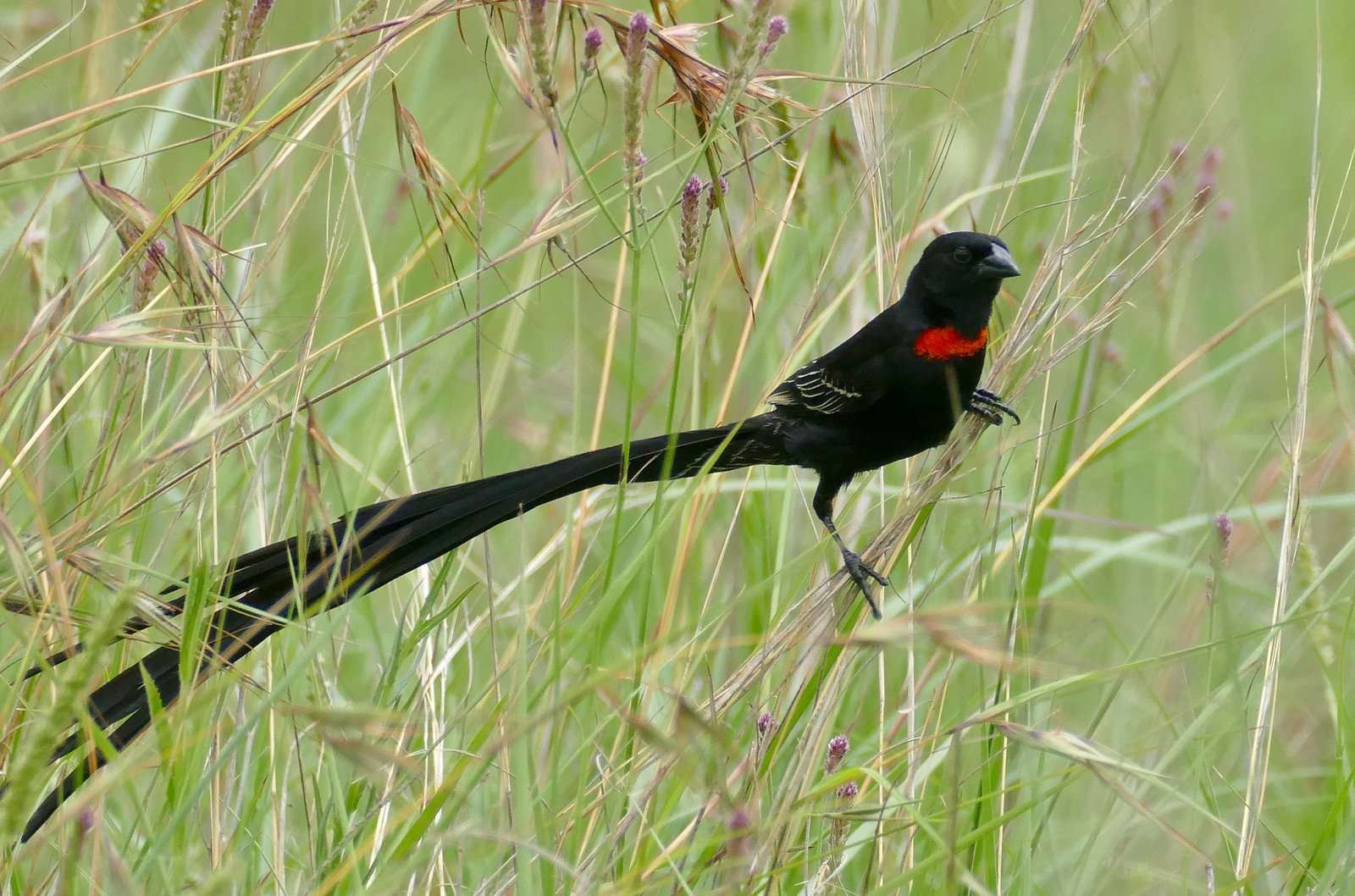
The Red-Collared Widowbird is a slim, wholly black widowbird with a scarlet crescent on the throat and a long, narrow tail that ripples behind the bird like a ribbon in flight. It lives on rank grassy slopes in the east of the region.
Voice
A soft, high, thin twittering, chip-chip-chirrrr, from a grass stem or bush, and a dry rattling sound in display flight. The call is a high chip.
Recording: Faansie Peacock — CC BY-NC-SA 4.0 · shortened to the first 60 s, mono · xeno-canto
Identification
The breeding male measures 25–30 cm including the tail and 12–13 cm without; the long, narrow, graduated tail makes up over half the total length. Outside the breeding season and in the female 12–13 cm. The breeding male is dull velvety black with a narrow scarlet to orange-red crescent across the lower throat; the bill is black. The non-breeding male resembles the female but is larger, with blackish flight feathers. The female is small, tawny and dark-streaked above, with a bright ochre-buff supercilium and an unstreaked, pale ochre throat and breast. Moulting males may grow the tail before the plumage is fully black.
Confusion species
Long-Tailed Widowbird (Euplectes progne) is much larger, with a red-and-white shoulder, an even longer, broad tail and a pale bill. Pin-Tailed Whydah (Vidua macroura) has white underparts and a red bill. Long-Tailed Paradise Whydah (Vidua paradisaea) has a rufous breast and a yellow nape. Females can be told from other female widowbirds and bishops by their small size, unstreaked ochre breast and bright supercilium.
Habitat
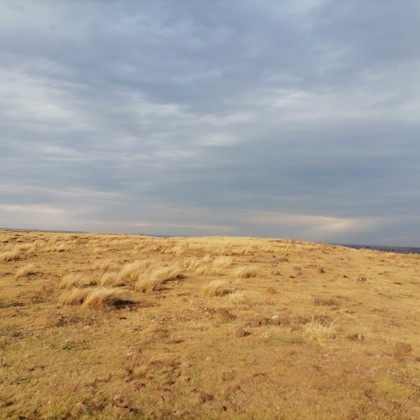
Rank tall grass on slopes with scattered bushes and bracken, montane grasslands, forest edges, clearings and abandoned fields, often at somewhat higher altitude than White-Winged Widowbird. In display the male flies low over the grass with fast wingbeats and undulating tail; he holds a territory with several females.
Where the bird is most at home, classified by the vegetation units of southern Africa.


Range and movements
In South Africa from the Eastern Cape through KwaZulu-Natal, Eswatini and the Mpumalanga escarpment to Limpopo; further in Zimbabwe (mainly the eastern highlands and central plateau), Mozambique (highlands and locally in the lowlands), Malawi, Zambia and Angola. It is absent from Botswana, Namibia and western South Africa. Beyond the region from West Africa east to Ethiopia and south through East Africa; in the north-east of the range males have a red crown.
- Resident
- Summer visitor (c. Oct–Mar)
- Winter visitor (c. Apr–Sep)
- Passage (Mar–Apr, Oct–Nov)
- dark = core range, pale = thinly spread
How and when to look
Best from December to March on grassy slopes on the Mpumalanga escarpment, in the Natal Midlands or in the eastern highlands of Zimbabwe, when males patrol over the grass with their long tails. The red collar is often invisible at distance; then look for the slim build and narrow tail.
Conservation status
Not threatened; locally common. It has declined locally through afforestation, intensive grazing and frequent burning of grassland. It is often used as a model in research on sexual selection for tail length.
Scientific name
Euplectes ardens | (Boddaert, 1783)
Boddaert described the species in 1783 as Fringilla ardens; because it was later moved to another genus, the author and year stand in brackets. The genus Euplectes was introduced in 1829 by Swainson. Euplectes joins Greek eu 'fine, good' to New Latin plectes 'weaver'. ardens is Latin for 'burning, glowing' — for the male's fiery red throat band. The specimen the first description was based on came from Cape of Good Hope.