All species › Passerines › Weavers › Yellow-Mantled Widowbird
Yellow-Mantled Widowbird | Euplectes macroura
Geelrugwidavink | Obispo Dorsiamarillo
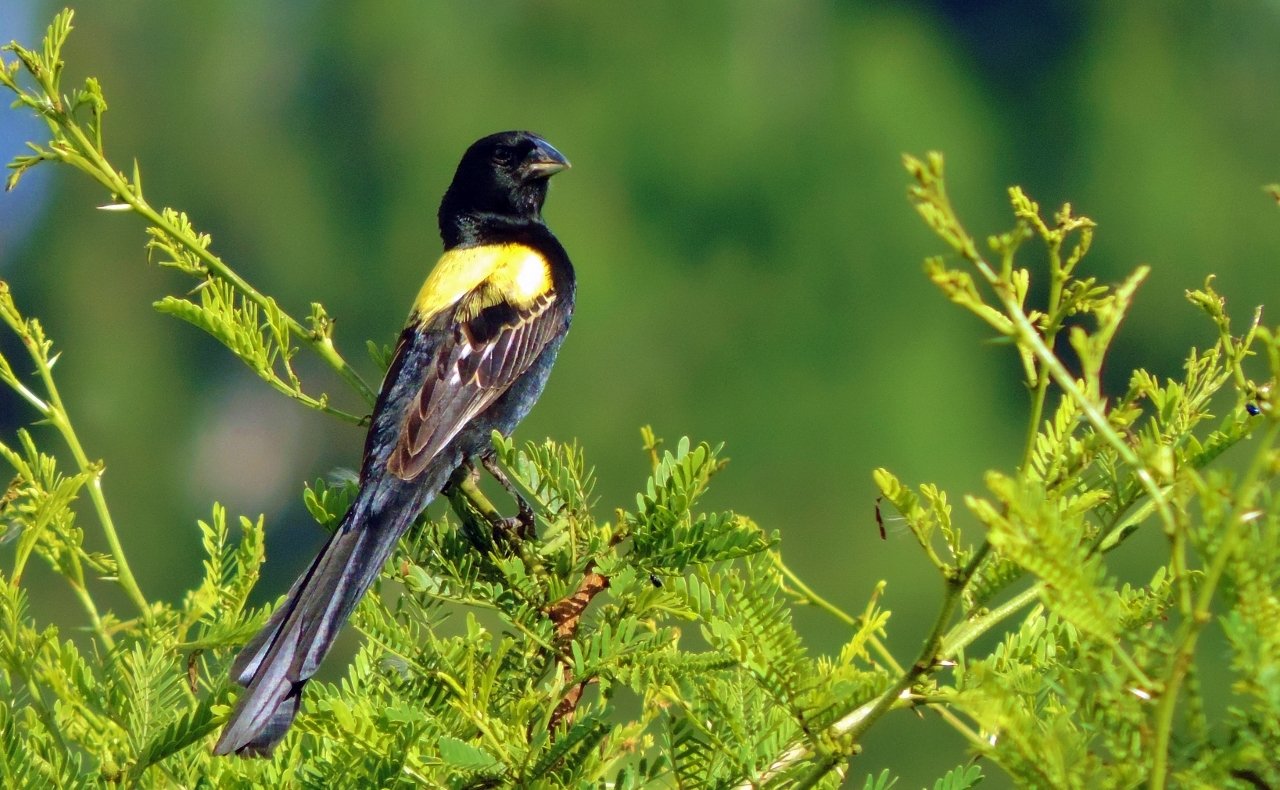
The Yellow-Mantled Widowbird is a black widowbird with a yellow mantle and yellow shoulders and a medium-length tail. It is a bird of wet grasslands and dambos in the north of the region, where males float over the grass on slow wingbeats with the tail hanging.
Voice
A thin, sizzling and scratchy song, chi-chi-chirrr-zzee, from a grass stem or in the slow display flight. The call is a soft chip.
Recording: Peter Ward — CC BY-NC-SA 4.0 · converted to mono · xeno-canto
Identification
The breeding male measures 19–22 cm including the tail and 13–14 cm without; the tail is narrow and graduated and droops somewhat in flight. Outside the breeding season and in the female 13–14 cm. The breeding male is black with a bright yellow mantle and yellow lesser wing coverts, so that the yellow of the back runs into the shoulder patch; the flight feathers are brown with pale edges and the bill is black. Outside the breeding season the male is streaky brown with a yellow shoulder patch. The female is tawny and heavily streaked above, paler and barely streaked on the breast, with a yellowish supercilium and a yellowish edge to the shoulder.
Confusion species
Yellow Bishop (Euplectes capensis) has a yellow rump instead of a yellow mantle and a short tail. White-Winged Widowbird (Euplectes albonotatus) has a white wing patch and a black mantle. Marsh Widowbird (Euplectes hartlaubi) of Angola and Zambia is larger, with an orange-yellow to buff shoulder patch, a black mantle and a longer tail. Golden-Backed Bishop (Euplectes aureus) of western Angola has a golden back but a short tail and no yellow shoulder patch. Out of breeding plumage the yellow shoulder patch and broad supercilium point to this species.
Habitat
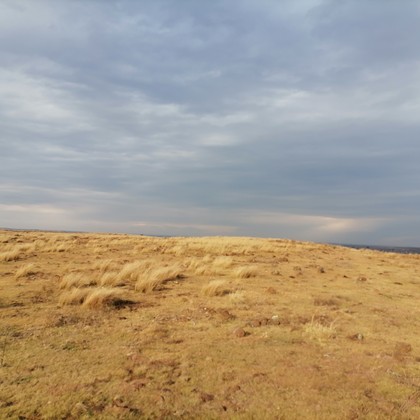
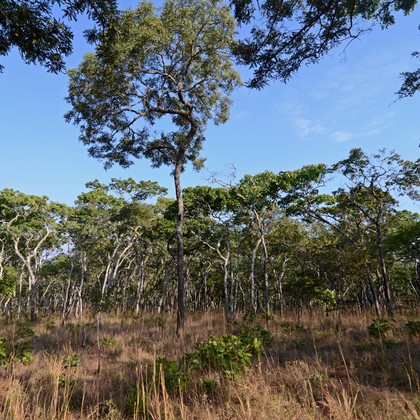
Wet and seasonally flooded grasslands, dambos, vleis, marsh edges and tall-grass openings in miombo, also rank field margins. The male holds a territory on open grassland and floats over it with mantle raised and tail hanging. Outside the breeding season it joins flocks of other widowbirds and bishops.
Where the bird is most at home, classified by the vegetation units of southern Africa.

Range and movements
Within the region in Angola, Zambia, Malawi, central and northern Mozambique and northern and eastern Zimbabwe (mainly the Mashonaland highveld); in Botswana, Namibia and South Africa absent or at most a vagrant. Beyond the region from Senegal east through the savanna belt to Ethiopia, Uganda, Kenya and Tanzania.
- Resident
- Summer visitor (c. Oct–Mar)
- Winter visitor (c. Apr–Sep)
- Passage (Mar–Apr, Oct–Nov)
- dark = core range, pale = thinly spread
How and when to look
Visit a dambo or wet grassland in Zambia or Malawi from January to March; males stand out by the contrast of black and yellow and the slow, floating display flight. In Angola and Zambia always check the mantle colour and tail length to rule out Marsh Widowbird.
Conservation status
Not threatened; locally common in wet grasslands. Vulnerable to drainage and the conversion of dambos to cultivation.
Scientific name
Euplectes macroura | (Gmelin, 1789)
Gmelin described the species in 1789 as Loxia macroura; because it was later moved to another genus, the author and year stand in brackets. The genus Euplectes was introduced in 1829 by Swainson. Euplectes joins Greek eu 'fine, good' to New Latin plectes 'weaver'. macroura comes from the Greek makros, 'long', and oura, 'tail' — for the breeding male's long tail. The specimen the first description was based on came from Ouidah, Benin.