All species › Gamebirds › Pheasants and partridges › Red-Necked Spurfowl
Red-Necked Spurfowl | Pternistis afer
Roodkeelfrankolijn | Francolín Gorjirrojo
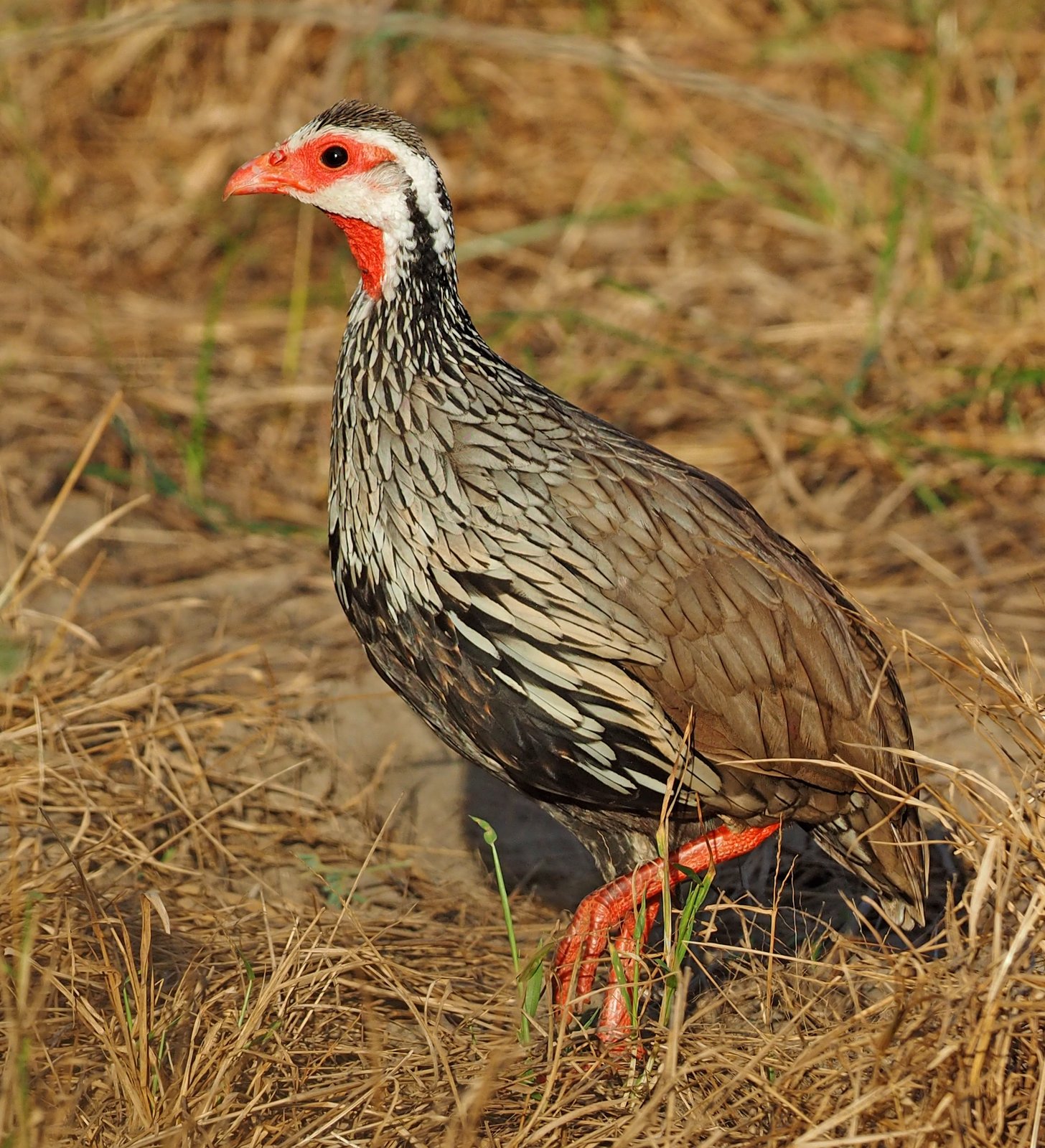
The Red-Necked Spurfowl is the spurfowl of the wet, green margins of the region: forest edges, dense rank growth and cultivation in the east and north. A bare red throat, red bill and red legs identify it, but the plumage varies so much from district to district that the subspecies look like different birds.
Voice
A loud, hoarse kwoor-kwoor-kwoor-kwaaa, rising at the end and then fading, given by the male at dawn and dusk from a termite mound, a log or the edge of a bush. When disturbed a sharp kek-kek-kek.
Recording: isaac kilusu — CC BY-NC-SA 4.0 · converted to mono · xeno-canto
Identification
About 36 cm, robust. The throat and a ring around the eye are bare and bright red, and the bill and legs are red too. The plumage varies by subspecies: in eastern South Africa dark with chestnut, black-streaked underparts; in eastern Zimbabwe and Mozambique with boldly black-and-white streaked or scaled breast and belly; in Zambia, Malawi and eastern Angola grey-brown with fine dark streaks; in western Angola almost black with white barring. The upperparts are brown with dark shaft streaks throughout. The male carries spurs; otherwise the sexes are alike. Juveniles have less bare skin and a duller bill.
Confusion species
Swainson's Spurfowl also has a bare red throat but a dark bill and black legs, and lives in drier, more open country; where both occur, as in Zimbabwe and Mozambique, bill and legs are decisive. Natal Spurfowl has an orange-red bill but no bare throat. Scaly Spurfowl in northern Angola and Malawi lacks the bare red skin.
Habitat
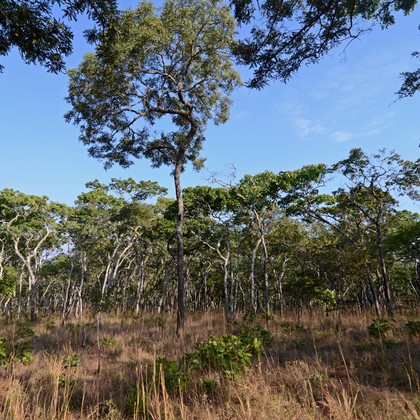
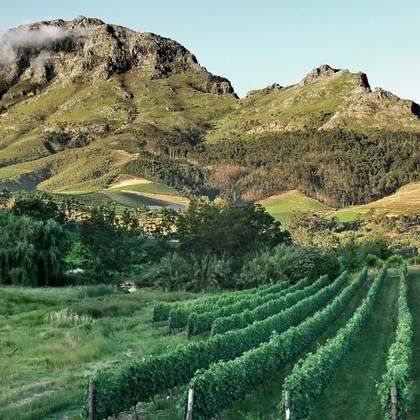
Forest edges, dense rank growth along rivers, miombo with a thick understorey, grassy slopes with scrub, old fields and gardens, sugarcane and tea plantations. It avoids dry open plains. It forages in pairs or small groups on the ground for seeds, tubers, berries, young shoots and insects, keeping close to cover.
Where the bird is most at home, classified by the vegetation units of southern Africa.

Range and movements
In the east and north of the region: the eastern Eastern Cape, KwaZulu-Natal, the escarpment of Mpumalanga and Limpopo, Eswatini, the eastern highlands of Zimbabwe, almost all of Mozambique, Malawi, most of Zambia and much of Angola. Absent from Botswana, Namibia and the arid west. Beyond the region to Tanzania, Kenya, Uganda, DR Congo and Gabon.
- Resident
- Summer visitor (c. Oct–Mar)
- Winter visitor (c. Apr–Sep)
- Passage (Mar–Apr, Oct–Nov)
- dark = core range, pale = thinly spread
How and when to look
Drive forest edges and plantation roads early in the morning in the KwaZulu-Natal Midlands, the Vumba near Mutare or around Blantyre and listen for crowing males. After rain groups come out onto roads and into maize fields. Look carefully at the underparts to assign the subspecies.
Conservation status
Not threatened and common in suitable habitat. The species copes well with small-scale farming but suffers locally from heavy hunting, snaring and the loss of cover along fields and forest edges. In South Africa its distribution is fragmented.
Scientific name
Pternistis afer | (Müller, 1776)
Müller described the species in 1776 as Tetrao afer; because it was later moved to another genus, the author and year stand in brackets. The genus Pternistis was introduced in 1832 by Wagler. Pternistis comes from Greek pternistēs 'one who strikes with the heel', from pterna 'heel', after the spurs on the legs. afer is Latin for 'African'. The specimen the first description was based on came from Africa (unspecified); Benguela, Angola, later proposed.