All species › Passerines › African Warblers › Rockrunner
Rockrunner | Achaetops pycnopygius
Roodstuitrotszanger | Saltarrocas de Damara
The Rockrunner is one of Namibia’s special near-endemics: a streaked, long-tailed warbler that runs over boulders and through grass tufts and delivers a characteristic song of the west from a rock. Its relationships were long unclear; today it is placed with the grassbirds in the family Macrosphenidae.

Voice
A loud, rollicking and very melodious song of clear whistles and trills, often introduced by a few separate notes, such as tip-tip… tiddle-dee-doo-doo-weet, sung from a boulder or a grass tuft. Pairs sometimes duet. The alarm call is a sharp, dry tchak.
Recording: Meena Haribal — CC BY-NC-SA 4.0 · converted to mono · xeno-canto
Identification
17–18 cm. The head and back are streaked black-and-white to brown, with a distinct white eyebrow, a dark eye-stripe and a black malar stripe bordering the white throat. The breast is white with black spots and streaks on the sides; belly, flanks, rump and undertail coverts are warm rufous. The long, dark tail is often cocked or fanned. The wings are short and rounded; the bird flies little and prefers to run. The sexes are alike.
Confusion species
Herero Chat Namibornis herero, which shares the same terrain, is unstreaked on the back, has a rufous rump and tail with a dark terminal band, and perches upright on bushes. Familiar Chat Oenanthe familiaris is plain grey-brown with a rufous tail. Cinnamon-Breasted Warbler Euryptila subcinnamomea is much smaller, with a chestnut breast band and a dark, cocked tail. White-Tailed Shrike Lanioturdus torquatus is black, white and grey with a short white tail.
Habitat
Grassy, boulder-strewn hillsides, koppies and the foot of the escarpment, with scattered bushes and dense grass tufts, from about 500 to 2000 m. It runs over rocks and through grass, searching for insects on and just above the ground.
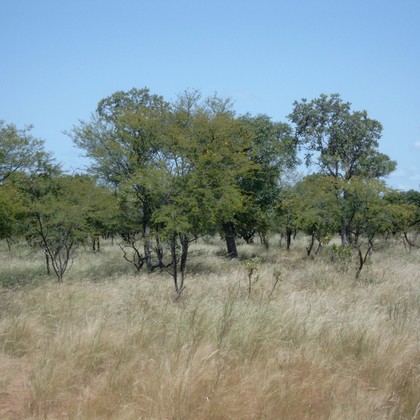
Where the bird is most at home, classified by the vegetation units of southern Africa.

Range and movements
Near-endemic to Namibia and south-western Angola. In Namibia in the central highlands and along the western escarpment, from the Khomas Hochland and the Erongo north to the Waterberg and the Kaokoveld. In Angola in the west and south-west, in the provinces of Namibe, Huíla and Benguela, north into Cuanza Sul.
- Resident
- Summer visitor (c. Oct–Mar)
- Winter visitor (c. Apr–Sep)
- dark = core range, pale = thinly spread
How and when to look
Year-round. Good sites are the Erongo, the Spitzkoppe, the Waterberg Plateau and the hills around Windhoek. At sunrise the birds sing from boulders and are easiest to see; later in the day they vanish among the grass tufts.
Conservation status
Not threatened; fairly common within its limited range. Its rocky, grassy habitat faces few threats, although overgrazing can locally degrade the grass tufts it depends on.
Scientific name
Achaetops pycnopygius | (Sclater, 1853)
Sclater described the species in 1853 as Sphenoeacus pycnopygius; because it was later moved to another genus, the author and year stand in brackets. The genus Achaetops was introduced in 1922 by Roberts. Achaetops comes from the Latin ad- (shortened to a- before c), 'resembling', and the genus name Chaetops (rockjumpers). Roberts (1922) separated the species from Chaetops for its much shorter legs and softer crown feathers. pycnopygius comes from the Greek puknos, 'dense', and pugē, 'rump' — for the dense, rufous rump and undertail feathers. The specimen the first description was based on came from Damaraland, Namibia; later restricted to the Erongo Mountains.