All species › Passerines › Hyliotas › Southern Hyliota
Southern Hyliota | Hyliota australis
Mashonahyliota | Hiliota Austral
The Southern Hyliota is a small black, white and yellow canopy bird that lives almost only in miombo. It is the only hyliota that occurs regularly south of the Zambezi, and one of the sought-after species of the miombo on the Zimbabwe plateau.

Voice
A soft, high, rapid twittering of clear whistled notes, tsee-tsee-tsweee-tsweee, mixed with thin trills and chirps. The contact call is a thin tsip or tsik. The call is easily lost in the chatter of a mixed flock.
Recording: Dries Van de Loock — CC BY-NC-SA 4.0 · converted to mono · xeno-canto
Identification
11–12 cm. Male: upperparts dull velvety black without obvious gloss. On the wing a white patch confined to the median and greater coverts; the tertials are black with at most narrow pale edges. Underparts pale yellow, slightly warmer on the breast, paler to whitish on the belly and undertail. The female is grey-brown above, with the same white wing patch and pale yellow underparts. The bill is short, pointed and black; the legs grey. It moves restlessly through the outer foliage of the canopy, often high in the trees.
Confusion species
Yellow-Bellied Hyliota Hyliota flavigaster, in the region mainly north of the Zambezi, has a steel-blue gloss on the male's black upperparts, a white wing patch that extends across the tertials and a deeper, orange-yellow breast; the female is slate-grey rather than brownish. Yellow-Bellied Eremomela Eremomela icteropygialis lacks black and white. Chinspot Batis Batis molitor is black, grey and white without yellow, with a black breast band or rufous chin spot.
Habitat
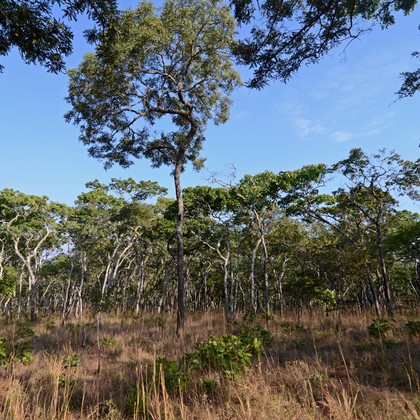
Tall, well-developed miombo with a closed canopy, on the Zimbabwe plateau especially on granite soils, and adjoining broadleaf woodland. It forages in the canopy for insects and caterpillars and, outside the breeding season, travels with mixed flocks of tits, eremomelas, flycatchers and cuckooshrikes.
Where the bird is most at home, classified by the vegetation units of southern Africa.
Range and movements
Within the area in the miombo of north-eastern and central Zimbabwe (Mashonaland, especially around Harare, Marondera and the lower slopes of the Eastern Highlands), central and northern Mozambique, Malawi, Zambia and eastern Angola. Beyond, in southern DR Congo and Tanzania, with isolated populations further north to Uganda and western Kenya.
- Resident
- dark = core range, pale = thinly spread
How and when to look
Well-known sites are the miombo of Gosho Park near Marondera, Mukuvisi Woodland in Harare and the woodland around the Mazowe valley. Go out early, find a mixed flock and scan the highest branches; the white wing patch and yellow breast give the bird away. North of the Zambezi, always check for confusion with Yellow-Bellied Hyliota.
Conservation status
Not threatened; widespread but rather scarce. Because it depends on tall, mature miombo, it is sensitive to clearing for charcoal, firewood and farming, which fragments its habitat especially around Harare and in parts of Malawi and Mozambique.
Scientific name
Hyliota australis | Shelley, 1882
Shelley described the species in 1882 and placed it straight away in the genus where it still stands. The genus Hyliota was introduced in 1837 by Swainson. Hyliota comes from the Greek huleiōtēs, 'forester', an epithet of the god Pan, from hulē, 'woodland, forest'. australis is Latin for 'southern' — the southernmost hyliota, compared with the more northerly Yellow-bellied Hyliota. The specimen the first description was based on came from Hartley Hills near the Umfuli River, Mashonaland, Zimbabwe.