All species › Passerines › Hyliotas › Yellow-Bellied Hyliota
Yellow-Bellied Hyliota | Hyliota flavigaster
Geelbuikhyliota | Hiliota Ventrigualda
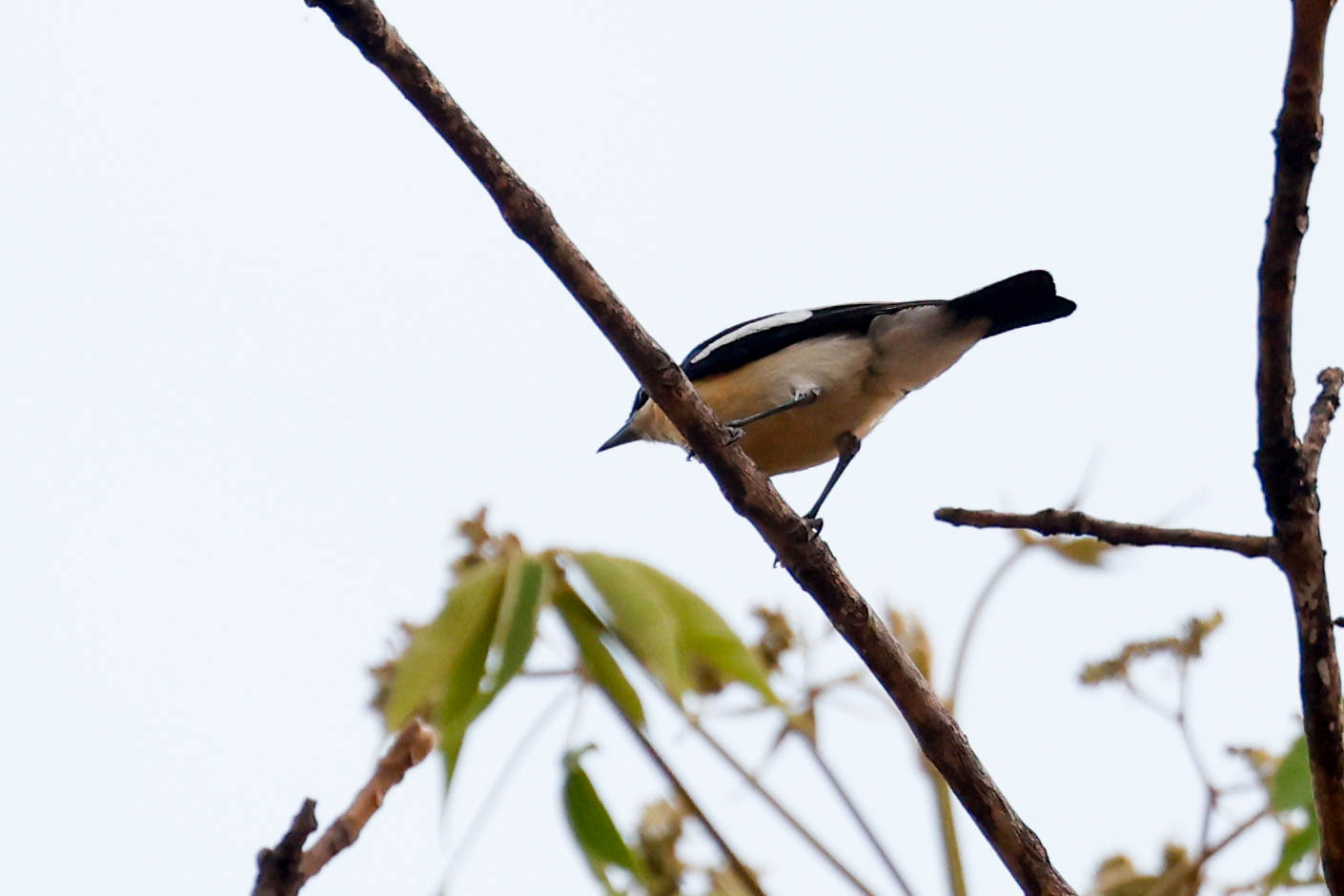
The Yellow-Bellied Hyliota is a small black, white and yellow bird of the canopy of open woodland. The male stands out with glossy blue-black upperparts, a long white wing patch and golden-yellow underparts. Hyliotas form their own African family; in the north of the region this species overlaps with the very similar Southern Hyliota.
Voice
A soft, high twittering and a quick, whistled song of short clear notes, tsee-tsee-tsweee-tchoo, mixed with thin trills. The contact call is a thin tsip. Not loud; often only heard when the bird is close by in a mixed flock.
Recording: Dries Van de Loock — CC BY-NC-SA 4.0 · converted to mono · xeno-canto
Identification
11–12 cm. Male: upperparts glossy black with a clear steel-blue sheen. On the wing a large white patch that runs from the coverts across the inner secondaries (tertials), forming a long white panel. Underparts yellow, deeper orange-yellow on the breast, paler towards the undertail. The female is slate-grey above with a faint blue sheen, with the same white wing patch and paler yellow underparts. The bill is short, pointed and black; the legs grey. It forages restlessly in the outer foliage of the canopy.
Confusion species
Southern Hyliota Hyliota australis is the main pitfall: the male is dull velvety black without blue gloss, the white patch is confined to the wing coverts and does not extend onto the tertials, and the underparts are usually paler yellow; the female is brownish rather than slate-grey. Yellow-Bellied Eremomela Eremomela icteropygialis is grey above with no black or white. Western Violet-Backed Sunbird Anthreptes longuemarei has violet-glossed upperparts but a white throat and breast and no white wing patch.
Habitat
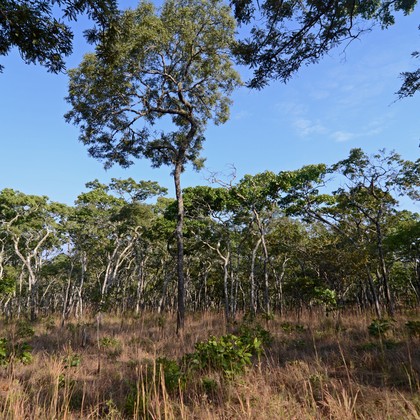
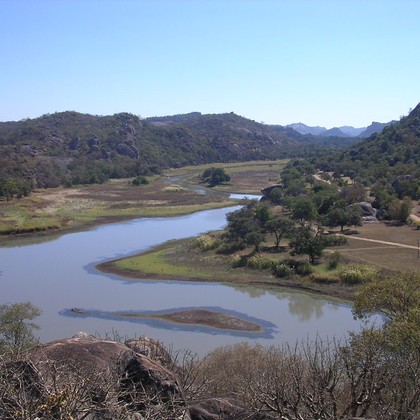
Open and semi-open woodland with large trees: miombo, mixed broadleaf woodland, well-wooded savanna and forest edge, also gardens and plantations with tall trees. It lives almost entirely in the canopy, searching leaves and twigs for small insects and caterpillars; outside the breeding season it joins mixed flocks of tits, eremomelas and flycatchers.
Where the bird is most at home, classified by the vegetation units of southern Africa.
Range and movements
Within the area in northern and eastern Angola, northern and western Zambia, Malawi and northern Mozambique, everywhere scarce and local. Records south of the Zambezi require good documentation because of confusion with Southern Hyliota. Beyond, from Senegal east through the savanna belt to Ethiopia and Kenya, and south through DR Congo and Tanzania.
- Resident
- dark = core range, pale = thinly spread
How and when to look
Search large, healthy miombo with mixed flocks, for example in northern Zambia and inland Malawi. Stay with such a flock and look up at the outermost twigs; the white wing panel catches the eye first. Check every male for gloss and for white extending over the tertials.
Conservation status
Not threatened; widespread over a very large range, though scarce in southern Africa. Clearing of miombo for charcoal and farming reduces habitat locally.
Scientific name
Hyliota flavigaster | Swainson, 1837
Swainson described the species in 1837 and placed it straight away in the genus where it still stands. He introduced the genus Hyliota in that same work. Hyliota comes from the Greek huleiōtēs, 'forester', an epithet of the god Pan, from hulē, 'woodland, forest'. flavigaster combines the Latin flavus, 'yellow', with the Greek gastēr, 'belly' — for the yellow underparts. The specimen the first description was based on came from Senegal.