All species › Passerines › African Warblers › Victorin's Warbler
Victorin's Warbler | Cryptillas victorini
Victorins struikzanger | Zarzalero de Victorin
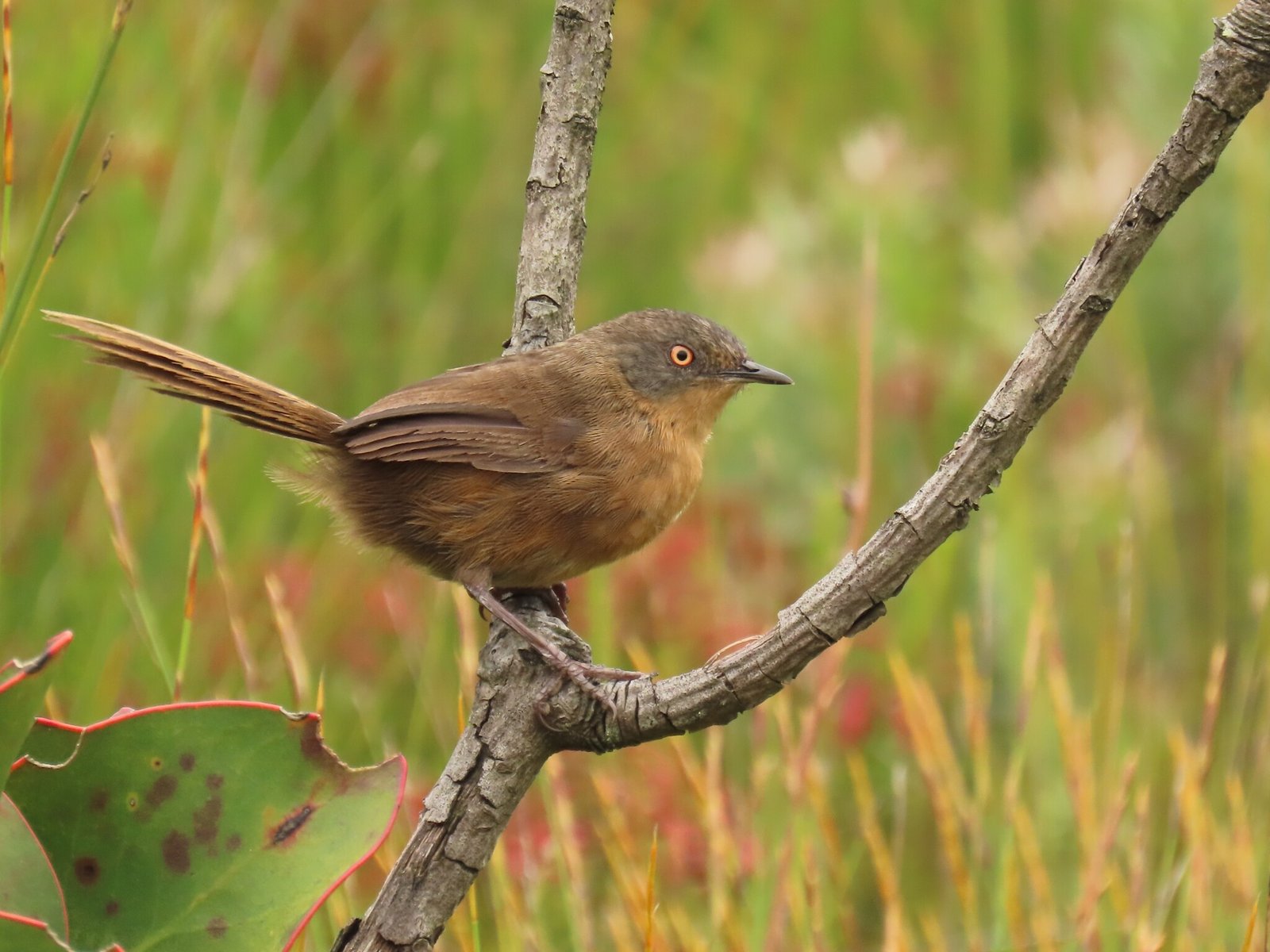
Victorin's Warbler is one of the hardest endemics of the Cape mountains to see: a warm brown warbler with an orange eye that lives deep in damp fynbos and is identified mainly by its loud, accelerating song. Formerly placed in Bradypterus, it now has its own genus within the African warblers (Macrosphenidae), alongside the crombecs and Cape Grassbird.
Voice
A loud, clear song that starts slowly and becomes ever faster and higher: tweet tweet tweet-tweet-ti-ti-ti-tititi, often ending with a few rolling notes. It sings all year, most at dawn, from a hidden perch low in the shrubs. The call is a dry tchik, and the alarm a sharp rattle.
Recording: Walter Wallner — CC BY-NC-SA 4.0 · shortened to the first 60 s, mono · xeno-canto
Identification
15–16 cm. Upperparts warm olive-brown, crown slightly darker. The face is grey, with grey ear-coverts and lores and a striking orange-yellow to orange eye. Throat and breast are warm cinnamon to orange-brown, browner on the flanks and paler on the centre of the belly. The tail is fairly long and rounded and is often half-cocked; the wings are short and rounded. Bill thin and dark, legs pinkish-brown. The sexes are alike; juveniles are duller, with a drabber brown breast and a darker eye.
Confusion species
Knysna Warbler Bradypterus sylvaticus is dark, uniform brown with no cinnamon on the breast and no grey face, and has a dark eye; it lives in dense forest-edge tangles at lower altitude, not in montane fynbos. Cape Grassbird Sphenoeacus afer is larger, heavily streaked on the back, with a rufous crown and a long, ragged tail. Cinnamon-Breasted Warbler Euryptila subcinnamomea also has a cinnamon breast band but is greyer, with a rufous rump and a black tail, and lives on rocky slopes in the arid Karoo. Barratt's Warbler Bradypterus barratti occurs only much further east and is streaked on the breast.
Habitat
Dense, damp montane fynbos with tall restios, ferns and shrubs along streams, seeps and in sheltered kloofs, from about 300 m to above 2,000 m. Also in rank fynbos that has regrown for several years after a fire. It forages almost invisibly on and just above the ground for insects and spiders.
Where the bird is most at home, classified by the vegetation units of southern Africa.

Range and movements
Endemic to South Africa: the mountain ranges of the Western Cape from the Cederberg and Koue Bokkeveld south to the Hottentots Holland mountains and Kogelberg, and east through the Langeberg, the Swartberg and the Outeniqua and Tsitsikamma mountains to the Kouga, Baviaanskloof and Groot Winterhoek mountains in the west of the Eastern Cape. It does not occur outside this area.
- Resident
- dark = core range, pale = thinly spread
How and when to look
Well-known sites are Jonkershoek Nature Reserve near Stellenbosch, the kloofs at Sir Lowry's Pass and the Du Toitskloof and Bainskloof passes. Go early and listen for the accelerating song, then wait quietly by a dense strip of restios along a stream. The bird sometimes pops up to sing on an exposed twig but dives back at the slightest movement. Playback is not permitted in nature reserves and is not needed here.
Conservation status
Not threatened; locally fairly common within its small range. The main threats are overly frequent fires and the spread of invasive woody plants such as pines and hakea in montane fynbos. A large part of its habitat lies within protected mountain catchments.
Scientific name
Cryptillas victorini | (Sundevall, 1860)
Sundevall described the species in 1860 as Bradypterus victorini; because it was later moved to another genus, the author and year stand in brackets. The genus Cryptillas was introduced in 1899 by Oberholser. Cryptillas comes from the Greek kruptos, 'hidden', and illas, 'thrush' — for this bird's skulking life deep in the scrub. victorini honours the Swedish naturalist Johan Fredrik Victorin (1831–1855), who collected birds in the Cape Colony. The specimen the first description was based on came from Knysna, South Africa.