All species › Passerines › Larks › Rudd's Lark
Rudd's Lark | Heteromirafra ruddi
Sporenleeuwerik | Alondra de Rudd
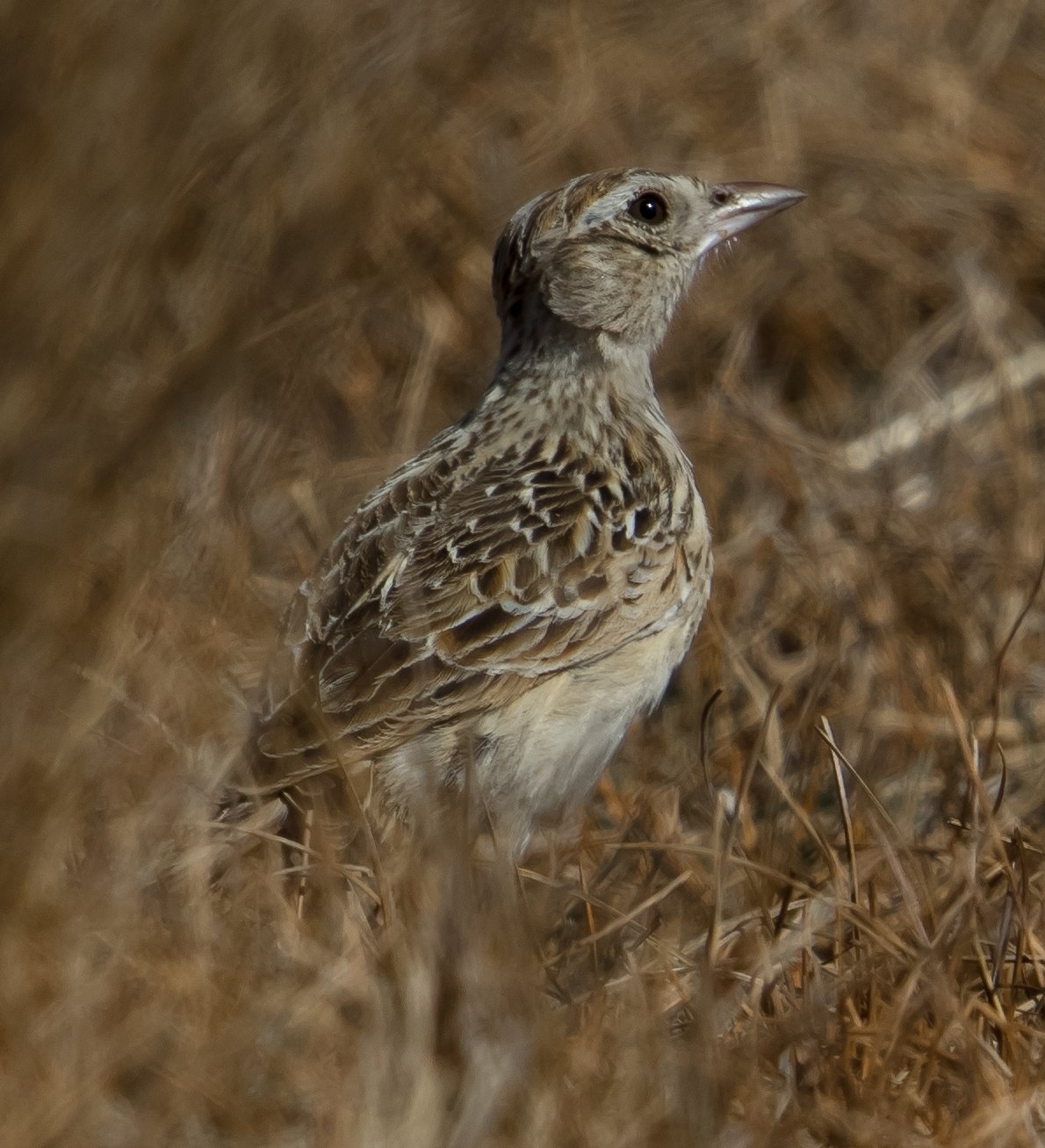
Rudd's Lark is a small, large-headed lark with a strikingly short tail, found only in the high grasslands of eastern South Africa. In summer the male hangs high in the sky for minutes, repeating a clear, whistled phrase. It is one of the rarest birds in the region.
Voice
Song is almost always given in a high display flight, the male hovering in one spot for a long time, often at 50 metres or more: a clear, whistled phrase of three or four notes, roughly wee-weet-weeeoo, repeated after a short pause. At dawn it sometimes sings from the ground. Otherwise it calls little.
Recording: Rick Nuttall — CC BY-NC-SA 4.0 · shortened to the first 60 s, mono · xeno-canto
Identification
14 cm. Small and compact, with a large head, a short, fine bill and a very short, narrow tail that makes the bird look almost tailless in flight. A narrow pale buff median stripe runs over the crown, bordered by dark lateral stripes; the supercilium is broad and pale buff. The upperparts are dark brown, scaled with pale feather edges. The underparts are warm buff with fine dark streaking on the breast sides. The legs are long and thin, with a long, straight hind claw. The sexes are alike.
Confusion species
Botha's Lark Spizocorys fringillaris shares the same area but has a pink, conical bill, a longer tail with white outer edges and lives in small groups. Pink-Billed Lark Spizocorys conirostris also has a pink bill and lacks the crown stripe. Red-Capped Lark Calandrella cinerea has a rufous cap and breast patches. Spike-Heeled Lark Chersomanes albofasciata stands upright, has a longer, decurved bill and white tail tips. African Pipit Anthus cinnamomeus is slimmer and longer-tailed with white outer tail feathers. Eastern Clapper Lark Corypha fasciolata has rufous wings and claps its wings in display.
Habitat
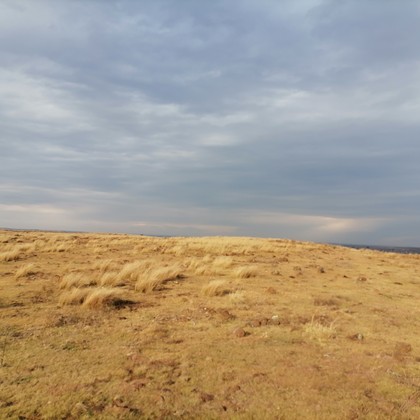
Short, dense highland grassland, usually above 1,600 metres, especially on hilltops, ridges and gentle slopes with few rocks and no shrubs or trees. It avoids tall ungrazed grass and heavily grazed or freshly burnt ground, and nests on the ground among grass tufts.
Where the bird is most at home, classified by the vegetation units of southern Africa.

Range and movements
Endemic to South Africa, in a small number of fragmented populations: the highlands of southern Mpumalanga around Wakkerstroom, Volksrust and Amersfoort, north-western KwaZulu-Natal, the eastern Free State around Memel and Verkykerskop, and isolated sites in the north-east of the Eastern Cape.
- Resident
- Summer visitor (c. Oct–Mar)
- dark = core range, pale = thinly spread
How and when to look
Search from October to January on calm mornings shortly after sunrise, when the males sing. Wakkerstroom is the classic site; a local guide knows where the territories are. Listen for the whistled phrase high above you and then scan the sky for the fluttering speck; on the ground the bird is hard to find. The stubby tail and the crown stripe are the best features.
Conservation status
Endangered. The population is small, highly fragmented and declining. Highland grassland is being lost to forestry plantations, crop farming and mining, and overgrazing and too-frequent fires make the remaining grassland unsuitable. As the birds are highly site-faithful, local populations disappear quickly when their patch changes.
Scientific name
Heteromirafra ruddi | (Grant, 1908)
Grant described the species in 1908 as Heteronyx ruddi; because it was later moved to another genus, the author and year stand in brackets. The genus Heteromirafra was introduced in 1913 by Grant. Heteromirafra comes from the Greek heteros, 'different', and the genus Mirafra — a lark that differs from the true Mirafra species. ruddi honours the British businessman Charles Dunell Rudd (1844–1916), who financed the collecting expedition on which Claude Grant discovered the species. The specimen the first description was based on came from Wakkerstroom, Mpumalanga, South Africa.