All species › Passerines › Larks › Monotonous Lark
Monotonous Lark | Mirafra passerina
Musleeuwerik | Alondra Monótona
Monotonous Lark is an inconspicuous brown lark that goes unnoticed for most of the year, until after good rains the savanna suddenly fills with singing males. Day and night they repeat the same short ditty, which gave the species its name in many languages. It is a nomad that follows the rain.

Voice
A short, monotonous ditty of four or five notes, roughly choo-chee-chee-wee or for-syth-i-a, repeated endlessly from a bush top, a post or in a short fluttering flight with dangling legs. It sings by day and by night, especially in the weeks after heavy rain. Almost silent outside the breeding season.
Recording: Rick Nuttall — CC BY-NC-SA 4.0 · shortened to the first 60 s, mono · xeno-canto
Identification
14 cm. A small, stocky lark with a short, stout bill and a fairly short tail. The upperparts are greyish brown with dark streaking and the supercilium is faint. The throat is pure white and conspicuous, especially when the singing male puffs it out. The breast is buff with dark spots, the belly paler. In flight a rufous wing panel shows. The sexes are alike.
Confusion species
Sabota Lark Calendulauda sabota has a crisp white supercilium and no rufous wing panel. Fawn-Colored Lark Calendulauda africanoides is warmer brown above, with a white supercilium and a virtually unspotted belly. Flappet Lark Amirafra rufocinnamomea is darker and more rufous and claps its wings in display. Rufous-Naped Lark Corypha africana is larger, has a short crest and sings a whistled tsee-tseeoo. The best feature is the endlessly repeated song.
Habitat
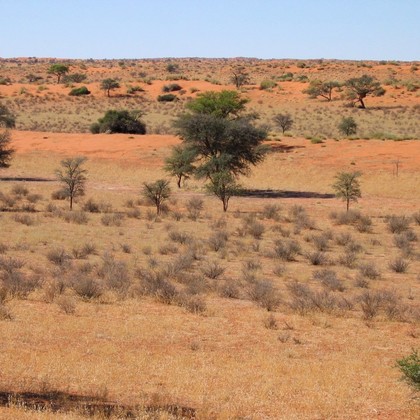
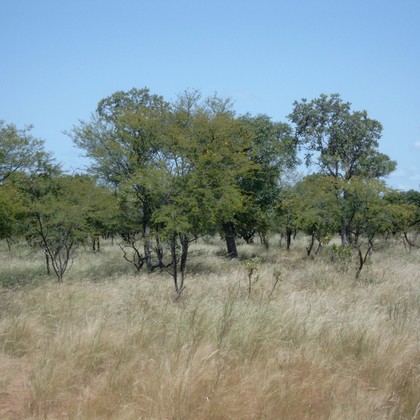
Open savanna and woodland with bare ground and a sparse grass layer: mopane woodland, Kalahari thornveld and acacia savanna, often on calcareous or clay soils and around pans. It forages on the ground for seeds and insects.
Where the bird is most at home, classified by the vegetation units of southern Africa.

Range and movements
Almost endemic to southern Africa: Botswana, northern and eastern Namibia, western and southern Zimbabwe and northern South Africa (Limpopo, North West and the north of the Northern Cape), extending into south-eastern Angola, south-western Zambia and western Mozambique. Numbers and exact distribution vary greatly from year to year.
- Resident
- Summer visitor (c. Oct–Mar)
- Passage (Mar–Apr, Oct–Nov)
- dark = core range, pale = thinly spread
How and when to look
In a wet summer (November–February), visit mopane or thornveld in northern South Africa or Botswana, for example the mopane of northern Kruger or the Central Kalahari. Listen in the evening and at night too: the monotonous ditty gives the species away at once. In dry years you may miss it even at known sites.
Conservation status
Not threatened. The species has a large range and is numerous in wet years. Its nomadic habits make trends hard to measure, but there are no signs of a serious decline.
Scientific name
Mirafra passerina | Gyldenstolpe, 1926
Gyldenstolpe described the species in 1926 and placed it straight away in the genus where it still stands. The genus Mirafra was introduced in 1821 by Horsfield. The origin of Mirafra is unknown; Horsfield gave no explanation, and according to Jobling it is probably a word from a native language, though not a known Javanese name. passerina is Latin for 'sparrow-like', from passer, 'sparrow' — for its plain, sparrow-like appearance. The specimen the first description was based on came from Mohapoani, 'Bechuanaland' (Damaraland, Namibia, according to Grant).