All species › Pelicans, herons and ibises › Ibises and spoonbills › Southern Bald Ibis
Southern Bald Ibis | Geronticus calvus
Kaapse ibis | Ibis Calvo
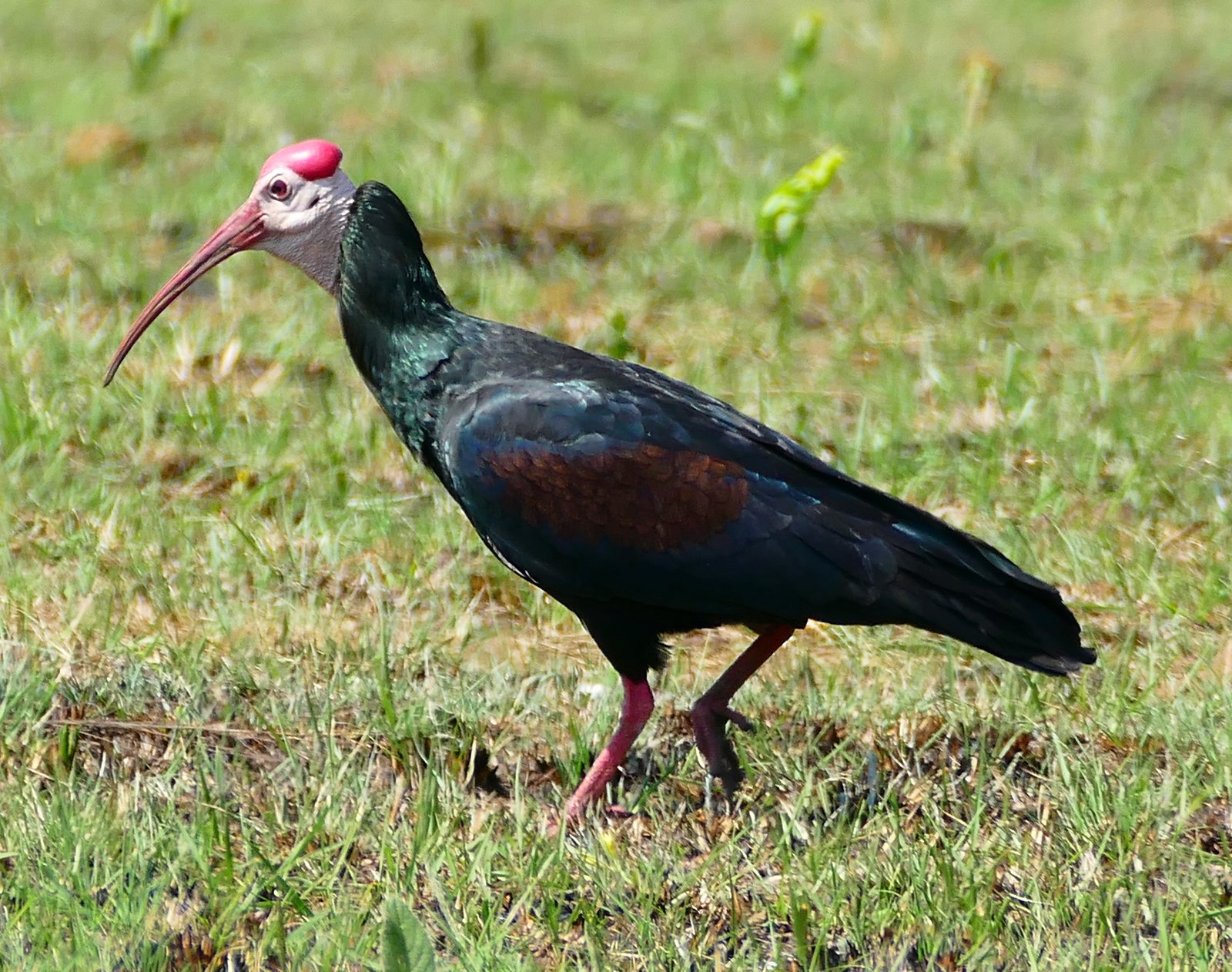
The Southern Bald Ibis is an endemic ibis of the high-altitude grasslands of South Africa, Lesotho and Eswatini, with a bare red crown and a whitish bare face. It breeds in colonies on cliff ledges and in gorges and forages in short, burnt or grazed grassland.
Voice
Usually silent. At the colony and in flight a high, hoarse kee-kaa and gabbling, especially when groups arrive or take off.
Recording: Guilherme Melo — CC BY-NC-SA 4.0 · converted to mono · xeno-canto
Identification
About 78 cm. The plumage is dark glossy blue-black to green, with a coppery to purple patch on the wing coverts. The head is unfeathered: face and throat are whitish, the crown is bright red. The long, decurved bill is red, as are the legs, which are rather short. The sexes are alike. Juveniles are duller, with a greyish feathered head, a darker bill and no red crown. It flies with fast wingbeats and outstretched neck, often in small groups.
Confusion species
The Hadada Ibis Bostrychia hagedash has a feathered grey-brown head with a white cheek stripe, a dark bill and a loud call. The Glossy Ibis Plegadis falcinellus is slimmer and longer-legged, with a feathered head and a dark bill; it lives in marshes, not in short grassland. Young Southern Bald Ibises can resemble Hadada Ibises but lack the white cheek stripe.
Habitat
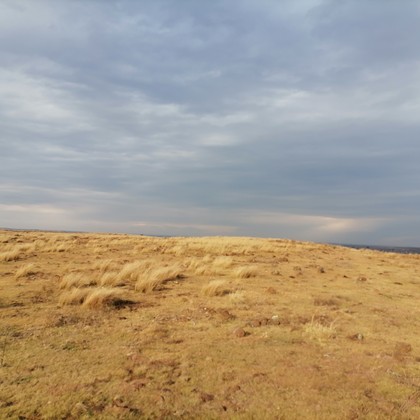
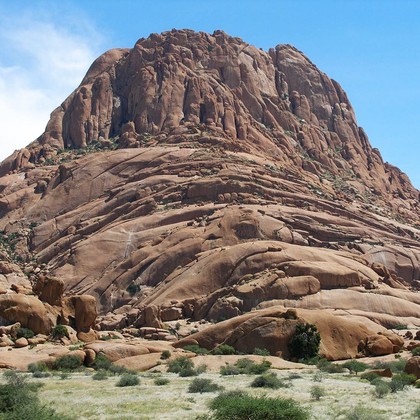
Short, open grassland on the highveld and in the Drakensberg foothills, preferably freshly burnt or closely grazed, as well as fields, pastures and lawns on farms and golf courses. Forages in groups for insects, especially beetle larvae, caterpillars and grasshoppers, and also small vertebrates. Breeds in colonies on cliff ledges, often behind or beside waterfalls in gorges; also roosts on cliffs.
Where the bird is most at home, classified by the vegetation units of southern Africa.

Range and movements
Endemic to the region: eastern South Africa, from the Eastern Cape through KwaZulu-Natal, the Free State and Mpumalanga to southern Limpopo, and also Lesotho and western Eswatini. Found nowhere else in the world.
- Resident
- Summer visitor (c. Oct–Mar)
- Passage (Mar–Apr, Oct–Nov)
- dark = core range, pale = thinly spread
How and when to look
In winter (May–September) breeding on cliffs in the gorges of Mpumalanga, KwaZulu-Natal and Lesotho; outside the breeding season in groups on freshly burnt grassland, where they stand out against the black stubble. The red face shows at a distance in the morning sun.
Conservation status
Near Threatened. The population is estimated at a few thousand birds and is vulnerable to the conversion of grassland to cropland and timber plantations, disturbance of colonies, poisoning and unfavourable fire management. Many colonies lie on private land, making the cooperation of farmers essential.
Scientific name
Geronticus calvus | (Boddaert, 1783)
Boddaert described the species in 1783 as Tantalus Calvus; because it was later moved to another genus, the author and year stand in brackets. The genus Geronticus was introduced in 1832 by Wagler. Geronticus comes from Greek gerōn 'old man', alluding to the bald, wrinkled head. calvus is Latin for 'bald' — for the featherless red head. The specimen the first description was based on came from Cape of Good Hope.