All species › Mousebirds › Mousebirds › Speckled Mousebird
Speckled Mousebird | Colius striatus
Gestreepte muisvogel | Pájaro Ratón Común
The Speckled Mousebird is the darkest and dullest of the three mousebirds in the region, with a very long stiff tail and loose, hair-like plumage. It clambers mouse-like through bushes and crosses from thicket to thicket in single file.

Voice
A harsh rasping tsu-tsu and a grating zhrrik as a contact note, especially as a party flies over, plus a nasal churring when agitated. Less musical than the clear whistles of the region's other two mousebirds.
Recording: Walter Wallner — CC BY-NC-SA 4.0 · converted to mono · xeno-canto
Identification
About 32 cm, of which the strongly graduated tail makes up well over half. The plumage is grey-brown, with fine dark barring on mantle and breast visible at close range, and an upstanding crest. The face carries a blackish mask around eye and cheek. The bill is two-toned: black above, whitish pink below. The legs are dark red-brown, with an outer toe that can be turned forwards or backwards. The sexes are alike.
Confusion species
White-Backed Mousebird (Colius colius) of the arid west is paler grey, with a white back stripe, a blue-white bill and red legs. Red-Faced Mousebird (Urocolius indicus) is grey-green with a bare red face, a red bill, a whistled call and a faster, higher flight. Speckled Mousebird is the only one combining a dark mask with a black-and-white bill and dark legs.
Habitat
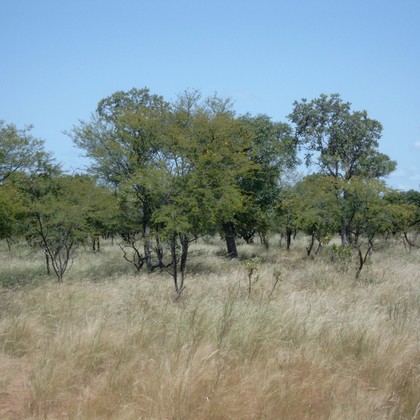
Thickets, riverine bush, woodland edge, dense thorn scrub, orchards and town and suburban gardens. It eats fruit, buds, leaves, flowers and nectar. Parties of five to twenty stay together, creeping through the vegetation and roosting in tight clusters; by day they sunbathe on an open branch with legs splayed and belly exposed.
Where the bird is most at home, classified by the vegetation units of southern Africa.

Range and movements
The eastern and northern half of the region: from the Eastern Cape through KwaZulu-Natal, Eswatini, Mpumalanga, Limpopo and Gauteng to eastern Botswana, Zimbabwe, Mozambique, Malawi, Zambia and Angola, plus the Namibian escarpment. Absent from the Namib, most of Namibia and the western Karoo. Beyond the region it ranges across eastern and central Africa to Ethiopia and Cameroon.
- Resident
- Summer visitor (c. Oct–Mar)
- Winter visitor (c. Apr–Sep)
- Passage (Mar–Apr, Oct–Nov)
- dark = core range, pale = thinly spread
How and when to look
Gardens and orchards in the east, early in the morning when the party sits spread open on top of a bush to sun itself. Watch for the weak whirring flight in which birds cross one behind the other, and listen for the harsh contact note that goes with it. Present all year.
Conservation status
Not threatened and common. The species benefits from gardens, planted fruit trees and rank scrub and has increased in many suburbs. In fruit-growing areas it is regarded as damaging and is locally controlled.
Scientific name
Colius striatus | Gmelin, 1789
Gmelin described the species in 1789 and placed it straight away in the genus where it still stands. The genus Colius was introduced in 1760 by Brisson. The origin of Colius is uncertain; it may go back to the Greek koloios, a name for a jackdaw-like bird, here applied to the quite different mousebirds. striatus is Latin for 'streaked', for the fine, dark streaking on the breast and back. The specimen the first description was based on came from Cape of Good Hope.