All species › Mousebirds › Mousebirds › Red-Faced Mousebird
Red-Faced Mousebird | Urocolius indicus
Roodwangmuisvogel | Pájaro Ratón Carirrojo
The Red-Faced Mousebird is the slimmest and fastest of the region's mousebirds: a greyish-green bird with a bare red face, a long needle-like tail and a clear whistle. Small parties fly fast and straight, high over the bushveld, and are therefore less tied to dense thicket than the other species.

Voice
A clear, descending three-syllable whistle, tsee-wee-wee or tee-vi-vi, often given in flight and answered by the rest of the group; it is one of the characteristic sounds of the bushveld. When alarmed a sharper tchik.
Recording: African Bioacoustics Community — CC BY-NC-SA 4.0 · converted to mono · xeno-canto
Identification
32–36 cm, of which the tail is well over two-thirds. Head, breast and back are soft bluish grey with a greenish tinge, the belly pale buff; the rump is blue-grey and the crest short and blunt. The face around the eye is bare, bright crimson and reaches the base of the bill; the bill itself is red with a black tip, the legs dull red. The sexes are alike. Juveniles have greenish, not red, facial skin and a greenish bill. The flight is fast, direct and falcon-like, on rapid beats of the short wings with the tail trailing like a straight spike; unlike the other mousebirds it seldom glides between bushes.
Confusion species
Speckled Mousebird Colius striatus is dark brownish grey with fine barring, a dark mask, a black-and-white bill and dark legs, and flies weakly and whirringly from bush to bush. White-Backed Mousebird Colius colius is paler grey with a white back stripe that shows in flight, a maroon rump, a bluish-white bill and a grey face without bare red skin. Only the Red-Faced Mousebird has the bare red face and clear whistled call.
Habitat
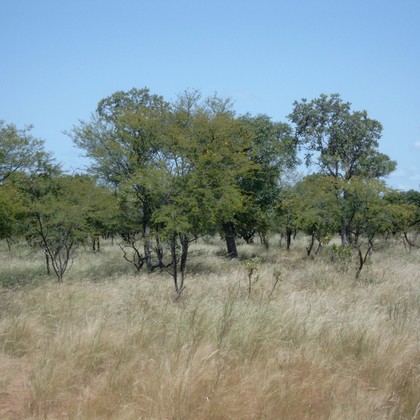
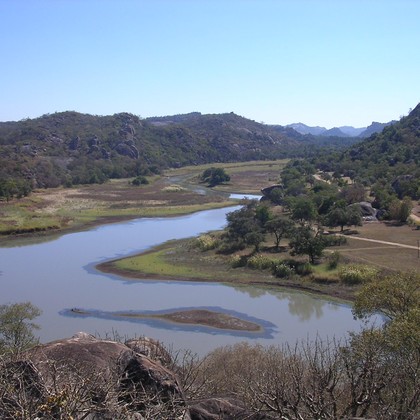
Dry bushveld, thornveld, riverine woodland, mopane, orchards and gardens, also the edges of desert rivers in the west. It eats fruit, berries, leaves, flowers and nectar, and gathers in groups at fruiting figs and berry bushes. It drinks less often than the other mousebirds. It roosts in clusters in dense scrub and suns itself on bare branches in the morning.
Where the bird is most at home, classified by the vegetation units of southern Africa.

Range and movements
The most widespread mousebird of the region: almost everywhere except the Namib and the wettest forests, from the Eastern Cape and the northern Western Cape through the Karoo, KwaZulu-Natal, Eswatini, Lesotho (locally), the whole north of South Africa, Namibia, Botswana and Zimbabwe to Mozambique, Zambia, Malawi and southern Angola. Beyond the region north through eastern Africa to Tanzania and southern DR Congo.
- Resident
- Summer visitor (c. Oct–Mar)
- Winter visitor (c. Apr–Sep)
- Passage (Mar–Apr, Oct–Nov)
- dark = core range, pale = thinly spread
How and when to look
In the bushveld, listen for the falling whistle above the treetops and follow the party with binoculars: the birds often land on the top of a tree or bush, where the red face can be seen in the sun. A fruiting fig or berry bush near a campsite is a good spot to see them at close range.
Conservation status
Not threatened and common. Like the other mousebirds it benefits from gardens and fruit farming, where it is locally controlled as a pest. There is no evidence of declines.
Scientific name
Urocolius indicus | (Latham, 1790)
Latham described the species in 1790 as Colius indicus; because it was later moved to another genus, the author and year stand in brackets. The genus Urocolius was introduced in 1854 by Bonaparte. Urocolius comes from the Greek oura, 'tail', and the genus Colius — for the very long tail of these mousebirds. indicus is Latin for 'Indian' — based on an error: the type locality was wrongly given as India, although the species occurs only in Africa. The specimen the first description was based on came from the Gamtoos River, Cape Province (originally given in error as 'India').