All species › Birds of prey › Ospreys › Osprey
Osprey | Pandion haliaetus
Visarend | Águila Pescadora
The Osprey is a slender, long-winged raptor that lives entirely on fish and plunges feet-first into the water to catch them. In southern Africa it is mainly a scarce migrant from Europe and Asia, spending the summer at large lakes, dams and estuaries.
Voice
Usually silent in the non-breeding range. At times a series of short whistles, chewp-chewp-chewp, clear and plaintive, mainly during squabbles or when a fish eagle tries to rob it.
Recording: David Darrell-Lambert — CC BY-NC-SA 4.0 · converted to mono · xeno-canto
Identification
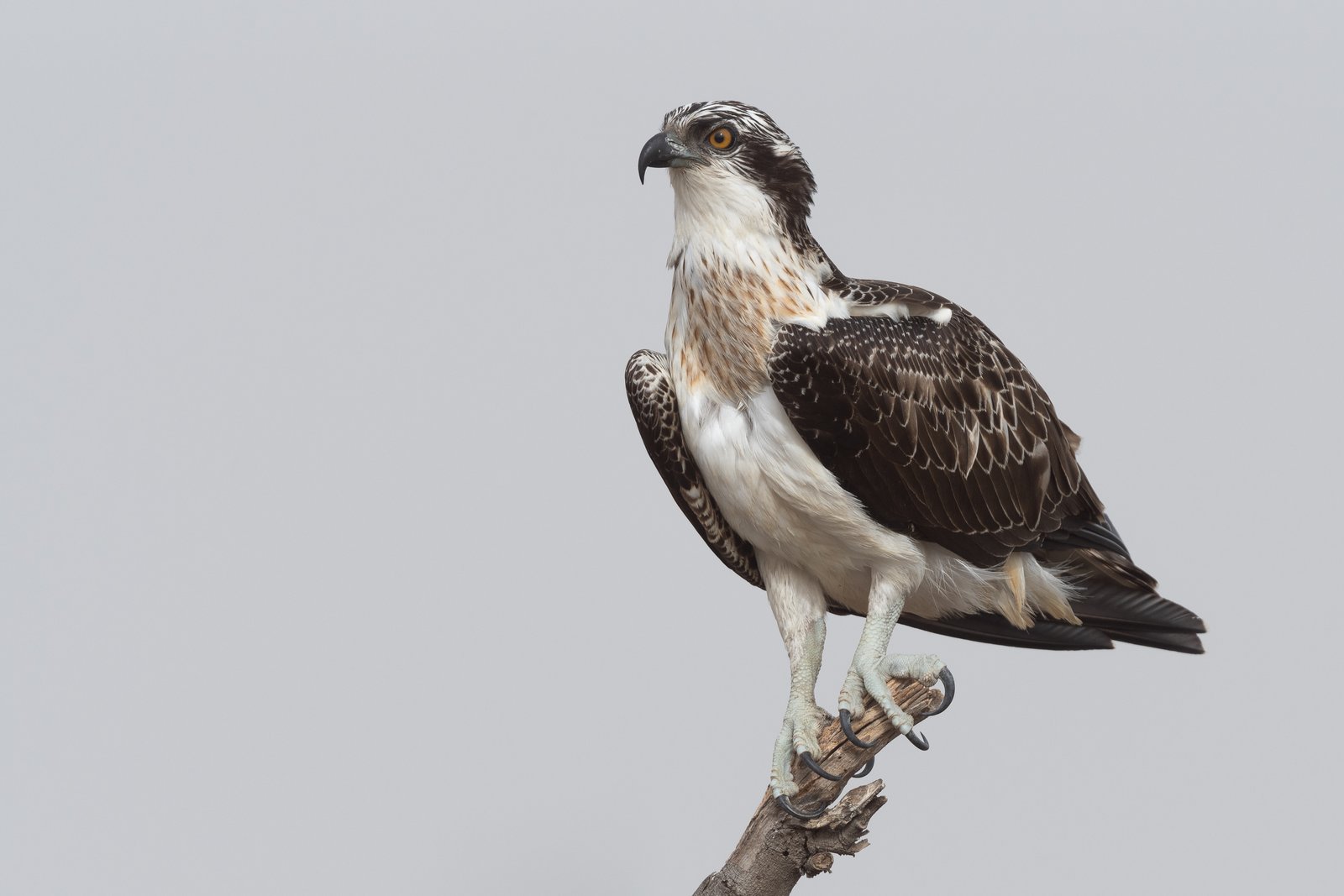
55–63 cm, wingspan 145–170 cm. Dark brown above, clean white below with a narrow brown breast band that is usually stronger in the female. The head is white with a dark brown eyestripe running back to the nape; a short, ragged crest on the crown. Eyes yellow, bill black with blue-grey cere, legs blue-grey with spiny soles and a reversible outer toe. In flight the long, narrow wings are sharply bent at the carpal, giving the silhouette of a large gull; the underwing is white with a black carpal patch and barred flight feathers. Juveniles have pale fringes to the upperparts, giving a scaly pattern, and orange eyes.
Confusion species
Juvenile African Fish Eagle Icthyophaga vocifer is much heavier and broader-winged, with a short tail and a messy brown-and-white plumage lacking clean white underparts. Pale-morph Booted Eagle Hieraaetus pennatus has white underwing coverts but dark flight feathers and no eyestripe. Black-Chested Snake Eagle Circaetus pectoralis has a dark head and breast and large yellow eyes. The gull-like silhouette with angled wings and the black carpal patches rule out confusion.
Habitat
Dams, large lakes, slow rivers, lagoons, estuaries and sheltered coastal waters with clear water. It searches for fish from the air, hovers briefly and dives feet-first, sometimes almost fully submerging. It rests on dead trees, poles and masts beside the water.
Where the bird is most at home, classified by the vegetation units of southern Africa.


Range and movements
Thinly spread across the whole region, mainly in the east: the coast and lagoons of Mozambique, Lake Malawi, Kariba and the Zambezi, the Okavango, dams in Zimbabwe, Zambia and northern and eastern South Africa, and the estuaries of KwaZulu-Natal and the south coast. Scarcer in the arid west, but also along the Namibian coast and in Angola. Beyond the region almost worldwide; birds in southern Africa breed in Scandinavia, Finland and Russia. There are no proven breeding records in the region.
- Resident
- Summer visitor (c. Oct–Mar)
- Passage (Mar–Apr, Oct–Nov)
- dark = core range, pale = thinly spread
How and when to look
In the summer months look at a large dam or estuary for a bird on a dead tree or pole at the water's edge; ringing recoveries show that individuals return to the same water year after year. A hunting Osprey hovers high over the water and then drops with wings half closed. Keep an eye on African Fish Eagles, which often try to steal the catch.
Conservation status
Not threatened; the world population has recovered strongly since DDT and other organochlorines were banned. Along the flyway and in the wintering range, collisions with power lines, entanglement in fishing nets and shooting are the main known causes of death.
Scientific name
Pandion haliaetus | (Linnaeus, 1758)
Linnaeus described the species in 1758 as Falco Haliaetus; because it was later moved to another genus, the author and year stand in brackets. The genus Pandion was introduced in 1809 by De Savigny. Pandion is taken from Pandion, the mythical king of Athens and grandfather of Theseus. haliaetus comes through Latin from the Greek haliaetos 'sea eagle', from hals 'sea' and aetos 'eagle'. The specimen the first description was based on came from Sweden.