All species › Birds of prey › Hawks, eagles and kites › Rüppell's Vulture
Rüppell's Vulture | Gyps rueppelli
Rüppells gier | Buitre Moteado
Rüppell's Vulture is a large griffon of the Sahel and East Africa that reaches southern Africa as a rare vagrant. It is known as one of the highest-flying birds in the world and in the region is found mainly among Cape Vultures, with which it shares roosts and sometimes cliffs.
Voice
Silent except at carcasses and in the colony: hissing, cackling and croaking screams, as in other griffons.
Recording: Alain Malengreau — CC BY-NC-SA 4.0 · converted to mono · xeno-canto
Identification
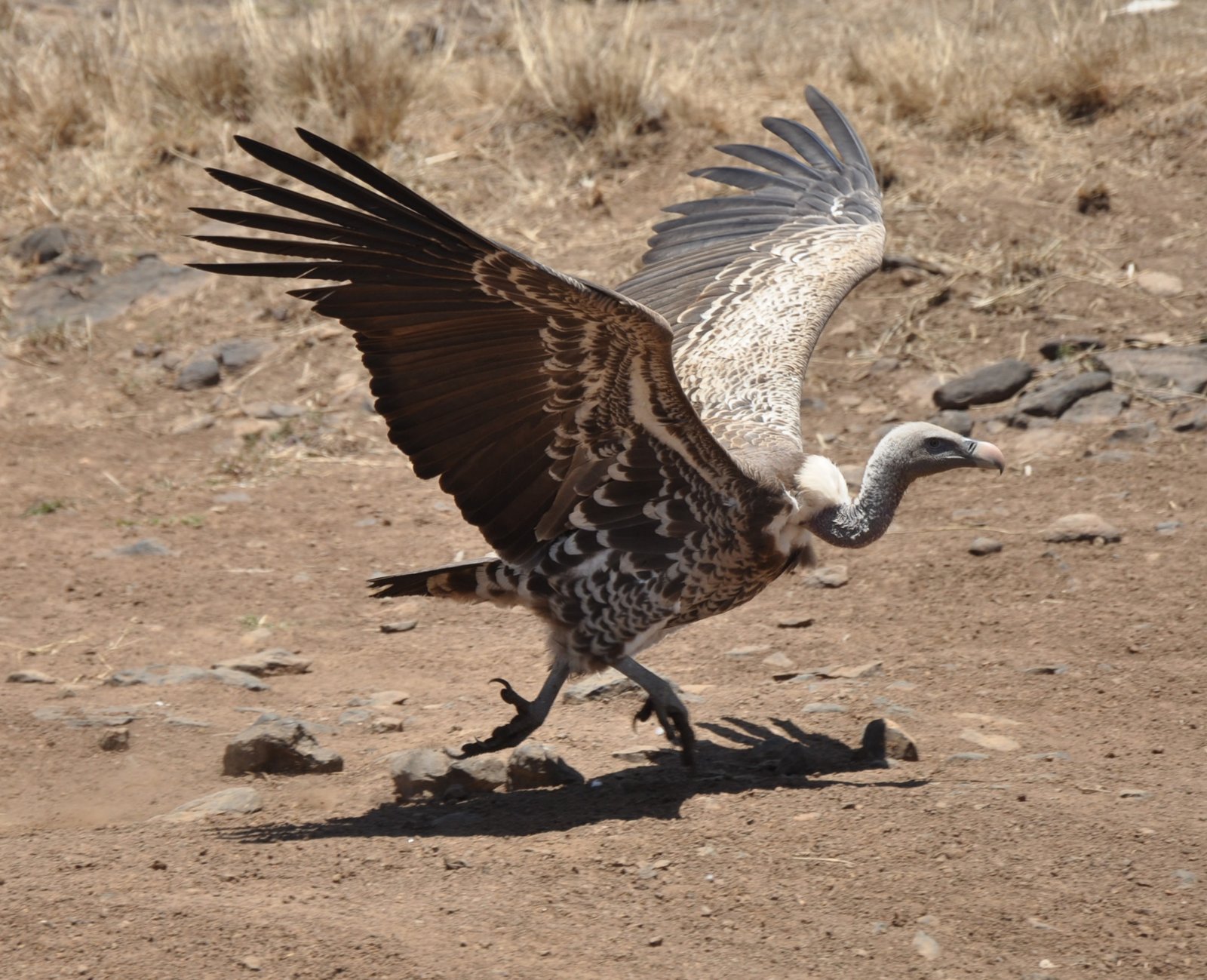
About 95 cm, wingspan more than two metres. The adult is dark brown with broad pale cream edges to almost all feathers of the upperparts, breast and wing coverts, giving a strongly scaled or spotted appearance. The head and long neck are covered in grey down, with a pale downy ruff. The bill is yellowish horn to orange-yellow, the eye yellow to amber. Juveniles are plainer dark brown with narrow pale streaks, a dark bill and a dark eye, and therefore closely resemble young White-Backed Vultures. In flight the adult underwing shows several narrow pale bands across the coverts, and the body is spotted.
Confusion species
Cape Vulture (Gyps coprotheres) is paler and more uniform in tone, without the strong scaling, with a black bill and blue throat patches. White-Backed Vulture (Gyps africanus) has a black bill, a dark eye and, as an adult, plain pale underparts and white underwing coverts. Young Rüppell's Vultures can hardly be told from young White-Backed Vultures in the field; only adults or near-adults can be identified with confidence.
Habitat
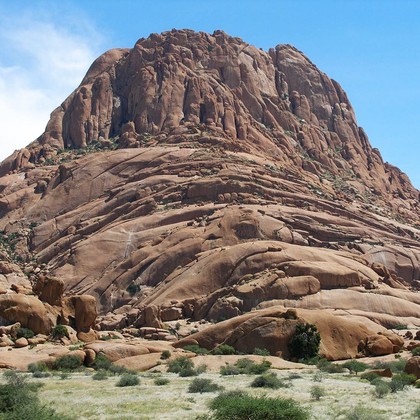
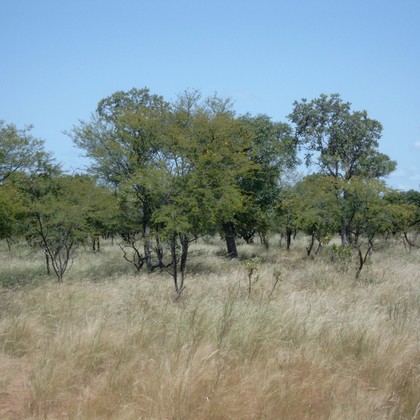
In the region mainly at cliffs with Cape Vulture colonies and roosts and at vulture restaurants, and also in open savanna and grassland where carcasses are found. In its own range it breeds on cliffs in dry savanna, semi-desert and mountainous country.
Where the bird is most at home, classified by the vegetation units of southern Africa.
Range and movements
A rare vagrant, recorded almost annually since the 1990s, mainly in northern and north-eastern South Africa (including Limpopo, North West and Mpumalanga) and in KwaZulu-Natal, often among Cape Vultures and sometimes staying for months at one colony; there are also a few records from neighbouring countries. The main range runs through the Sahel from Senegal to Sudan and through East Africa from Ethiopia to Tanzania.
How and when to look
At a Cape Vulture breeding colony or vulture restaurant, check every dark, scaly bird with a pale bill. Bear in mind young White-backed and young Cape Vultures and note especially bill colour, eye colour and the scaling; photographs are almost always needed for acceptance.
Conservation status
Critically Endangered on the Red List, after a rapid decline estimated at more than ninety percent over three generations, especially in West Africa and the Sahel. The main causes are poisoning, hunting and trade for traditional use, and the decline of game and livestock as a food source. The increase in records in southern Africa reflects greater observer attention and perhaps shifts in wandering birds, not a recovery of the species.
Scientific name
Gyps rueppelli | (Brehm, 1852)
Brehm described the species in 1852 as Vultur Ruppellii; because it was later moved to another genus, the author and year stand in brackets. The genus Gyps was introduced in 1809 by De Savigny. Gyps is Greek gups 'vulture'. rueppelli honours the German naturalist and African explorer Eduard Rüppell (1794–1884). The specimen the first description was based on came from Khartoum, Sudan.