All species › Woodpeckers and allies › African barbets › Speckled Tinkerbird
Speckled Tinkerbird | Pogoniulus scolopaceus
Gespikkelde ketellapper | Barbudito Escolopáceo
The Speckled Tinkerbird is a large, drably patterned tinkerbird of the West and Central African forests that reaches the region only in northern Angola. Its endlessly repeated ticking call is often the only sign of its presence at forest edges.
Voice
A long, monotonous series of dry ticks, tok-tok-tok-tok, which may speed up into a rattling trill; also a rapid series of higher pi-pi-pi-pi notes. It calls patiently and at length from a single perch high in a tree.
Recording: Jaap van der Waarde — CC BY-NC-SA 4.0 · converted to mono · xeno-canto
Identification
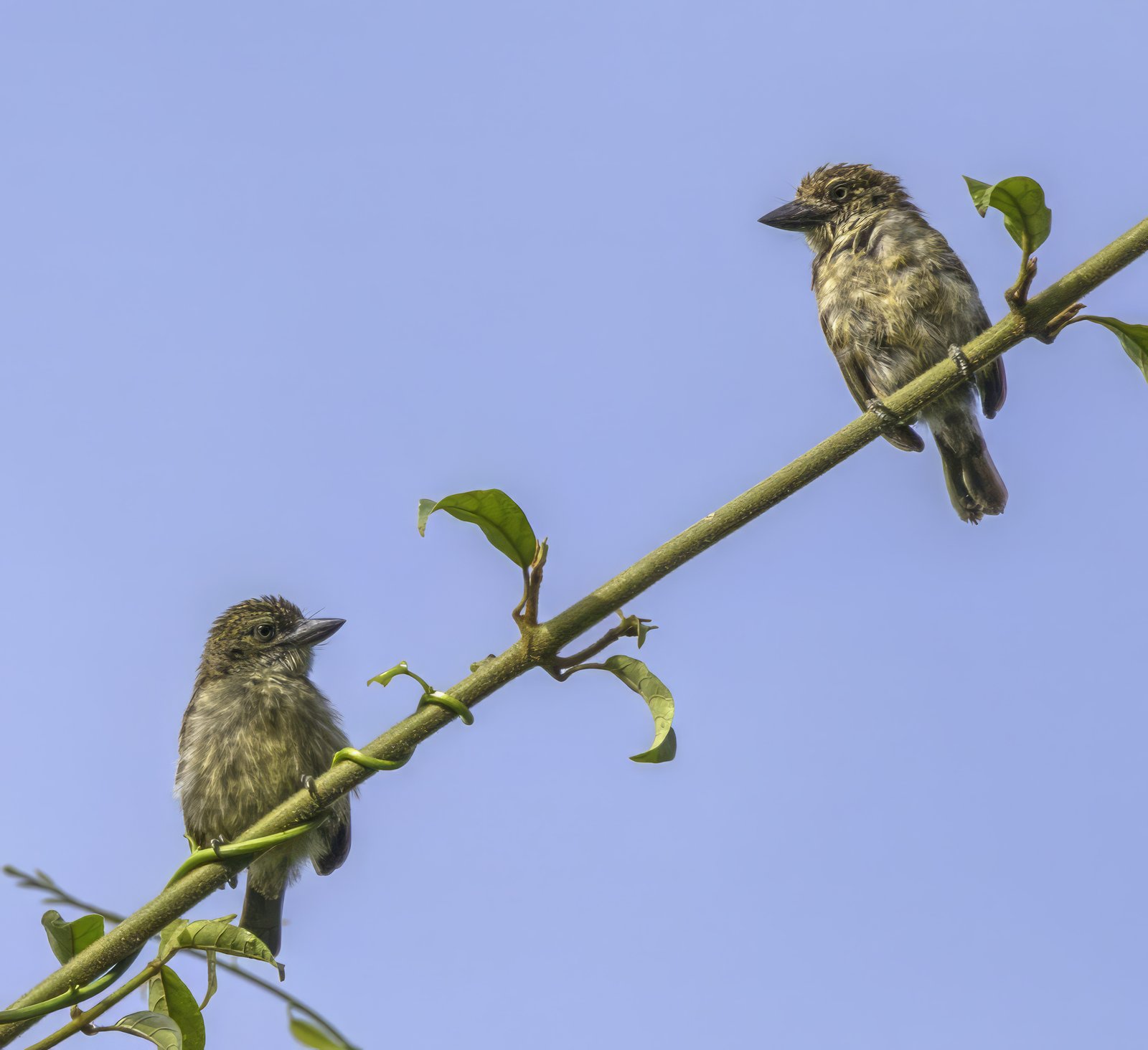
About 11–12 cm, larger and heavier than the other tinkerbirds. The upperparts are blackish-brown with dense yellowish or ochre spots and scales, the wing with yellowish edgings. Throat and underparts are dirty white to pale yellow with dark speckles and scales, especially on breast and flanks. The face lacks bright stripes; adults have a pale, yellowish to whitish iris that gives the face a staring look. The bill is black. The sexes are alike; juveniles have a dark eye and less crisp speckling.
Confusion species
Yellow-Throated Tinkerbird (Pogoniulus subsulphureus) and Yellow-Rumped Tinkerbird (Pogoniulus bilineatus) are smaller, with a black back, clear yellow or white face stripes and a yellow rump. Least Honeyguide (Indicator exilis) has an unspotted olive-green back, a thin bill and white outer tail feathers. The speckled pattern without face stripes and the pale eye make the species recognisable.
Habitat
Edges of humid lowland forest, secondary forest, clearings, gallery forest and wooded farmland, often high in the canopy. It eats mainly mistletoe berries and figs, supplemented with insects, and plays a part in dispersing mistletoes. It excavates a small nest cavity in a dead branch.
Where the bird is most at home, classified by the vegetation units of southern Africa.


Range and movements
Within the region in northern Angola, from Cabinda and Zaire and Uíge provinces east into Lunda Norte, mostly in gallery forest and forest edges. Beyond the region from Sierra Leone and Guinea through the West and Central African forest belt to South Sudan, Uganda and western Kenya.
- Resident
- dark = core range, pale = thinly spread
How and when to look
At forest edges and clearings listen for the ticking series, then search the tops of trees carrying mistletoe; the bird often stays long on the same branch. A telescope helps to see the pale eye and the speckling.
Conservation status
Not threatened and common over most of its range. It adapts well to secondary forest and farmland. In Angola the species is local and little studied.
Scientific name
Pogoniulus scolopaceus | (Bonaparte, 1850)
Bonaparte described the species in 1850 as Xylobucco scolopaceus; because it was later moved to another genus, the author and year stand in brackets. The genus Pogoniulus was introduced in 1842 by De Lafresnaye. Pogoniulus is a diminutive of Pogonias, from the Greek pōgōnias, 'bearded' — thus 'little barbet', fitting for these smallest barbets. scolopaceus means 'snipe-like', after Scolopax (woodcock) — for the finely speckled plumage. The specimen the first description was based on came from Ashanti, Ghana.