All species › Kingfishers, bee-eaters and rollers › Bee-eaters › White-Throated Bee-Eater
White-Throated Bee-Eater | Merops albicollis
Witkeelbijeneter | Abejaruco Gorjiblanco
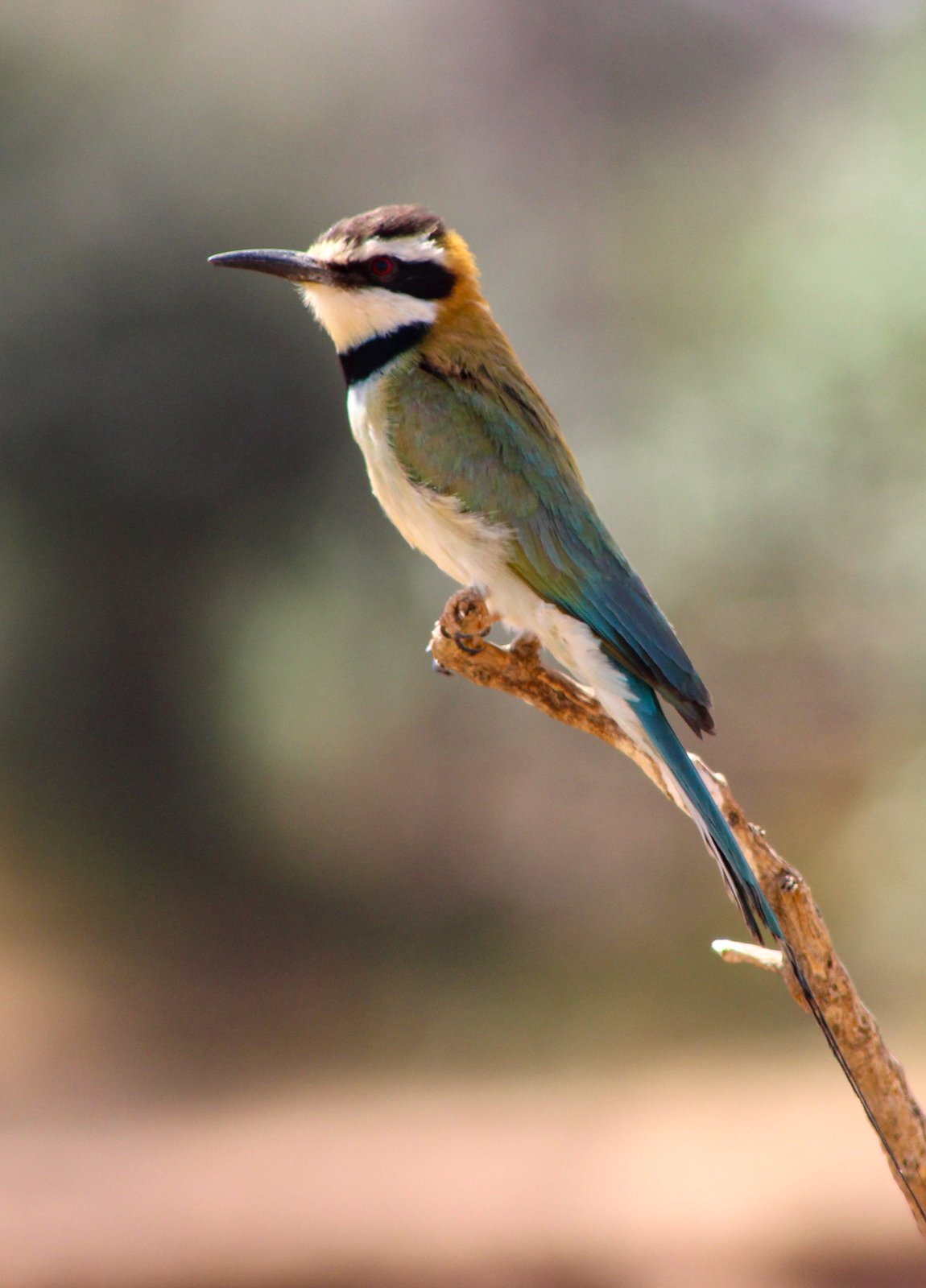
The White-Throated Bee-Eater is a bee-eater with a black-and-white patterned head and very long streamers that breeds south of the Sahara and spends the rest of the year in the rainforest. In the region it has been recorded only a handful of times, in the far north of Angola.
Voice
A liquid, rolling prrrp or pruik, often repeated by birds hunting in groups high over the forest; in chorus it sounds like a continuous soft chatter.
Recording: Mischa Keijmel — CC BY-NC-SA 4.0 · converted to mono · xeno-canto
Identification
The body is 19–21 cm, with wire-thin central tail feathers projecting up to 12 cm in adults. The head is boldly patterned: black crown, white supercilium and cheek, a broad black mask and a white throat closed off by a black breast band. Nape and upper mantle are golden-buff, back and wings green, rump and tail pale blue, the underparts pale greenish white. In flight the flight feathers are ochre with a dark trailing edge. The sexes are alike, although the female has shorter streamers. Juveniles are duller, with a greenish crown and no streamers.
Confusion species
No other bee-eater in the region has the black-and-white head pattern. Blue-Cheeked Bee-Eater (Merops persicus) also has long streamers but is larger and wholly green, with a blue-and-white cheek stripe and a rufous throat. European Bee-Eater (Merops apiaster) has a yellow throat and a chestnut crown and mantle. Böhm's Bee-Eater (Merops boehmi) has a rufous crown and throat.
Habitat
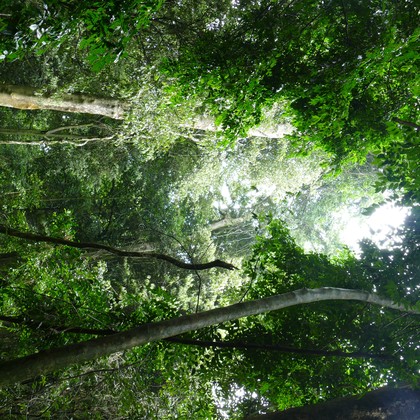
Outside the breeding season, clearings, edges and cleared areas in lowland rainforest, secondary forest, riverbanks and villages with trees in forest country. It hunts in groups high above the canopy, among other things on winged ants and termites, and also feeds on the fruit of the oil palm.
Where the bird is most at home, classified by the vegetation units of southern Africa.
Range and movements
In the region only a few records from the far north of Angola, at the southern edge of the winter range. It breeds in the Sahel from Mauritania to Sudan and in parts of Ethiopia, Somalia and Kenya; it winters in the rainforest from Senegal and Guinea to Uganda and south to Gabon and western DR Congo.
How and when to look
A genuine vagrant: the best chance is between October and April in the forest country of Cabinda or the Congo mouth. Watch for groups of bee-eaters circling high over the forest, and for the long streamers and black-and-white head when they land on a dead treetop. Any sighting deserves documentation with photographs.
Conservation status
Not threatened and common in its breeding and wintering ranges. For the area of this guide the species is a vagrant of no conservation significance.
Scientific name
Merops albicollis | Vieillot, 1817
Vieillot described the species in 1817 and placed it straight away in the genus where it still stands. The genus Merops was introduced in 1758 by Linnaeus. Merops is Greek and means 'bee-eater'. albicollis is Latin, from albus, 'white', and collum, 'neck' — for the white throat. The specimen the first description was based on came from Senegal.