All species › Pelicans, herons and ibises › Ibises and spoonbills › Spot-Breasted Ibis
Spot-Breasted Ibis | Bostrychia rara
Geschubde ibis | Ibis Moteado
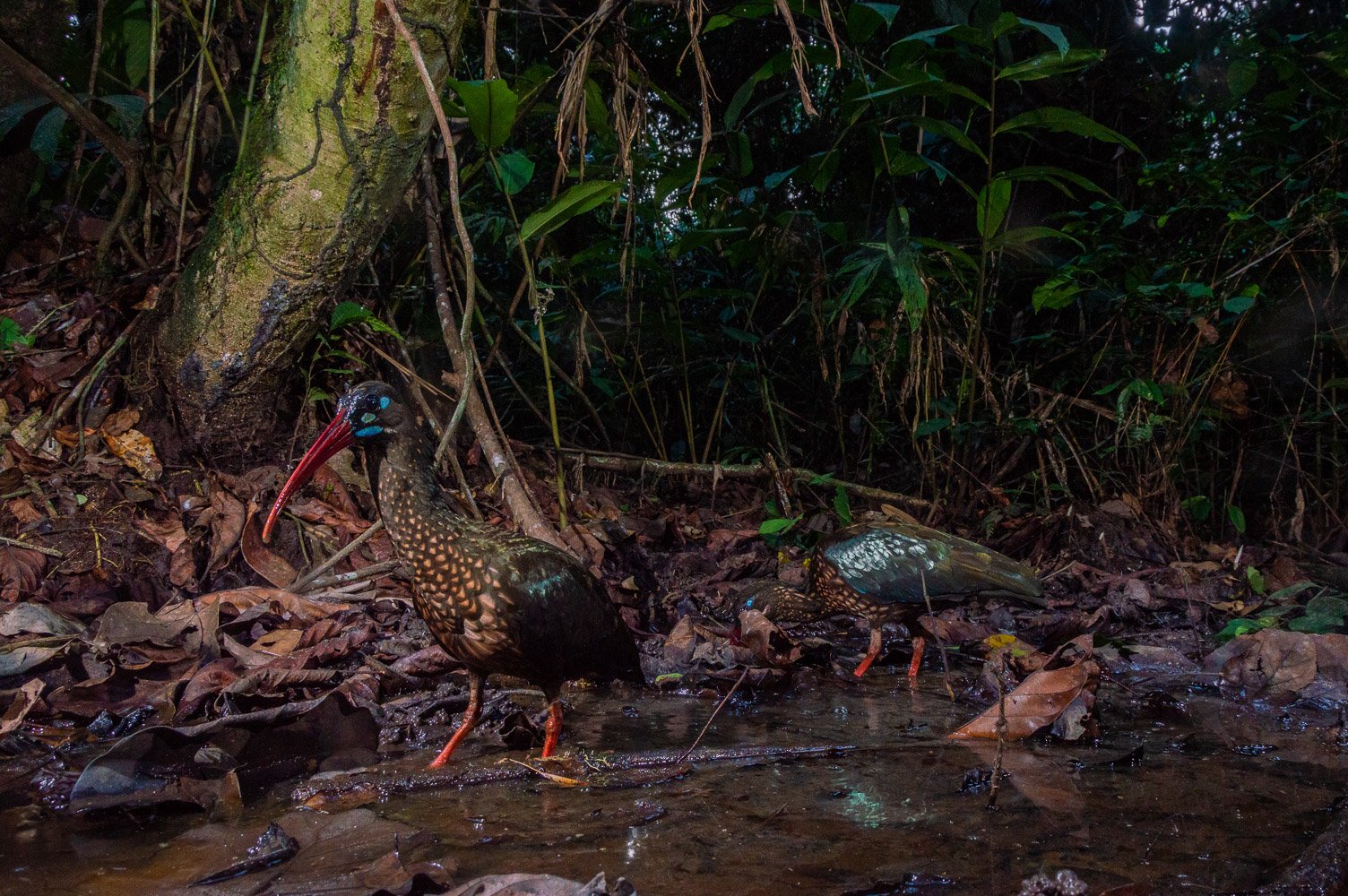
The Spot-Breasted Ibis is a shy, stocky forest ibis of the West and Central African rainforest, occurring in the region only in northern Angola. It lives hidden along streams and in swamp forest and is heard far more often than seen, especially at dusk.
Voice
A loud, raw, repeated call, kaa-kaa-kaa-kaa or kwaa-ha, carrying through the forest at dusk and sometimes at night, often in duet or with several birds calling together.
Recording: gbaltus — CC BY-NC-SA 4.0 · converted to mono · xeno-canto
Identification
About 52 cm, compact and short-legged, with a relatively short, decurved bill and a small, shaggy crest on the hindcrown. The plumage is dark olive-brown, densely marked with sandy to buff drop-shaped spots on the neck, breast and upper back, giving a scaly pattern. The wing coverts are glossed green to bluish purple. The bill is dark with a red base to the upper mandible; there is a narrow bare patch around the eye. The legs are dark reddish. The sexes are alike; juveniles are duller, less spotted and lack the crest.
Confusion species
Within the region only the Hadada Ibis Bostrychia hagedash is similar, but it is larger, unspotted grey-brown with a white cheek stripe, and lives in open country. The Glossy Ibis Plegadis falcinellus is much slimmer and longer-legged and lives in open marshes, not forest.
Habitat
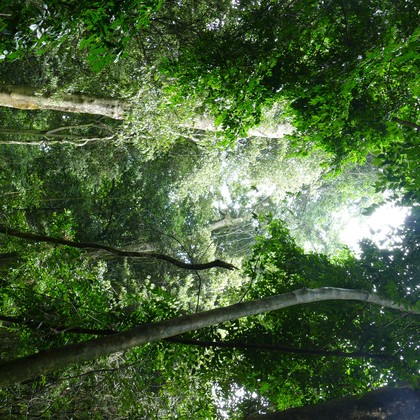
Swamp forest, gallery forest and moist lowland rainforest with streams, pools and muddy clearings. Forages alone or in pairs on the forest floor and in waterlogged patches, probing for worms, insect larvae and other invertebrates. By day it rests high and hidden in trees; the nest is a stick platform in a tree, often over water.
Where the bird is most at home, classified by the vegetation units of southern Africa.

Range and movements
Within the region only in northern Angola, notably Cabinda and the forested north; rare and poorly known. Beyond the region in the lowland forest of West and Central Africa, from Liberia through Nigeria and Cameroon to Gabon, Congo, the Central African Republic and the Democratic Republic of the Congo.
How and when to look
Listen at dusk from a stream or the edge of swamp forest for the raw calls, when birds fly between roost and feeding site. By day it is almost impossible to find unless flushed from the forest floor. A local guide in Cabinda greatly improves the chances.
Conservation status
Not threatened, but marginal and little studied in the region. Sensitive to deforestation and hunting at the edges of its range; still fairly common in large unbroken forests.
Scientific name
Bostrychia rara | (Rothschild, Hartert & Kleinschmidt, 1897)
Rothschild, Hartert & Kleinschmidt described the species in 1897 as Lampribis rara; because it was later moved to another genus, the author and year stand in brackets. The genus Bostrychia was introduced in 1847 by Gray. Bostrychia comes from the Greek bostrukhion, 'little curl, ornament', a diminutive of bostrukhos, 'curl, tendril'. The name refers to the thin, pendant wattle on the throat of the Olive Ibis. rara is Latin for 'rare' — for the scarcity in collections of this secretive forest ibis. The specimen the first description was based on came from Denkera, Ghana.