All species › Waders, gulls and terns › Sandpipers and snipes › Terek Sandpiper
Terek Sandpiper | Xenus cinereus
Terekruiter | Andarríos del Terek
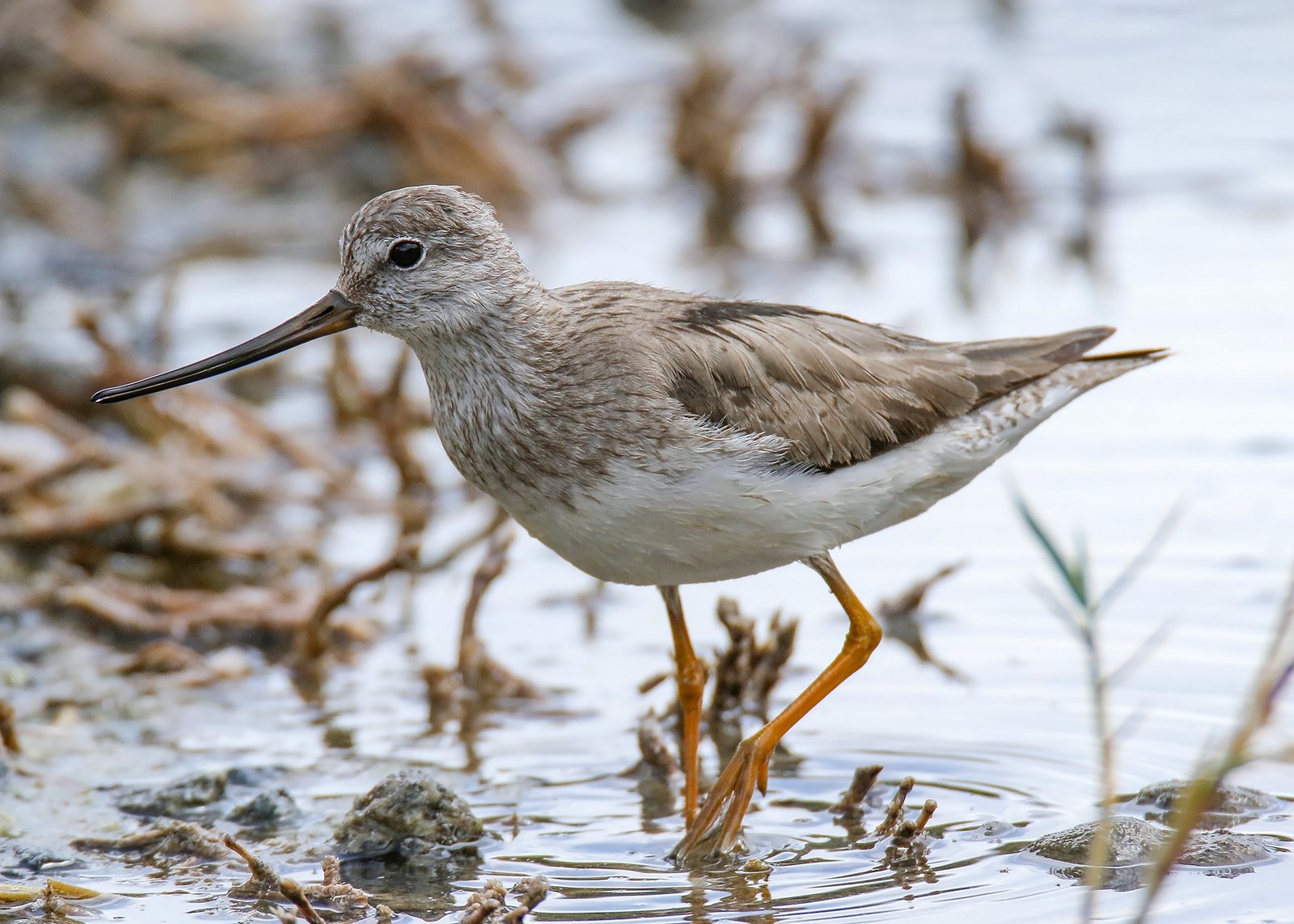
The Terek Sandpiper is a small grey wader with a long upturned bill and short orange-yellow legs, which runs over the mud in a crouched posture and in short sprints. It breeds from Finland to eastern Siberia and winters along the shores of the Indian Ocean, in southern Africa mainly in estuaries and mangroves on the east coast.
Voice
A fluty, slightly descending too-too-too or twee-wee-wee, often in threes, faster and higher than the call of Common Greenshank. Also a short cheet when disturbed.
Recording: Ray Tsu 诸仁 — CC BY-NC-SA 4.0 · converted to mono · xeno-canto
Identification
22–25 cm. Plain grey-brown above, showing in flight a white trailing edge to the secondaries and a grey rump; white below with a greyish wash on the breast sides. The bill is long, distinctly upturned and dark with a yellow or orange base. The short legs are yellow-orange. Adults show a dark line along the scapulars, black and conspicuous in breeding plumage. The posture is hunched; it bobs the rear like a Common Sandpiper and runs fast and jerkily after small crabs.
Confusion species
Common Sandpiper Actitis hypoleucos has a short, straight bill, a white hook in front of the bend of the wing and a white wingbar in flight. Marsh Sandpiper Tringa stagnatilis and Common Greenshank Tringa nebularia have long legs and a white wedge up the back. Curlew Sandpiper Calidris ferruginea has a decurved bill, black legs and a white rump.
Habitat
Tidal mudflats, sandy and muddy estuary shores, mangroves, lagoons and weed-covered rocky shores; rarely at fresh water inland. At high tide it roosts in groups on sandbanks, in mangroves or on groynes, often with other waders.
Where the bird is most at home, classified by the vegetation units of southern Africa.

Range and movements
Mainly along the east coast: Mozambique (numerous at Inhambane, Beira and the Bazaruto archipelago) and KwaZulu-Natal (Richards Bay, St Lucia), in smaller numbers along the south coast to the Western Cape; scarce on the west coast, with a few birds at the Walvis Bay and Sandwich Harbour lagoons in Namibia and along the coast of Angola. Rare inland. Beyond the region it occurs along the coasts of East Africa, the Arabian Sea, southern and South-East Asia and Australia.
- Resident
- Summer visitor (c. Oct–Mar)
- Passage (Mar–Apr, Oct–Nov)
- dark = core range, pale = thinly spread
How and when to look
At low tide in mangrove estuaries look for a small grey wader that races over the mud like a greyhound and stops abruptly. At the high-tide roost the yellow legs and upturned bill are the quickest clues. Richards Bay and the Mozambique coast produce most sightings.
Conservation status
Not threatened, although the East Asian flyway population is declining through the loss of intertidal habitat. In southern Africa the east-coast estuaries and mangroves are important; disturbance and coastal development are the main threats there.
Scientific name
Xenus cinereus | (Güldenstädt, 1775)
Güldenstädt described the species in 1775 as Scolopax cinerea; because it was later moved to another genus, the author and year stand in brackets. The genus Xenus was introduced in 1829 by Kaup. Xenus is from Ancient Greek xenos 'stranger'. cinereus is Latin for 'ash-grey', from cinis 'ashes', after the grey upperparts. The specimen the first description was based on came from the Caspian shore at the mouth of the Terek.