All species › Tubenoses › Petrels and shearwaters › Trindade Petrel
Trindade Petrel | Pterodroma arminjoniana
Arminjon-stormvogel | Petrel de Trinidad
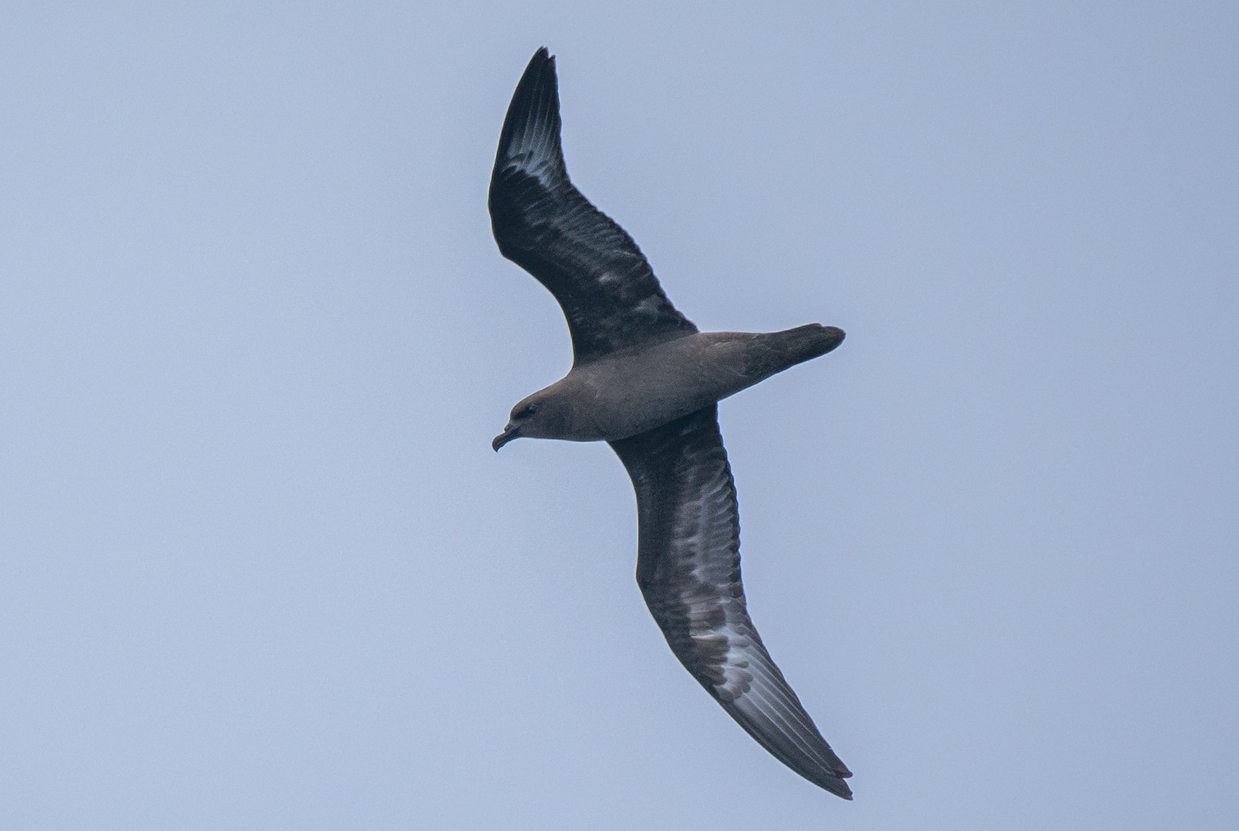
The Trindade Petrel is a slim, long-winged Pterodroma that occurs in pale, dark and intermediate morphs. It breeds on Trindade and Martim Vaz off Brazil and in small numbers on Round Island off Mauritius, and has been recorded with certainty in southern Africa only once.
Voice
Silent at sea. At the colonies a rapid, high, twittering ki-ki-ki-ki and drawn-out, moaning calls.
Recording: Kathryn Hodder — CC BY-NC-SA 4.0 · converted to mono · xeno-canto
Identification
About 37 cm, slim, with long, narrow wings, a fairly long wedge-shaped tail and a slender black bill. The pale morph has a grey-brown head, neck and breast, a white belly and undertail coverts and dark grey-brown upperparts. The dark morph is wholly dark grey-brown; intermediates have a mottled belly. In all morphs the underwing is dark with a conspicuous pale patch at the base of the primaries and often a pale line along the greater coverts. The legs are flesh-coloured or dark. The sexes and ages are alike. It flies with fluid, relaxed wingbeats and high arcs, a little less fast than smaller Pterodroma species.
Confusion species
Great-Winged Petrel (Pterodroma macroptera) resembles the dark morph but is bulkier, with a shorter, thicker bill and no clear pale patch under the primaries. Atlantic Petrel (Pterodroma incerta) is larger and heavier, with a more sharply demarcated white belly and a wholly dark underwing. Kerguelen Petrel (Aphrodroma brevirostris) is greyer, with a large head and a short tail. Barau's Petrel (Pterodroma baraui) has a white underwing.
Habitat
Warm, deep tropical and subtropical ocean, far beyond the continental shelf. It feeds mainly on squid and flying fish, picked from the surface. It breeds on rock ledges and in cavities on steep, rocky islands, often under overhanging rocks.
Where the bird is most at home, classified by the vegetation units of southern Africa.
Range and movements
In the region so far only one accepted record: a bird photographed in January 2014 about 30 nautical miles south-east of Port Elizabeth; vagrants are most likely in the warm waters of the Agulhas Current and off Mozambique. The species breeds on Trindade and Martim Vaz in the South Atlantic and on Round Island off Mauritius, where it hybridises with related species; Atlantic birds move as far as the North Atlantic outside the breeding season.
How and when to look
There is no site where this species can be expected. On pelagic trips over warm water off the east coast, watch for a slim, long-winged petrel with a pale patch under the primaries, and photograph the upper and lower sides: the pale and dark morphs are otherwise easily mistaken for other species.
Conservation status
Vulnerable, because the species breeds on very few islands. On Trindade most of the forest disappeared because of feral goats, which have since been removed; the vegetation has been recovering since. The small population on Round Island benefits from that island's restoration after rabbits and goats were eradicated.
Scientific name
Pterodroma arminjoniana | (Giglioli & Salvadori, 1869)
Giglioli & Salvadori described the species in 1869 as Aestrelata Arminjoniana; because it was later moved to another genus, the author and year stand in brackets. The genus Pterodroma was introduced in 1856 by Bonaparte. Pterodroma is Greek, from pteron 'wing' and dromos 'runner', after the fast, sweeping flight. arminjoniana honours the Italian naval officer Vittorio Arminjon, captain of the ship on the voyage during which the first specimen was collected. The specimen the first description was based on came from Trindade, Brazil.