All species › Storks › Storks › Yellow-Billed Stork
Yellow-Billed Stork | Mycteria ibis
Afrikaanse nimmerzat | Tántalo Africano
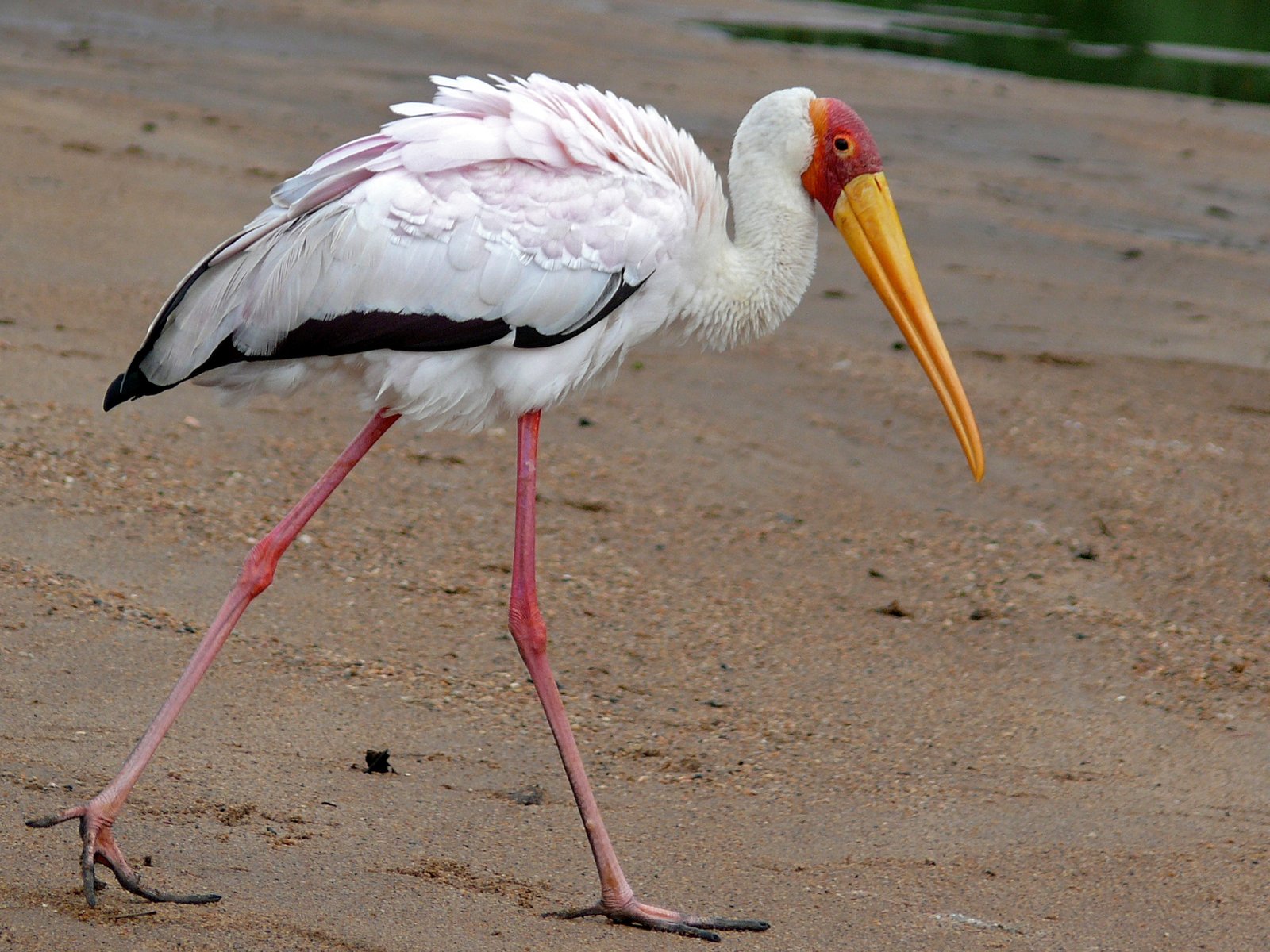
The Yellow-Billed Stork is a white stork with a red, bare face, a long, yellow and slightly decurved bill and black flight feathers and tail. It forages by touch: with the bill half open in the water it stands still or walks slowly, snapping the bill shut as soon as a fish or frog touches it. It is often seen in groups along the edge of a river or pan.
Voice
Virtually silent away from the colony. At the nest bill-clattering, squeaks and hissing; young beg with persistent squealing.
Recording: Bram Piot — CC BY-NC-SA 4.0 · converted to mono · xeno-canto
Identification
95–105 cm, wingspan 150–165 cm. The body is white, in the breeding season with a pink wash on the mantle and wing coverts; flight feathers and tail are glossy green-black. The bare face and forehead are bright red, the bill yellow and slightly decurved at the tip. The legs are pink to red. Juveniles are grey-brown with a dirty yellow bill and a duller, orangey face, and only gradually become white. In flight white with black flight feathers and a black tail, neck extended and slightly drooping, legs projecting far.
Confusion species
White Stork Ciconia ciconia has a straight red bill, a feathered head and a white tail. Saddle-Billed Stork Ephippiorhynchus senegalensis is much larger, with a black head and neck and a red-and-black bill. African Sacred Ibis Threskiornis aethiopicus has a bare black head and a strongly decurved black bill and is smaller. Young birds may recall a young African Openbill Anastomus lamelligerus, but that species is darker and has a grey bill.
Habitat
Shallow lakes, pans, floodplains, riverbanks, sandbars, dams and coastal lagoons, sometimes estuaries and mangroves. It stands with the bill half open in the water and stirs with the feet to flush prey: mainly fish, also frogs, crustaceans and aquatic insects. Breeds colonially in trees, often on islets or over water, usually together with herons and other waterbirds.
Where the bird is most at home, classified by the vegetation units of southern Africa.


Range and movements
Most numerous in the north: the Okavango Delta (with large breeding colonies) and the Chobe in Botswana, the Caprivi and Etosha in Namibia, Zambia, Malawi, Zimbabwe and Mozambique; also Angola. In South Africa mainly in the lowveld, the Kruger National Park and the pans and lakes of northern KwaZulu-Natal, such as around St Lucia; scarce further south. Irregular in Eswatini. Beyond the region in Africa south of the Sahara and on Madagascar.
- Resident
- Summer visitor (c. Oct–Mar)
- Winter visitor (c. Apr–Sep)
- Passage (Mar–Apr, Oct–Nov)
- dark = core range, pale = thinly spread
How and when to look
The Okavango during the flood (July–October), or the pans of the Kruger National Park and northern KwaZulu-Natal in summer. Look for groups of white birds standing motionless with the bill in the water; with a relaxed bird the tactile fishing can be followed closely.
Conservation status
Not threatened; widespread and locally common. Only a very small number of pairs breed in South Africa, where the species is nationally listed as endangered. Loss and disturbance of wetlands and breeding colonies and the drying-out of pans are the main threats.
Scientific name
Mycteria ibis | (Linnaeus, 1766)
Linnaeus described the species in 1766 as Tantalus Ibis; because it was later moved to another genus, the author and year stand in brackets. The genus Mycteria was introduced in 1758 by Linnaeus. Mycteria comes from the Greek muktēr, 'snout, nose' — for the large, heavy bill. ibis is the Greek and Latin word for the sacred ibis of Egypt; Linnaeus mistakenly took this stork for that bird. The specimen the first description was based on came from Egypt.