All species › Passerines › Bushshrikes › Tropical Boubou
Tropical Boubou | Laniarius major
Tropische fiskaal | Bubú Tropical
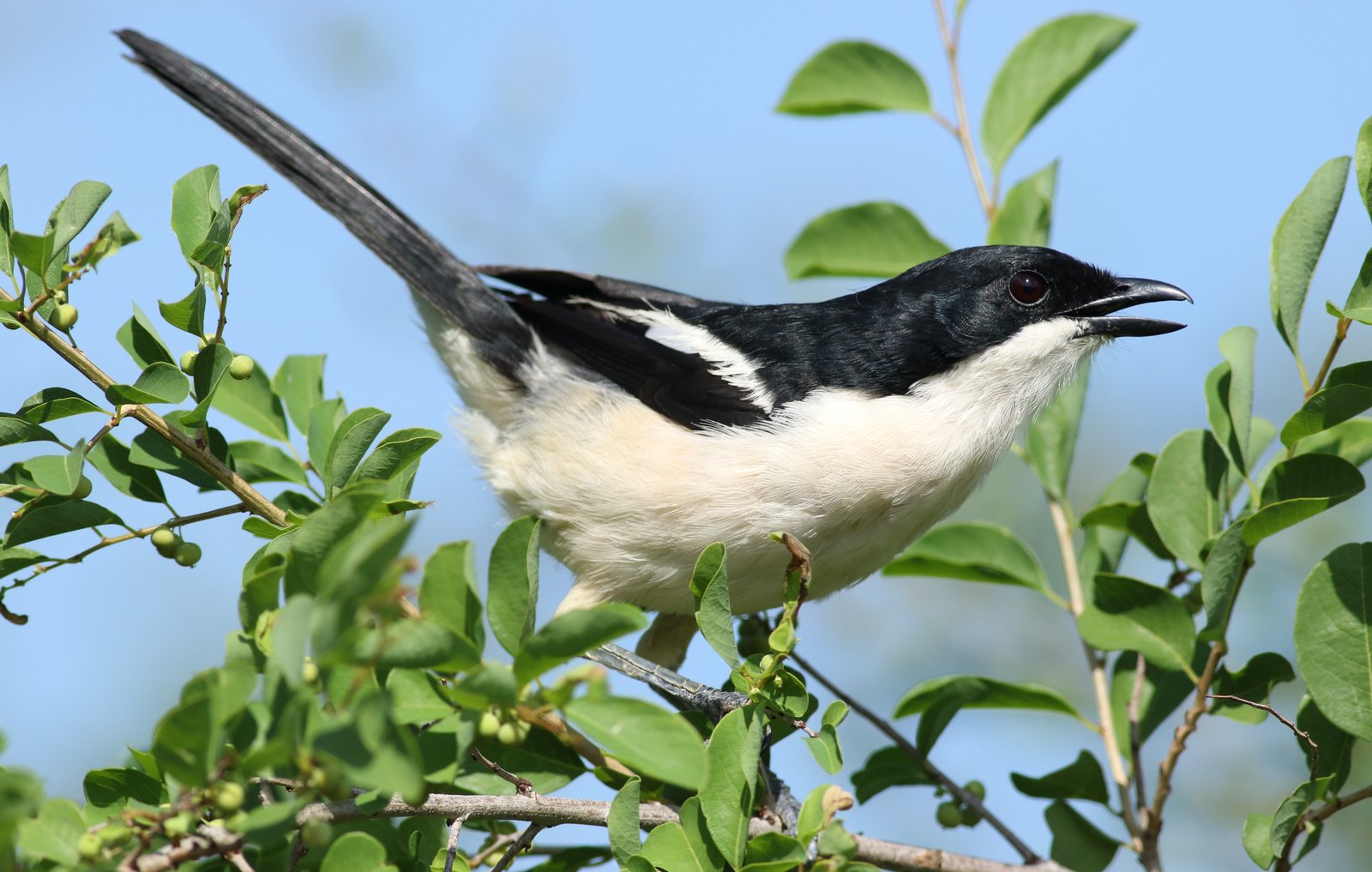
Tropical Boubou is the northern counterpart of Southern Boubou: black above, white below with a soft pink wash, and best known for its duets. The male’s bell-like whistles and the female’s harsh answer are a familiar dawn sound in woodland and along rivers from Angola to Mozambique. In older literature it is listed as Laniarius aethiopicus.
Voice
Duets so tightly timed that they sound like one bird: the male whistles one or two clear, bell-like notes such as hoo-hoo, boo-oo or a rising hoo-weet, and the female answers at once with a harsh kwee, a click or a rattling chrrr. The tempo is faster and more regular than in Southern Boubou, and the repertoire varies by district. In alarm it gives a hard, rasping rattle.
Recording: Jens Kirkeby — CC BY-NC-SA 4.0 · shortened to the first 60 s, mono · xeno-canto
Identification
21–24 cm. Head, back, wings and tail are glossy blue-black, with a long white stripe along the wing. The underparts are white, in fresh plumage with a soft pink or pale buff wash on the breast and flanks; the flanks are never rufous. The bill is heavy, black and hooked, and the eye is dark. The sexes are nearly alike. Juveniles are brownish-black above with pale spots and pale buff with fine barring below. It moves low and skulking through dense cover.
Confusion species
Southern Boubou Laniarius ferrugineus, which meets it in eastern Zimbabwe and central Mozambique, has a warm rufous belly and flanks. Swamp Boubou Laniarius bicolor of the Okavango, the Caprivi and the upper Zambezi is pure white below without a pink wash and has a different duet. Black-Backed Puffback Dryoscopus cubla is smaller, with a red eye and a white rump pad. Fülleborn’s Boubou Laniarius fuelleborni of the montane forests of northern Malawi is entirely blackish-slate.
Habitat
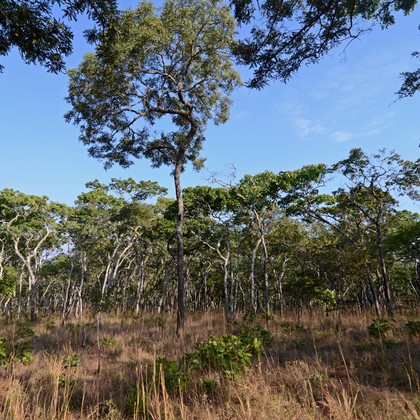
Dense cover in almost every wooded landscape: riverine and gallery forest, thick patches in miombo and mixed woodland, forest edge, bush-covered termite mounds, overgrown gardens and abandoned fields. It forages on or just above the ground, taking insects, other invertebrates, small vertebrates and fruit.
Where the bird is most at home, classified by the vegetation units of southern Africa.


Range and movements
Common in the north of the region: almost all of Angola except the bare desert of the south-west, all of Zambia and Malawi, northern and central Mozambique, northern and eastern Zimbabwe and the Zambezi valley, and northern Botswana (Chobe, Linyanti, edges of the Okavango) and the Zambezi Region and Kavango of Namibia. To the south it is replaced by Southern Boubou. Beyond the region it ranges across tropical Africa from West Africa to Uganda, Kenya and Tanzania.
- Resident
- Summer visitor (c. Oct–Mar)
- Winter visitor (c. Apr–Sep)
- Passage (Mar–Apr, Oct–Nov)
- dark = core range, pale = thinly spread
How and when to look
Year-round, best at dawn and in the early morning along wooded riverbanks and in dense thicket. Follow the duet and look low in the bushes; the birds often perch briefly on an open branch as they answer each other. Where it occurs alongside Southern Boubou, flank colour is the best feature.
Conservation status
Not assessed separately by the IUCN; it is included in Ethiopian Boubou in the broad sense (Laniarius aethiopicus, Least Concern). The species is common over much of its range, tolerates a great deal of disturbance and also lives in gardens and secondary growth. No large-scale threats are known.
Scientific name
Laniarius major | (Hartlaub, 1848)
Hartlaub described the species in 1848 as Telephonus major; because it was later moved to another genus, the author and year stand in brackets. The genus Laniarius was introduced in 1816 by Vieillot. Laniarius comes from the Latin lanius, 'butcher', the same root as for the true shrikes — for the hooked bill and the habit of impaling prey on thorns. major is Latin for 'greater', to distinguish it from related, smaller boubous. The specimen the first description was based on came from Elmina, Ghana.