All species › Passerines › Indigobirds and whydahs › Village Indigobird
Village Indigobird | Vidua chalybeata
Staalvink | Viuda Senegalesa
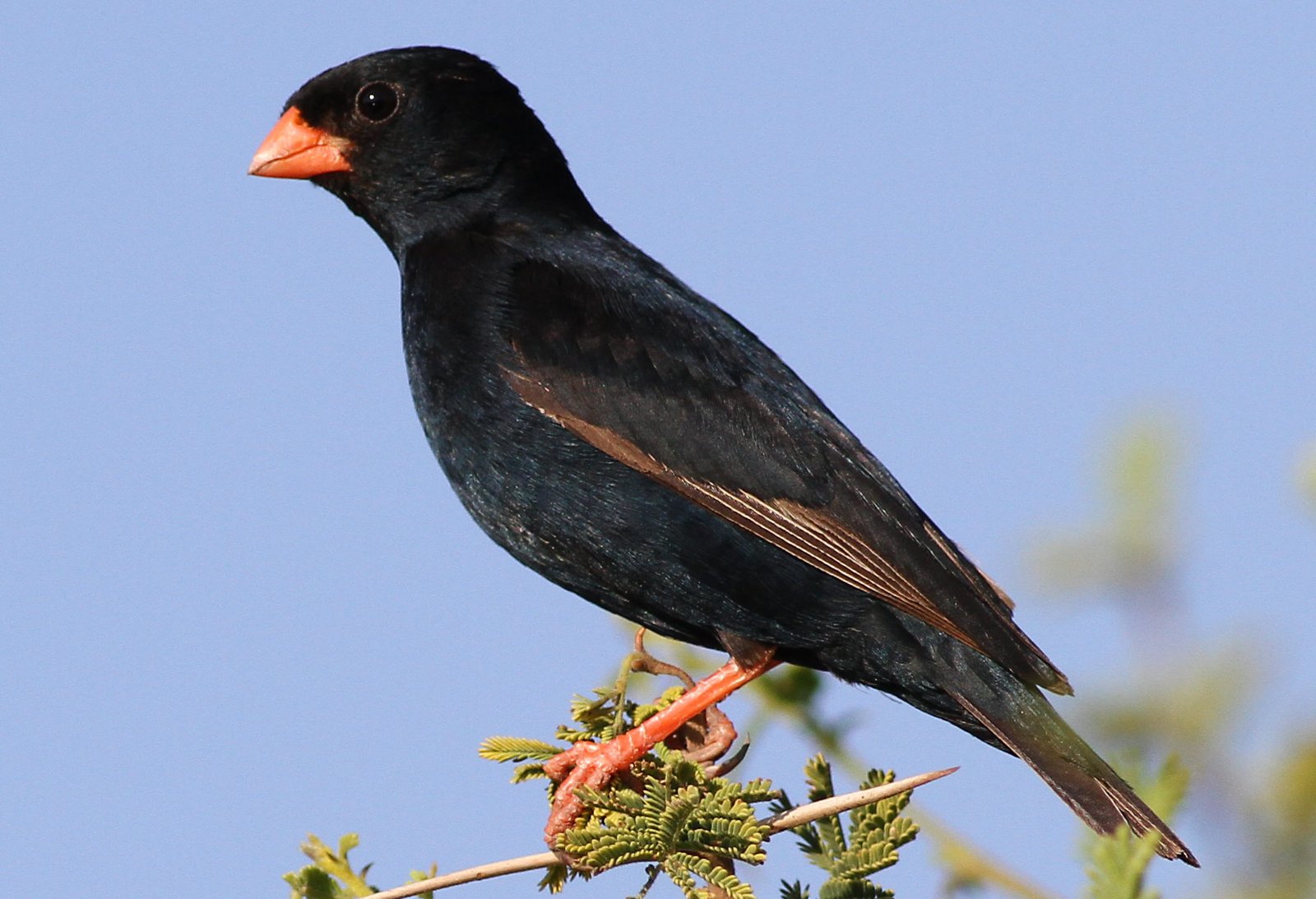
The Village Indigobird is the commonest indigobird of the region: a small, wholly glossy blue-black finch with a red bill and red legs. It parasitises only the Red-Billed Firefinch, and the male mimics the host's calls so accurately that sound is the best character.
Click a thumbnail to switch the photo above.
Voice
From a fixed song post the male sings a fast, scratchy and squeaky chatter interspersed with imitations of the Red-Billed Firefinch, such as the falling weet-weet and the soft chrr-chrr. The call is a dry chip.
Recording: Julien Birard — CC BY-NC-SA 4.0 · converted to mono · xeno-canto
Identification
11–12 cm, small and compact with a short tail. The breeding male is wholly black with a blue to blue-green gloss and brownish-black wings. In most birds in the region bill and legs are red to orange-red; in the north-west, around the Okavango, white-billed males also occur. The female is warm brown with dark streaking on the back and pale buff underparts, with a pale crown stripe, dark lateral crown stripes and a pale supercilium; her bill is pale horn and the legs orange-red. The non-breeding male resembles the female. Juveniles are plain brown.
Confusion species
The other indigobirds can only be separated with certainty on leg and bill colour, gloss and above all the mimicked host call. Dusky Indigobird (Vidua funerea) has a white bill, reddish legs and a dull blue-black plumage; Purple Indigobird (Vidua purpurascens) a white bill, very pale whitish-pink legs and a purple gloss; Zambezi Indigobird (Vidua codringtoni) a white bill, pale red legs, a green gloss and black wings. Females are almost inseparable; leg colour helps a little.
Habitat
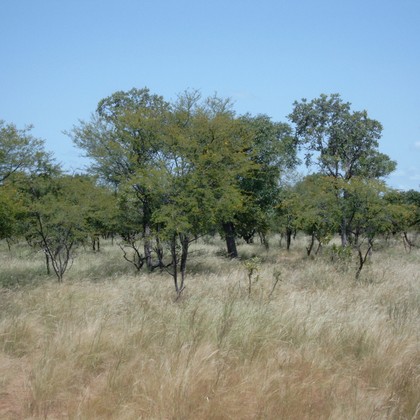
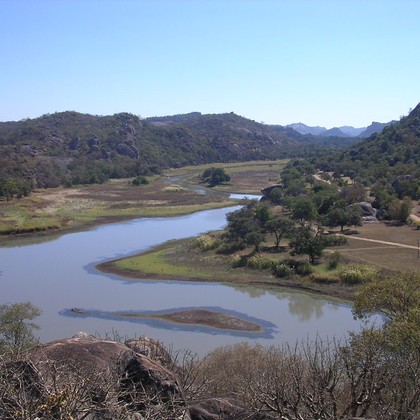
Savanna and woodland with a grassy understorey, often near water, villages, homesteads and cultivation and in gardens. It eats grass seeds from the ground, often with Red-Billed Firefinches. It lays its eggs only in the nests of Red-Billed Firefinch (Lagonosticta senegala); the chicks mimic the mouth markings of the host young and learn the calls of their foster parents.
Where the bird is most at home, classified by the vegetation units of southern Africa.

Range and movements
In the north and east of the region, wherever the Red-Billed Firefinch occurs: northern and eastern South Africa (Limpopo, Mpumalanga, North West, Gauteng and northern and eastern KwaZulu-Natal), Eswatini, Zimbabwe, Mozambique, Malawi, Zambia, Angola, northern and eastern Botswana and northern Namibia. Beyond the region it occurs over much of sub-Saharan Africa, from Senegal to Ethiopia.
- Resident
- Summer visitor (c. Oct–Mar)
- Winter visitor (c. Apr–Sep)
- Passage (Mar–Apr, Oct–Nov)
- dark = core range, pale = thinly spread
How and when to look
In summer the male sits for weeks on the same song post, often a bare treetop or wire near a village or campsite, and can be watched there. Listen whether it imitates the Red-Billed Firefinch, then check bill and legs: red with red almost always means this species.
Conservation status
Not threatened; common and benefits from villages and cultivation, where the Red-Billed Firefinch is also plentiful.
Scientific name
Vidua chalybeata | (Müller, 1776)
Müller described the species in 1776 as Fringilla chalybeata; because it was later moved to another genus, the author and year stand in brackets. The genus Vidua was introduced in 1816 by Cuvier, GLCFD. Vidua is the Latin word for 'widow'. chalybeata is Latin for 'steel-coloured', from chalybs, 'steel' — for the male's blue-black gloss. The specimen the first description was based on came from Senegal (substituted; originally Brazil in error).