All species › Passerines › Indigobirds and whydahs › Zambezi Indigobird
Zambezi Indigobird | Vidua codringtoni
Codringtons staalvink | Viuda Verdosa
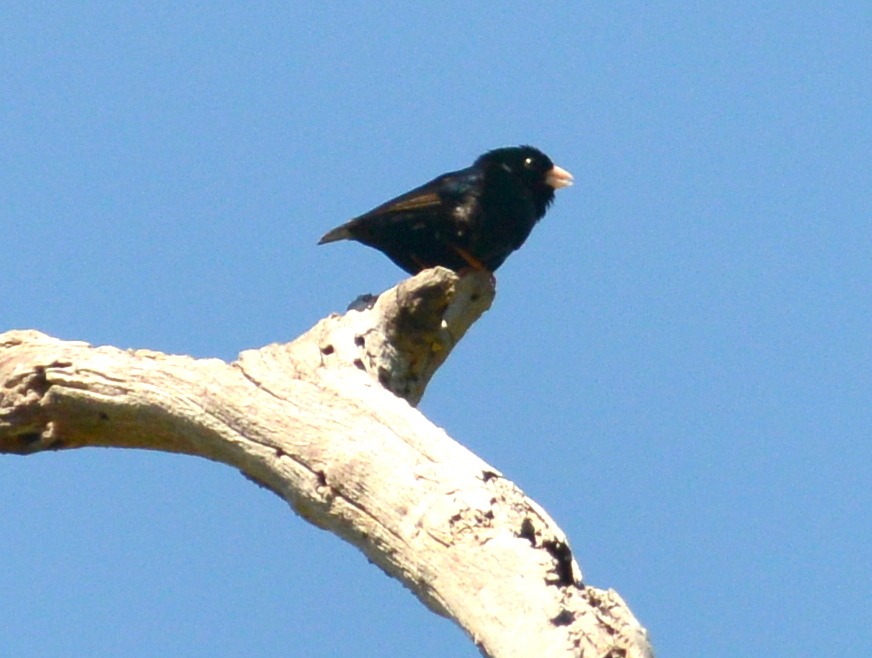
The Zambezi Indigobird is a little-known indigobird of tangles along forest edges in the Zambezi basin and adjacent areas. The male has a greenish gloss, a white bill and pale red legs. It parasitises the Red-Throated Twinspot and mimics its calls.
Voice
A fast mixture of scolding and squeaky notes interspersed with imitations of the Red-Throated Twinspot, such as a thin, trilling tsiiiii-tsi-tsi and soft ticking calls. The call is a short chip.
Recording: Magnus Wadstein — CC BY-NC-SA 4.0 · converted to mono · xeno-canto
Identification
11–12 cm, small and compact. The breeding male is glossy greenish-black, in good light with a paler greyish wash over head and breast, and with all-black wings lacking a brown panel. The bill is white, the legs pale red. The female and the non-breeding male are brown with dark streaking on the back, a bold head pattern of pale crown and supercilium and dark lateral crown and eye-stripes, and pale underparts with a grey wash across the breast. Juveniles are plain brown.
Confusion species
Village Indigobird (Vidua chalybeata) has a red bill and a blue gloss over most of the region. Purple Indigobird (Vidua purpurascens) has a purple gloss, very pale whitish-pink legs and a brownish wing panel. Dusky Indigobird (Vidua funerea) is dull blue-black with reddish legs. The green gloss and all-black wings are the male's best features, but only mimicry of the Red-Throated Twinspot gives certainty.
Habitat
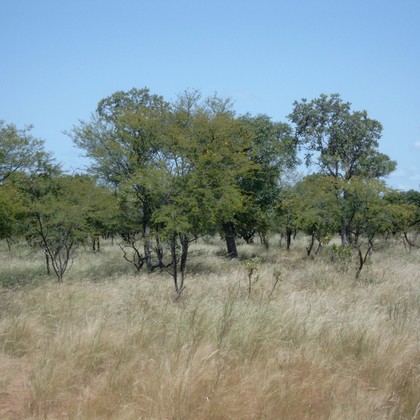
The edges of riverine and lowland evergreen forest, dense tangles and thickets nearby, and rank vegetation in acacia woodland. It searches for seeds on the ground in the cover of bushes, often with Red-Throated Twinspots (Hypargos niveoguttatus), in whose nests it lays its eggs.
Where the bird is most at home, classified by the vegetation units of southern Africa.


Range and movements
Local in the north-east of the region: north-western and eastern Zimbabwe, adjacent central and northern Mozambique, Malawi and scattered sites in Zambia. Beyond the region only in southern Tanzania.
- Summer visitor (c. Oct–Mar)
- Passage (Mar–Apr, Oct–Nov)
- dark = core range, pale = thinly spread
How and when to look
In summer look along riverside forest edges and in the thickets of eastern Zimbabwe or Malawi for a singing indigobird male on a projecting branch. A white bill and greenish gloss combined with Red-Throated Twinspot mimicry confirm the species. Especially in contact zones where Village Indigobird also occurs, sound is indispensable.
Conservation status
Not threatened, but local and poorly known. Clearance of riverine and lowland forest may affect the species and its host locally.
Scientific name
Vidua codringtoni | (Neave, 1907)
Neave described the species in 1907 as Hypochaera codringtoni; because it was later moved to another genus, the author and year stand in brackets. The genus Vidua was introduced in 1816 by Cuvier, GLCFD. Vidua is the Latin word for 'widow'. codringtoni honours Robert Edward Codrington (1869–1908), Governor of Northern Rhodesia (now Zambia) from 1898 to 1907. The specimen the first description was based on came from Molilo's, near Petauke, Zambia.