All species › Birds of prey › Hawks, eagles and kites › White-Backed Vulture
White-Backed Vulture | Gyps africanus
Witruggier | Buitre Dorsiblanco Africano
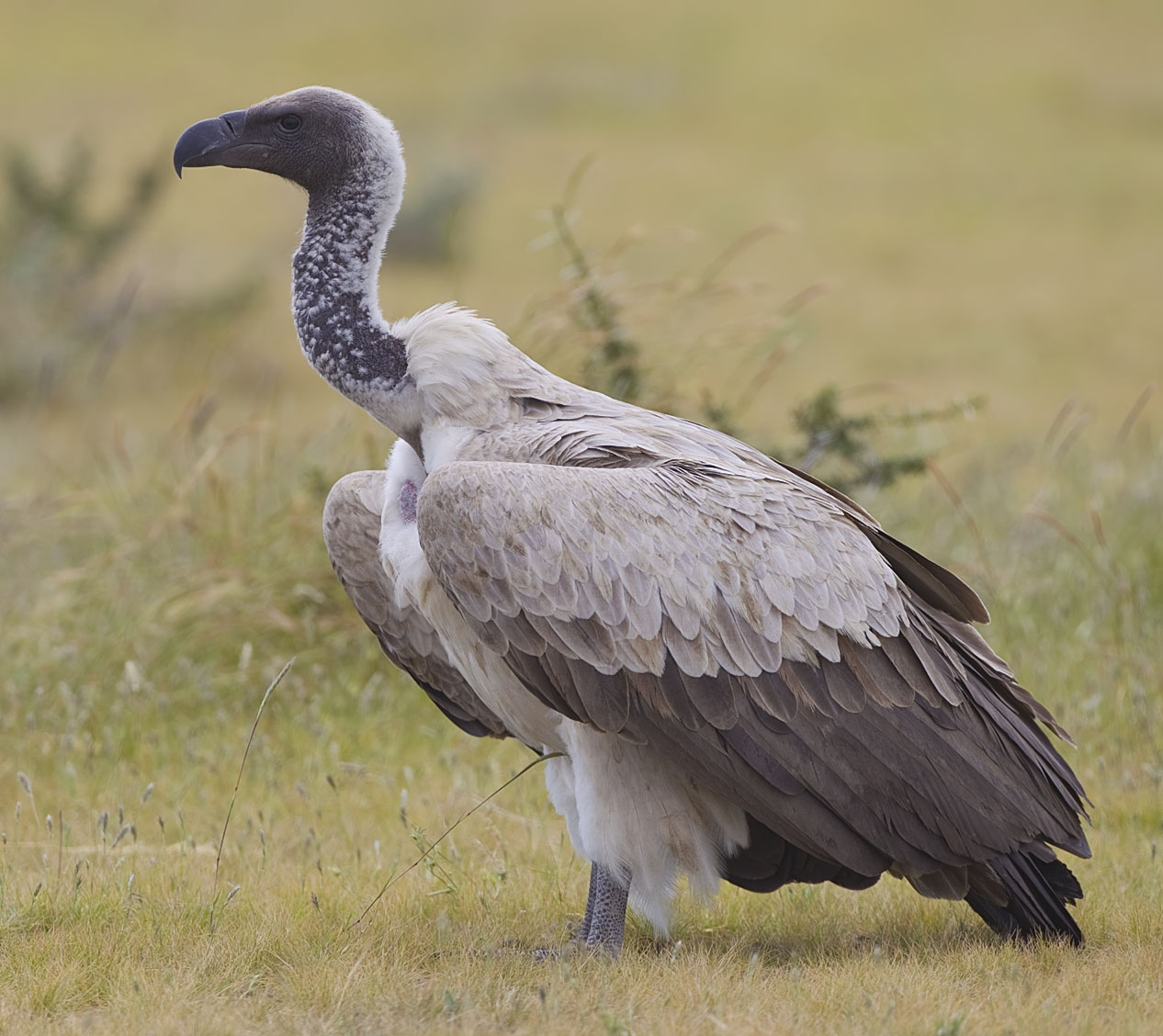
The White-Backed Vulture is the most numerous and widespread vulture of the southern African savannas and usually the species that descends in the greatest numbers at a carcass. It is a typical griffon with a long, bare neck, soaring in large groups high over the woodland and watching one another.
Voice
Around carcasses a noisy hissing, screeching, cackling and grunting as birds jostle one another. At the nest soft twittering and squeaking.
Recording: Ehren Eksteen — CC BY-NC-SA 4.0 · converted to mono · xeno-canto
Identification
About 90 cm, wingspan more than two metres. The adult is pale brownish to cream, with dark flight feathers and tail. The lower back is white, visible only when the wings are spread. The head and long neck are covered in grey down, with a white downy ruff at the base of the neck. The bill is heavy and black, the eye dark. Juveniles are darker brown with pale streaks on the breast and wing coverts, lack the white back and become gradually paler over five to seven years. In flight the white underwing coverts of adults contrast strongly with the black flight feathers; in young birds the underwing is darker with a narrow pale band.
Confusion species
Cape Vulture (Gyps coprotheres) is clearly larger and paler, with a pale yellow eye, blue throat patches and an underwing on which the flight feathers contrast less sharply; young birds of the two species are very similar. Rüppell's Vulture (Gyps rueppelli) has scaly plumage from pale feather edges and a yellowish bill. Lappet-Faced Vulture (Torgos tracheliotos) and White-Headed Vulture (Trigonoceps occipitalis) have shorter necks and strikingly coloured heads and bills.
Habitat
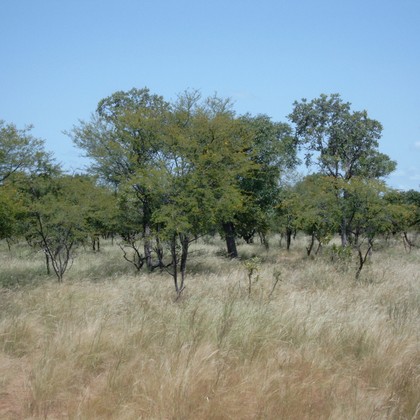
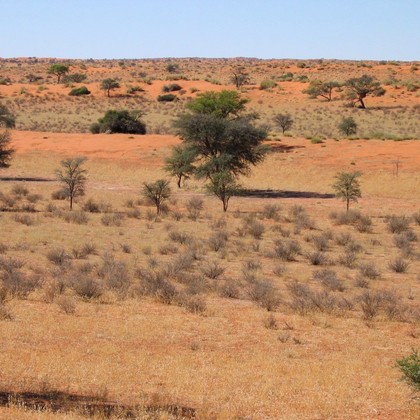
Open and semi-open savanna and woodland with tall trees, from dry thornveld and the Kalahari to mopane and miombo; avoids desert, high mountains and dense forest. It lives on the carcasses of large mammals and depends on good game populations or livestock. It breeds in loose colonies of a few to dozens of pairs, with stick nests in the crowns of tall acacias and other trees, often along rivers.
Where the bird is most at home, classified by the vegetation units of southern Africa.

Range and movements
Widespread in savanna throughout the region: Angola, Zambia, Malawi, Mozambique, Zimbabwe, Botswana, northern and central Namibia, and in South Africa the north and east (Limpopo, Mpumalanga, North West, the Northern Cape, northern KwaZulu-Natal) and Eswatini. Absent from the Western Cape, the Karoo, the Lesotho highlands and the Namib. Beyond the region across the savanna belt of sub-Saharan Africa, from Senegal to Sudan, Ethiopia and Tanzania.
- Resident
- Summer visitor (c. Oct–Mar)
- Winter visitor (c. Apr–Sep)
- Passage (Mar–Apr, Oct–Nov)
- dark = core range, pale = thinly spread
How and when to look
In any large game park such as Kruger, Hwange, Chobe or Etosha; early in the morning watch treetops where vultures have roosted, and later in the day follow the swirling groups above a carcass. To separate it from Cape Vulture, note the dark eye, the stronger contrast in the underwing and the size when both stand side by side.
Conservation status
Critically Endangered on the Red List. The species has declined by more than ninety percent over three generations across its range. Mass poisoning, in which hundreds of vultures can die at a single carcass, is the main cause, followed by trade in vulture parts for traditional use, collisions with power lines, loss of nest trees and declines in game. Southern Africa still holds an important share of the world population, mainly in large parks.
Scientific name
Gyps africanus | Salvadori, 1865
Salvadori described the species in 1865 and placed it straight away in the genus where it still stands. The genus Gyps was introduced in 1809 by De Savigny. Gyps is Greek gups 'vulture'. africanus is Latin for 'African'. The specimen the first description was based on came from Sennar, Sudan.