All species › Passerines › Chats and flycatchers › White-Browed Scrub Robin
White-Browed Scrub Robin | Cercotrichas leucophrys
Witbrauwwaaierstaart | Alzacola Dorsirrojo
The White-Browed Scrub Robin is the most widespread scrub robin of the region, a shy but noisy inhabitant of dense scrub in savanna and woodland. In the breeding season the male sings from a bush top, even in the heat of the day and at night, an endless repetition of the same short whistled phrase.

Voice
The song is a loud, endlessly repeated whistled phrase such as twee-choo-cheeree, varying between males and delivered for long periods, by day and on moonlit nights. The alarm is a dry, rattling trrrrr; there is also a sharp tchik.
Recording: Rory Nefdt — CC BY-NC-SA 4.0 · converted to mono · xeno-canto
Identification
A scrub robin of 15 cm. The upperparts are greyish brown in the south and warmer rufous-brown in the northern races; rump and tail base are rufous, the rest of the tail dark with white tips. A broad white supercilium and a dark eye-stripe mark the head. The wing shows two white wing bars and white edges to the tertials. The throat is white; breast and flanks are boldly streaked black in southern birds and much less so in northern races. The sexes are alike. It constantly cocks and fans its tail and droops its wings.
Confusion species
Kalahari Scrub Robin (Cercotrichas paena) is paler and sandier, with an unstreaked breast, no white wing bars and a black band in the tail; it lives in open, dry thornveld. Bearded Scrub Robin (Tychaedon quadrivirgata) has an orange breast and flanks, a black-and-white malar stripe and no wing bars, and lives in denser woodland and coastal forest. Miombo Scrub Robin (Tychaedon barbata) of miombo is very similar to it. Brown-Backed Scrub Robin (Cercotrichas hartlaubi) of Angola has a plain brown back and an almost unstreaked breast.
Habitat
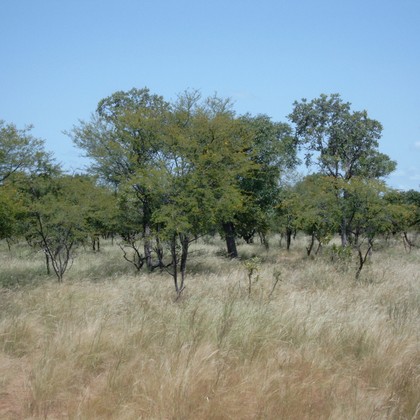
Acacia savanna, mixed woodland and mopane with dense bushes, thickets around termite mounds, riverine scrub, overgrown field margins and forest edges in the coastal belt. Forages on the ground and low in bushes for insects, especially ants, termites and beetles.
Where the bird is most at home, classified by the vegetation units of southern Africa.


Range and movements
Widespread in Angola, Zambia, Malawi, Mozambique and Zimbabwe, northern and eastern Botswana, northern Namibia and in South Africa in Limpopo, Mpumalanga, Gauteng, North West, KwaZulu-Natal and the north-east of the Eastern Cape; also in Eswatini. Beyond the region north through the DR Congo, Tanzania and Kenya to South Sudan and Somalia.
- Resident
- Summer visitor (c. Oct–Mar)
- Winter visitor (c. Apr–Sep)
- Passage (Mar–Apr, Oct–Nov)
- dark = core range, pale = thinly spread
How and when to look
Listen for the persistently repeated whistled phrase, which in woodland you often hear before you see the bird. Then check the bush tops around the singer. Outside the breeding season it is quieter and mostly seen as it briefly runs across a track with its tail raised. White wing bars plus a streaked breast separate it from every other scrub robin in the south.
Conservation status
Not threatened. The species is common and widespread, and numbers are stable. It tolerates grazing and bush encroachment well and also occurs in disturbed savanna and around farmsteads.
Scientific name
Cercotrichas leucophrys | (Vieillot, 1817) (GBIF: Erythropygia leucophrys)
Vieillot described the species in 1817 as Sylvia leucophrys; because it was later moved to another genus, the author and year stand in brackets. The genus Cercotrichas was introduced in 1831 by Boie. Cercotrichas is Greek, from kerkos 'tail' and trikhas 'thrush'. leucophrys combines the Greek leukos, 'white', with ophrus, 'eyebrow' — for the clear white supercilium. The specimen the first description was based on came from Gamtoos River, Eastern Cape, South Africa.