All species › Waders, gulls and terns › Sandpipers and snipes › White-Rumped Sandpiper
White-Rumped Sandpiper | Calidris fuscicollis
Bonapartes strandloper | Correlimos Culiblanco
The White-Rumped Sandpiper is an American sandpiper that migrates each year from the Canadian tundra to the far south of South America. In southern Africa it has been seen only a few times, usually among Curlew Sandpipers and Little Stints.

Voice
A high, thin, squeaky tzeet or jeet, almost like a mouse or a bat, usually on take-off.
Recording: Jacob Wijpkema — CC BY-NC-SA 4.0 · converted to mono · xeno-canto
Identification
15–18 cm. A slim sandpiper with long wings that reach well beyond the tail at rest, a fairly short, slightly drooping black bill with a reddish-brown or orangey spot at the base of the lower mandible, and black legs. In non-breeding plumage fairly plain grey above, with a grey, finely streaked breast whose streaking continues as fine chevrons along the flanks, and a distinct white supercilium. Juveniles have a rufous-scaled mantle. The decisive feature is visible in flight: wholly white uppertail coverts, forming a narrow white band across the base of the dark tail, and a weak wingbar.
Confusion species
Curlew Sandpiper Calidris ferruginea also has a white rump but is larger and longer-legged, with a much longer, evenly decurved bill and no flank streaking. Baird's Sandpiper Calidris bairdii has equally long wings but is warmer buffy brown, with a dark central stripe across the rump. Little Stint Calidris minuta is smaller and shorter-winged, with a dark central stripe across the rump. Dunlin Calidris alpina has a longer bill and likewise a dark rump stripe.
Habitat
Lagoons, estuaries, coastal pans, salt works and the muddy shores of dams and sewage works; in southern Africa mostly at sites with large numbers of other small sandpipers.
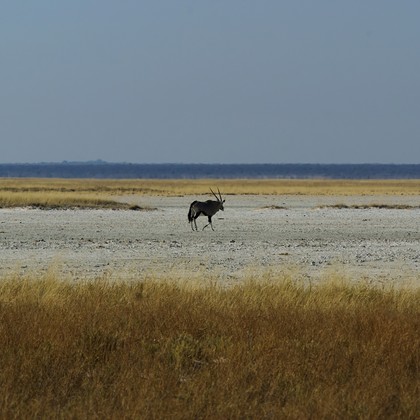
Where the bird is most at home, classified by the vegetation units of southern Africa.


Range and movements
A few records in the region, mainly in South Africa, including the Western Cape, and in Namibia. The bulk of the population migrates along the Atlantic side of the Americas to Argentina and Tierra del Fuego; vagrants regularly reach western Europe and occasionally southern Africa. It breeds on the tundra of Alaska and northern Canada.
How and when to look
Check roosts of Curlew Sandpipers and Little Stints for a grey bird with long wings and streaked flanks. Wait for the flock to take flight and look for a bird with a white rump but without the long decurved bill of Curlew Sandpiper; the thin, squeaky call helps. Document the sighting for the rarities committee.
Conservation status
Vulnerable on the Red List, after a rapid decline of the world population probably linked to changes on the tundra and the degradation of stopover and feeding sites along the flyway in North and South America. In southern Africa an extremely rare vagrant.
Scientific name
Calidris fuscicollis | (Vieillot, 1819)
Vieillot described the species in 1819 as Tringa fuscicollis; because it was later moved to another genus, the author and year stand in brackets. The genus Calidris was introduced in 1804 by Merrem. Calidris goes back to Ancient Greek kalidris or skalidris, a name Aristotle used for an unidentified grey waterside bird. fuscicollis combines Latin fuscus 'dusky, brown' with -collis '-necked', so 'dusky-necked'. The specimen the first description was based on came from Paraguay.