All species › Storks › Storks › White Stork
White Stork | Ciconia ciconia
Ooievaar | Cigüeña Blanca
In southern Africa the White Stork is a summer visitor from Europe and western Asia, roaming grasslands and farmland in flocks of tens to thousands. It follows the rains and outbreaks of locusts and caterpillars, which earned it the name locust bird in South African tradition. A small number of pairs have stayed behind in the Western Cape and breed there.
Voice
Virtually mute; the familiar bill-clattering is heard in southern Africa almost only from the Western Cape breeding birds. Otherwise at most a soft hiss.
Recording: Petter Westberg — CC BY-NC-SA 4.0 · converted to mono · xeno-canto
Identification
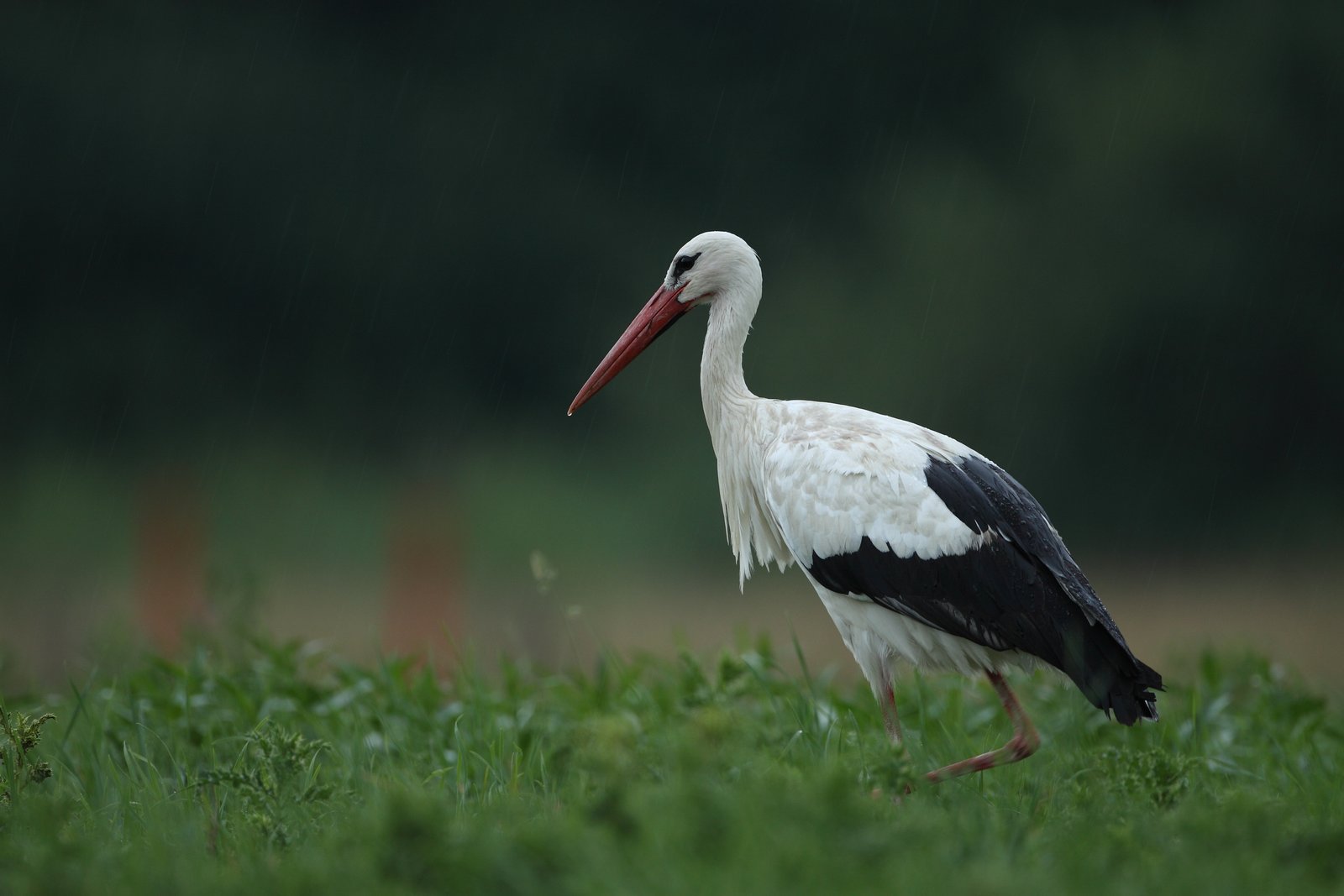
100–115 cm, wingspan 155–165 cm. White with black flight feathers and greater coverts; the long bill and the legs are red, the eye dark with a narrow ring of black bare skin. Juveniles have a duller, brownish-red bill with a dark tip and brownish wings. The legs are often splashed white with droppings, with which the bird cools itself. In flight a white stork with the rear half of the wing black, outstretched neck and projecting legs; it soars a great deal on thermals, spiralling upwards.
Confusion species
Yellow-Billed Stork Mycteria ibis has a bare red face, a yellow, decurved bill and a black tail. Abdim's Stork Ciconia abdimii is smaller and largely dark, with only the belly and back white. At great height Great White Pelican Pelecanus onocrotalus can look similar, but it flies with the head drawn in, has a shorter tail without projecting legs, and an enormous bill.
Habitat
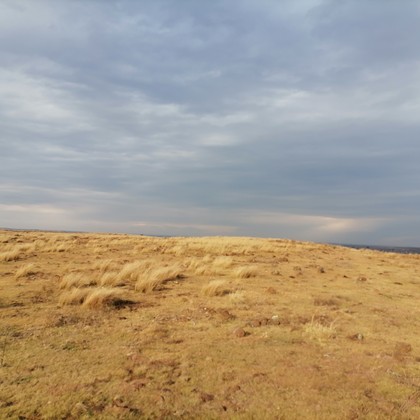
Open grassland, pasture, cropland, fallow fields and floodplains, especially after rain. It forages on foot for grasshoppers, locusts, caterpillars (especially armyworms), beetles, termites and small vertebrates; gathers at grass fires and behind ploughing tractors. Roosts in groups on poles, in trees or at dams.
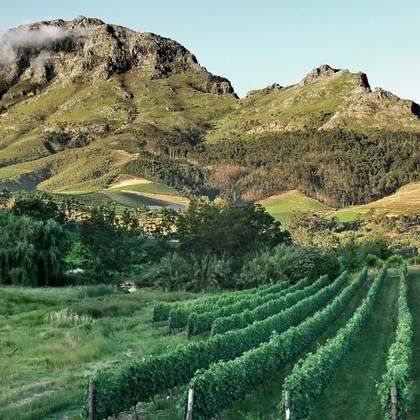
Where the bird is most at home, classified by the vegetation units of southern Africa.
Range and movements
In summer widespread over the east and centre of the region: the South African highveld (Free State, Mpumalanga, Gauteng, North West), KwaZulu-Natal, the Eastern Cape, the Karoo after rain, Lesotho, Eswatini, Botswana, Zimbabwe, Zambia and Malawi; scarcer and irregular in Mozambique, Angola and Namibia. A small breeding population has lived around Bredasdorp and Oudtshoorn in the Western Cape since the 1930s. Beyond the region the species breeds in Europe, North Africa and western Asia; the birds in southern Africa come mainly from the eastern population, which migrates via the Bosphorus and the Nile valley.
- Resident
- Summer visitor (c. Oct–Mar)
- Winter visitor (c. Apr–Sep)
- Passage (Mar–Apr, Oct–Nov)
- dark = core range, pale = thinly spread
How and when to look
The highveld and the Free State from December to February, especially after good rains or a locust outbreak. Flocks are visible from afar as white dots in the grassland or as a spiral of soaring birds above a thermal. Read the rings: many birds carry a European ring.
Conservation status
Not threatened; after a steep decline in the twentieth century, European numbers have recovered strongly. In southern Africa, poisoning during locust and armyworm control and collisions with power lines are the main risks.
Scientific name
Ciconia ciconia | (Linnaeus, 1758)
Linnaeus described the species in 1758 as Ardea Ciconia; because it was later moved to another genus, the author and year stand in brackets. The genus Ciconia was introduced in 1760 by Brisson. Ciconia is the Latin word for 'stork'. The specific name repeats the genus name. The specimen the first description was based on came from Sweden.