All species › Storks › Storks › Black Stork
Black Stork | Ciconia nigra
Zwarte ooievaar | Cigüeña Negra
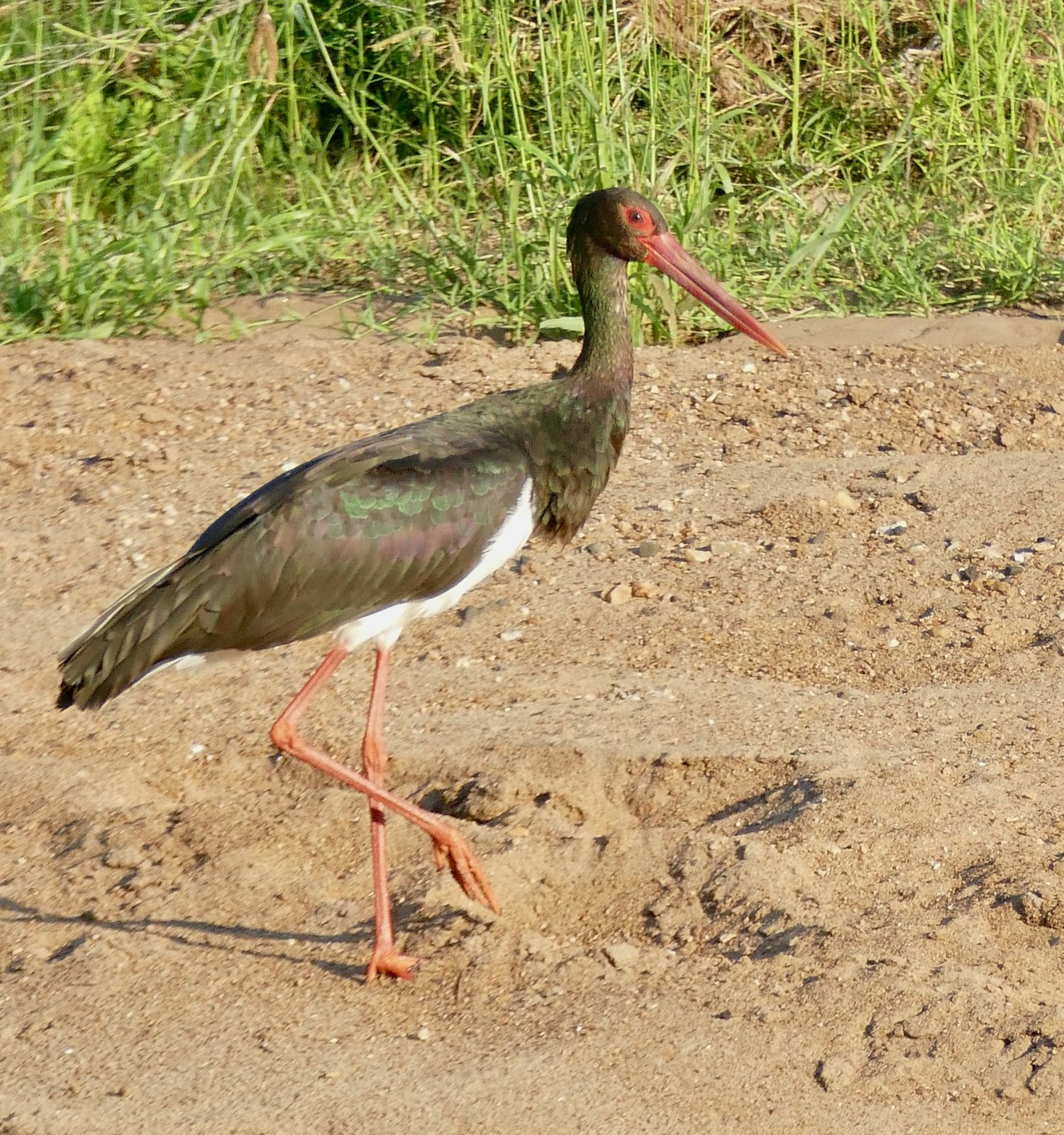
The Black Stork is a shy, glossy black stork with a white belly and a red bill and red legs. Southern Africa has its own breeding population, which nests on ledges in gorges and cliffs far from people. It forages alone or in pairs along rivers and dams and rarely joins flocks of other storks.
Voice
Quieter than White Stork, but vocal at the nest: a series of wheezing, whistling or squeaking notes, unlike most storks. It also clatters the bill, but less loudly.
Recording: Francesco Sottile — CC BY-NC-SA 4.0 · converted to mono · xeno-canto
Identification
95–100 cm, wingspan 173–205 cm. Head, neck, breast and upperparts are black with a strong green and purple gloss; belly, flanks and underwing coverts are white. The bill and legs are bright red, and the eye is surrounded by a bare red ring. Juveniles are duller brownish-black with a greenish-grey bill and grey-green legs. In flight a large dark stork with a white triangle on the underside between wing and belly, outstretched neck and projecting legs; it soars on flat wings in thermals.
Confusion species
Abdim's Stork Ciconia abdimii is smaller, with a grey-green bill, a blue face and a white back and rump that are conspicuous in flight, and forms large flocks. African Woolly-Necked Stork Ciconia microscelis has a white, woolly neck and a dark bill. African Openbill Anastomus lamelligerus is entirely dark, without a white belly. Young Black Storks can resemble Abdim's Stork because of their dull bill; check then for the dark back.
Habitat
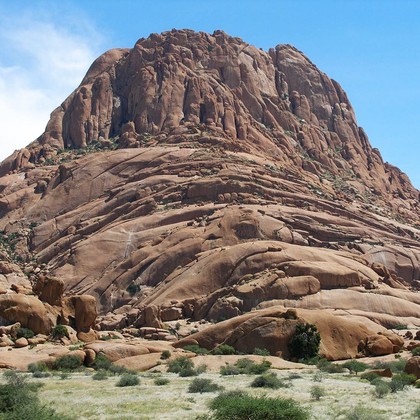
Rivers, streams, shallow dams and marsh edges in hilly and mountainous country and in savanna; it feeds on fish, frogs and aquatic insects, often by wading slowly through clear water. The nest is on a ledge or in a niche on a sheer cliff or gorge wall, sometimes in a large tree; the same nest is used for many years in a row.
Where the bird is most at home, classified by the vegetation units of southern Africa.

Range and movements
Thinly spread over the east and north of the region. In South Africa it breeds mainly in the gorges of Mpumalanga, Limpopo, the Magaliesberg, KwaZulu-Natal and the Eastern Cape; further in Lesotho, Eswatini, Zimbabwe, Mozambique, eastern Botswana, Zambia and Malawi, and locally in north-western Namibia and in Angola. Beyond the region the species breeds from Europe and North Africa to China; those birds winter in Africa south of the Sahara and in India, but reach the region only in small numbers.
- Resident
- Summer visitor (c. Oct–Mar)
- Winter visitor (c. Apr–Sep)
- Passage (Mar–Apr, Oct–Nov)
- dark = core range, pale = thinly spread
How and when to look
Gorges and river valleys with sheer walls, such as in Mpumalanga, the Magaliesberg and the Drakensberg, in the dry season (April–September), when the birds breed. Scan from a viewpoint for rock ledges with whitewashed edges, or search the river below for a foraging bird. In the Kruger National Park often at the rivers in winter.
Conservation status
Not threatened. The southern African breeding population is small, however, and the species is nationally listed as Vulnerable in South Africa. Disturbance at nests, dam construction and pollution or siltation of rivers are the main threats.
Scientific name
Ciconia nigra | (Linnaeus, 1758)
Linnaeus described the species in 1758 as Ardea nigra; because it was later moved to another genus, the author and year stand in brackets. The genus Ciconia was introduced in 1760 by Brisson. Ciconia is the Latin word for 'stork'. nigra is Latin for 'black', after the dark plumage. The specimen the first description was based on came from Sweden.