All species › Passerines › Leaf warblers › Willow Warbler
Willow Warbler | Phylloscopus trochilus
Fitis | Mosquitero Musical
The Willow Warbler is the most numerous Palearctic migrant in the region: from October to April almost every wooded spot in the east and centre is full of these small, restless leaf warblers. In the last months before departure they sing freely, so that their soft, descending phrase is then one of the familiar sounds of the bushveld.

Voice
The song is a soft, melodious, descending series of whistles that slowly dies away, si-si-si-sui-sui-sue-sue-swee-sweet, heard mainly from January until departure in April, often from a garden tree. The call is a soft, disyllabic, rising hoo-eet, which gives the species away even without song.
Recording: Stanislas Wroza — CC BY-NC-SA 4.0 · shortened to the first 60 s, mono · xeno-canto
Identification
11–12 cm, slim and restless, with a fine, pointed bill and a medium primary projection. The upperparts are olive-green to grey-green, the underparts dingy white with a yellow wash on throat and breast. A distinct pale supercilium runs well behind the eye, bordered by a dark eye-stripe. The legs are usually pale brown to flesh-coloured. First-year birds are strikingly yellow below in summer, especially after moult in December–February. Birds from the east of the breeding range (Siberia) are much greyer and browner with hardly any yellow, and are easily taken for another species. It constantly dips its tail and flicks its wings while foraging.
Confusion species
Icterine Warbler Hippolais icterina is larger and heavier, with a broad orange-pink bill, a pale wing panel, a flat head with a short yellow supercilium and blue-grey legs. Wood Warbler Phylloscopus sibilatrix, a vagrant, has a sharp border between yellow throat and white belly and a long primary projection. Yellow-Throated Woodland Warbler Phylloscopus ruficapilla has a rufous crown and is a resident of montane forest; Laura's Woodland Warbler Phylloscopus laurae is smaller, brighter yellow and green, with rounded wings, and stays in miombo and gallery forest in Zambia and Angola. Yellow-Bellied Eremomela Eremomela icteropygialis is grey with only a yellow belly and has a short tail. Garden Warbler Sylvia borin is grey-brown without a supercilium, with a short, stubby bill.
Habitat
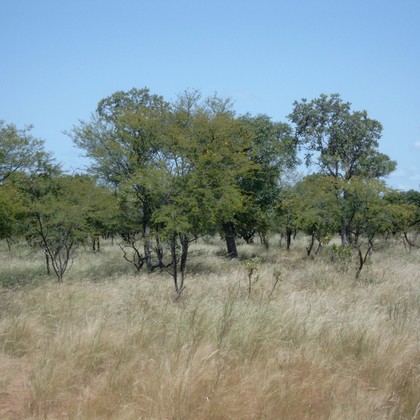
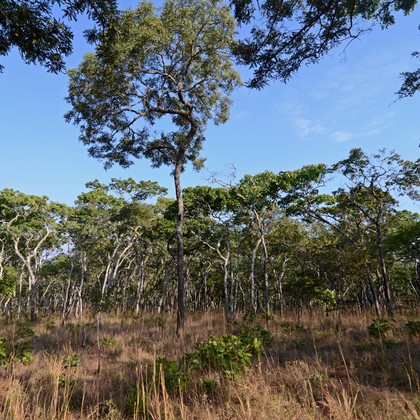
Almost any kind of woodland and wooded country: mixed bushveld, miombo, acacia savanna, riverine forest, forest edges, plantations, parks and gardens. It avoids closed rainforest and treeless areas. It forages in the canopy and shrub layer for small insects, often in mixed flocks.
Where the bird is most at home, classified by the vegetation units of southern Africa.

Range and movements
Widespread and common in the east, centre and north of the region: South Africa (especially Limpopo, Mpumalanga, Gauteng, KwaZulu-Natal and the Eastern Cape, scarcer in the Western Cape), Eswatini, Lesotho (locally), Botswana, Zimbabwe, Mozambique, Malawi, Zambia and Angola; in Namibia mainly in the north and centre. Scarce in the driest parts of the west, such as the Namib and the Karoo. It breeds from western Europe to eastern Siberia and winters in almost all of Africa south of the Sahara.
- Resident
- Summer visitor (c. Oct–Mar)
- Passage (Mar–Apr, Oct–Nov)
- dark = core range, pale = thinly spread
How and when to look
From November to April almost anywhere with trees; easiest in February and March, when birds are in full song and freshly coloured after moult. Watch for the constant tail-dipping and listen for the soft hoo-eet; a grey bird without yellow is almost always an eastern Willow Warbler and not a rarity.
Conservation status
Not threatened, with a very large world population. In the south-west of the breeding range, especially Britain, the species has clearly declined, possibly partly through changes in the African wintering areas. Within the region there is no obvious threat.
Scientific name
Phylloscopus trochilus | (Linnaeus, 1758)
Linnaeus described the species in 1758 as Motacilla Trochilus; because it was later moved to another genus, the author and year stand in brackets. The genus Phylloscopus was introduced in 1826 by Boie. Phylloscopus is Greek, from phullon 'leaf' and skopos 'seeker', from skopeō 'to watch': the bird that searches the foliage. trochilus is Ancient Greek trokhilos, 'wren', the classical authors' name for a small bird. The specimen the first description was based on came from England south of the Thames.