All species › Waders, gulls and terns › Sandpipers and snipes › Wilson's Phalarope
Wilson's Phalarope | Phalaropus tricolor
Grote franjepoot | Falaropo Tricolor
Wilson's Phalarope is an American phalarope that breeds on the prairies of Canada and the USA and winters on the salt lakes of the Andes and Patagonia. Unlike the other phalaropes it lives on inland waters outside the breeding season, not at sea. In southern Africa it is a rare vagrant.
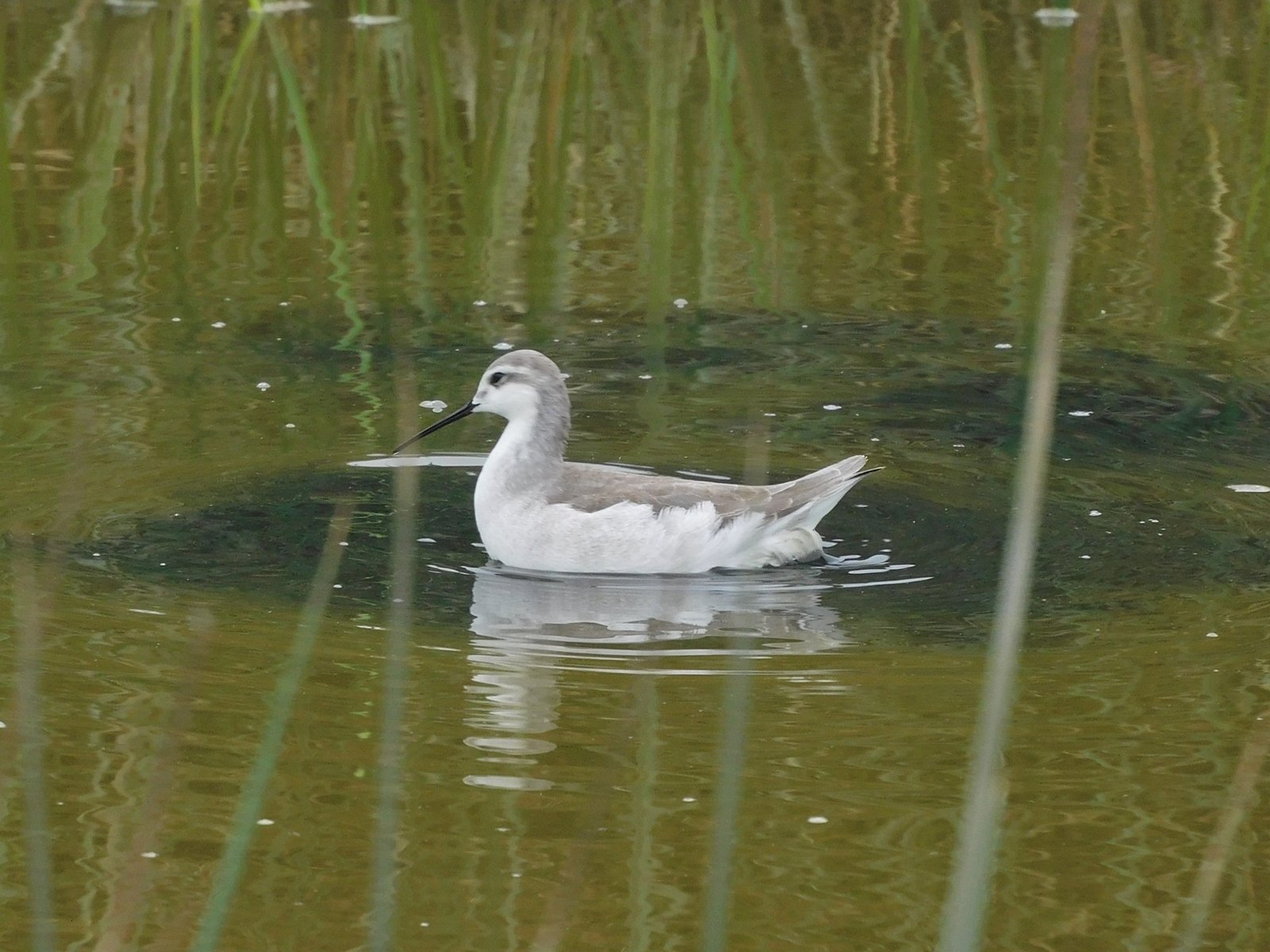
Click a thumbnail to switch the photo above.
Voice
Mostly silent away from the breeding grounds. Occasionally a soft, nasal wurk or vit, mainly in flight.
Recording: Aluisio Ribeiro — CC BY-NC-SA 4.0 · converted to mono · xeno-canto
Identification
22–24 cm. The largest phalarope, with a long, needle-fine, straight black bill and relatively long legs, yellow in winter. In non-breeding plumage, the one most likely in the region, it is plain pale grey above and white below, with a white supercilium and a faint grey line behind the eye, lacking the black eye patch of the other phalaropes. In flight it shows a plain grey wing without a wingbar and a white rump. In breeding plumage the female is brighter than the male, with a black-and-chestnut stripe along the neck and mantle. It swims and spins on the water, but also walks a lot along the shore.
Confusion species
Red-Necked Phalarope Phalaropus lobatus and Red Phalarope Phalaropus fulicarius are smaller, have a black eye patch, a white wingbar and a dark rump, and in the region are found mainly at sea. Marsh Sandpiper Tringa stagnatilis also has a needle-fine bill, but long green legs and a white wedge up the back, and rarely swims. Lesser Yellowlegs Tringa flavipes is longer-legged and browner above.
Habitat
Salt pans, salt-works evaporation ponds, shallow brackish lagoons, sewage works and the shallow margins of dams. It feeds swimming and spinning or walking along the waterline, picking at midge larvae and brine shrimps.
Where the bird is most at home, classified by the vegetation units of southern Africa.

Range and movements
A small number of accepted records in the region, mainly in South Africa (Western Cape and the highveld) and at the Walvis Bay salt works in Namibia. It breeds in western North America and winters in South America, especially on the high-altitude salt lakes of Bolivia, Chile and Argentina; it is also a vagrant to Europe and West Africa.
How and when to look
Check flocks of Marsh Sandpipers, Ruffs and Red-Necked Phalaropes on salt pans and sewage works for a pale grey, needle-billed bird that swims and spins. The lack of a wingbar and the white rump in flight are decisive; photograph the bird in flight.
Conservation status
Not threatened, but heavily dependent on a few major staging sites on migration, such as Mono Lake and the Great Salt Lake in the USA, where water abstraction threatens the habitat. It is of no conservation significance in southern Africa.
Scientific name
Phalaropus tricolor | (Vieillot, 1819)
Vieillot described the species in 1819 as Steganopus tricolor; because it was later moved to another genus, the author and year stand in brackets. The genus Phalaropus was introduced in 1760 by Brisson. Phalaropus comes through French phalarope from Greek phalaris 'coot' and pous 'foot': like coots, phalaropes have lobed toes. tricolor is Latin for 'three-coloured'. The specimen the first description was based on came from Paraguay.