All species › Waders, gulls and terns › Sandpipers and snipes › Common Snipe
Common Snipe | Gallinago gallinago
Watersnip | Agachadiza Común
The Common Snipe is the commonest snipe of Europe and Asia, but in southern Africa it is a great rarity: most European birds winter north of the equator. It is so hard to separate from African Snipe here that some birds probably go unnoticed.
Voice
On flushing a sharp, rasping ketch, often repeated, a little higher and drier than the call of African Snipe. The display with bleating tail feathers is not heard in Africa.
Recording: Stanislas Wroza — CC BY-NC-SA 4.0 · converted to mono · xeno-canto
Identification
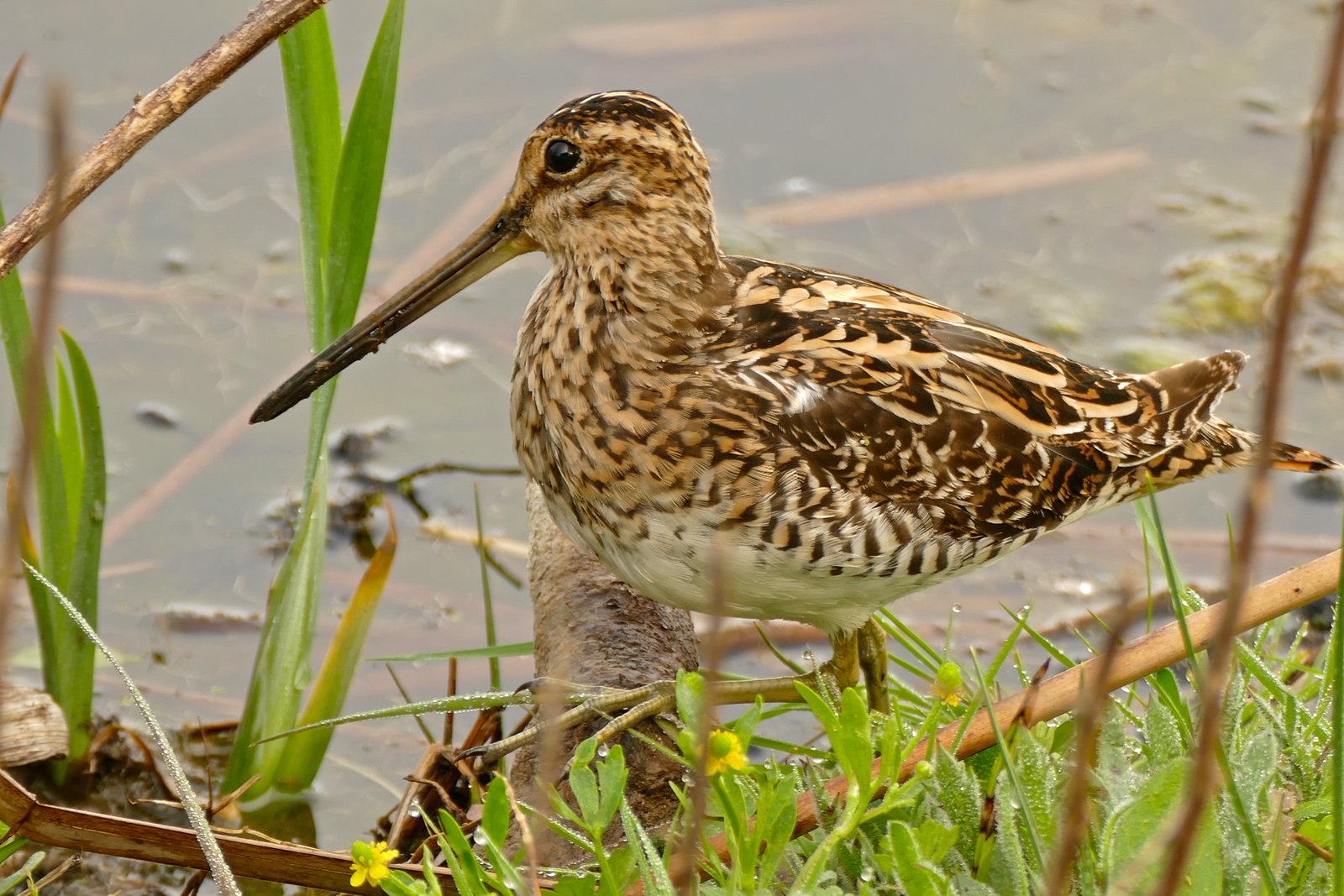
25–27 cm. A snipe with a long, straight bill, slightly shorter than in African Snipe. Head with a pale central crown stripe and supercilia, upperparts dark with sharp golden-buff mantle stripes, breast mottled brown and belly white. In flight the key features are a broad, clear white trailing edge to the secondaries and a pale underwing barred white and grey, with a white panel on the underwing coverts. The tail shows little white on the outer feathers. It flushes high and zigzagging.
Confusion species
African Snipe Gallinago nigripennis has a longer bill, darker wings with a narrower white trailing edge, a darker underwing and more white in the tail; its call is hoarser. Great Snipe Gallinago media is larger and stockier, with a barred belly and white wingbars, and flushes silently and straight. In practice identification requires good photographs of the spread wing and tail.
Habitat
Marsh edges, marshy vleis, flooded grassland and the muddy margins of dams and sewage works, the same places as African Snipe, with which it may occur.
Where the bird is most at home, classified by the vegetation units of southern Africa.

Range and movements
Known from a small number of records in the north of the region, mainly in Zambia and Zimbabwe; elsewhere, including South Africa, an exceptional vagrant. In Africa it winters mainly in the Sahel and East Africa, south to Tanzania and southern Congo. It breeds across much of Europe and northern Asia.
How and when to look
In the southern summer check every flushed snipe in the north of the region: look for the broad white trailing edge to the wing and the pale, barred underwing. Try to photograph the bird on the ground with the tail spread; the number and width of the outer tail feathers is an important feature.
Conservation status
Not threatened and numerous worldwide, although numbers in western Europe are declining through the drainage of wet grassland. It is of no conservation significance in southern Africa.
Scientific name
Gallinago gallinago | (Linnaeus, 1758)
Linnaeus described the species in 1758 as Scolopax Gallinago; because it was later moved to another genus, the author and year stand in brackets. The genus Gallinago was introduced in 1760 by Brisson. Gallinago is New Latin for a snipe, from Latin gallina 'hen' and the suffix -ago 'resembling'. The specific name repeats the genus name. The specimen the first description was based on came from Sweden.