All species › Waders, gulls and terns › Sandpipers and snipes › Asian Dowitcher
Asian Dowitcher | Limnodromus semipalmatus
Aziatische grijze snip | Agujeta Asiática
The Asian Dowitcher is a large, godwit-like wader of the East Asian flyway, breeding in Siberia, Mongolia and Manchuria and wintering from South-East Asia to northern Australia. In southern Africa it is an extremely rare vagrant, known from only one or a few records.
Voice
Little known and mostly silent away from the breeding grounds. Occasionally a soft, plaintive chew-ee or a short, yelping kiow in flight.
Recording: Sébastien Provost - Birding Mont-Saint-Michel — CC BY-NC-SA 4.0 · converted to mono · xeno-canto
Identification
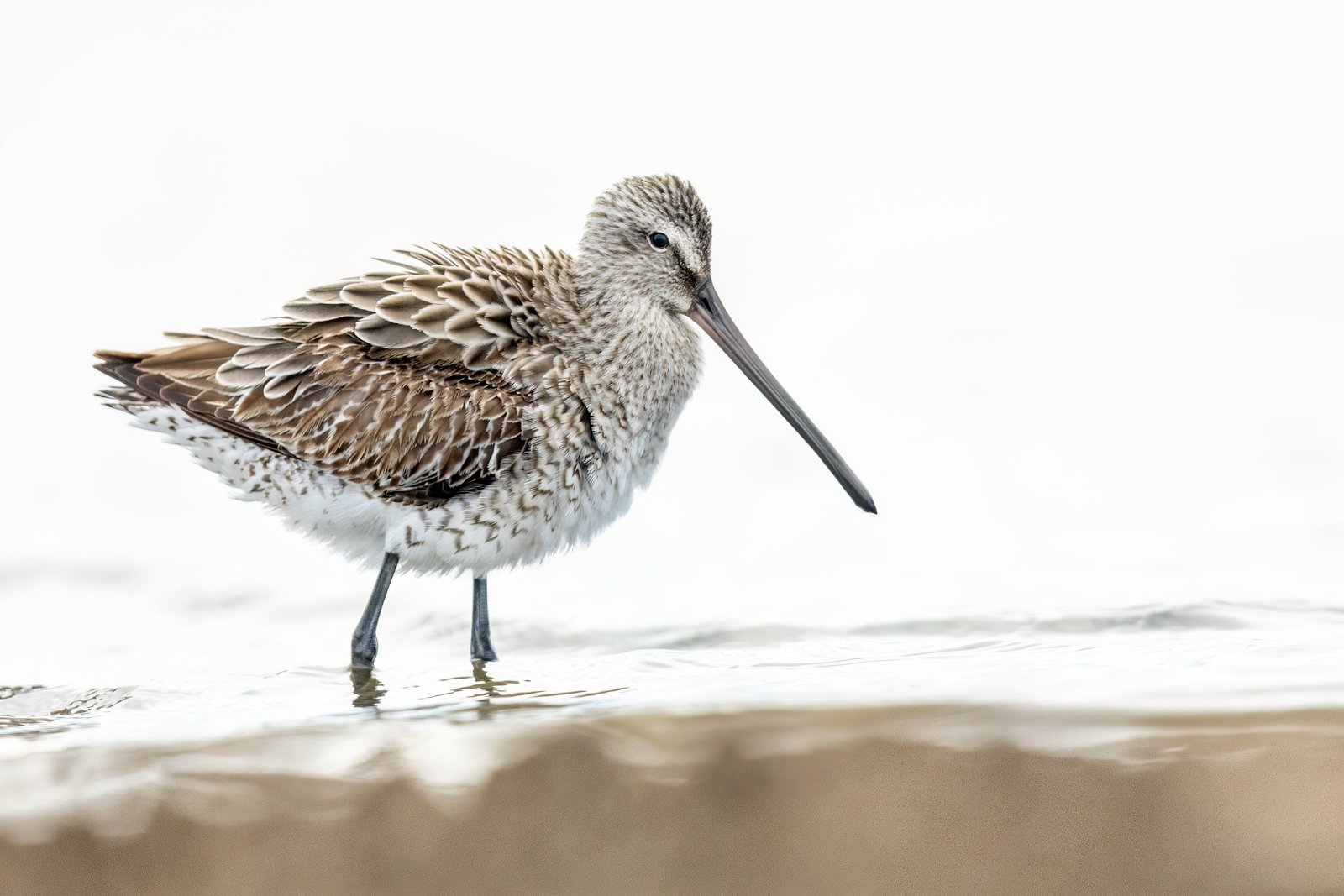
33–36 cm. A grey wader with the build of a small godwit, but with a perfectly straight, all-black bill slightly swollen at the tip. The legs are dark grey to black. In non-breeding plumage it is grey-brown with pale fringes above, whitish below with a grey breast and finely barred flanks, and a clear pale supercilium. In flight it shows a faint pale wingbar, a barred whitish rump and lower back, and a whitish underwing. In breeding plumage the head and underparts are rufous.
Confusion species
Bar-Tailed Godwit Limosa lapponica is larger, with an upturned, two-toned bill with a pink base and longer legs. Black-Tailed Godwit Limosa limosa has a black-and-white wing and tail. Feeding action is the best distinction at range: the Asian Dowitcher probes rapidly and repeatedly straight down like a sewing machine, whereas godwits probe more slowly and deeply.
Habitat
Tidal mudflats, estuaries and coastal lagoons, also salt pans and wet pasture near the coast. It often feeds belly-deep in water among godwits.
Where the bird is most at home, classified by the vegetation units of southern Africa.


Range and movements
An extremely rare vagrant to the region, with only one or a few documented coastal records. It breeds patchily in southern Siberia, Mongolia and north-eastern China and winters mainly in Indonesia and northern Australia; elsewhere in East Africa it is likewise an exceptional vagrant.
How and when to look
In estuaries look for a 'godwit' with a straight, black bill and a sewing-machine feeding action. Photograph the bill and the wing in flight; details of bill shape and rump pattern are needed to have a record accepted.
Conservation status
Near Threatened. The species is declining through the loss of intertidal flats around the Yellow Sea, its key staging area on migration, and through the draining of wetlands on the breeding grounds. It is of no conservation significance in southern Africa.
Scientific name
Limnodromus semipalmatus | (Blyth, 1848)
Blyth described the species in 1848 as Macrorhamphus semipalmatus; because it was later moved to another genus, the author and year stand in brackets. The genus Limnodromus was introduced in 1833 by Wied-Neuwied. Limnodromus is Ancient Greek, from limnē 'marsh' and -dromos '-runner'. semipalmatus is Latin for 'half-webbed', from semi, 'half', and palmatus, 'webbed' — for the small webs between the toes. The specimen the first description was based on came from Calcutta (Kolkata), India.