All species › Waders, gulls and terns › Sandpipers and snipes › Hudsonian Godwit
Hudsonian Godwit | Limosa haemastica
Rode grutto | Aguja Café
The Hudsonian Godwit breeds in northern Canada and Alaska and winters in the far south of South America. In southern Africa it is an exceptional vagrant, usually turning up among flocks of Bar-Tailed Godwits or other large waders. Every sighting merits careful documentation.
Voice
Usually silent away from the breeding grounds. In flight it sometimes gives a high, doubled kwee-weet or a single kweet, higher than the calls of Black-Tailed Godwit.
Recording: Avery Bartels — CC BY-NC-SA 4.0 · converted to mono · xeno-canto
Identification
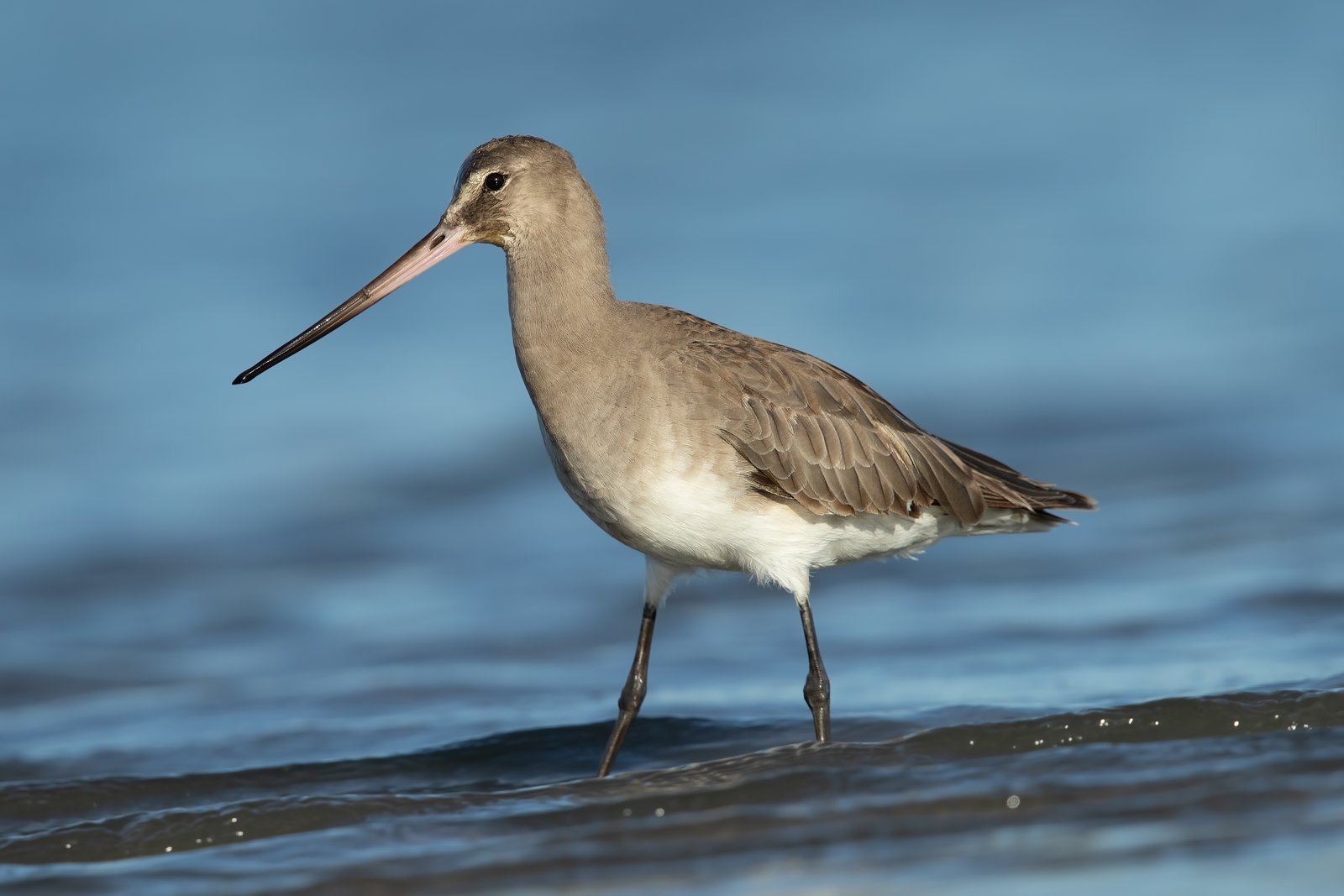
37–42 cm. A slender godwit with a long, slightly upturned bill, pink at the base and dark at the tip. In non-breeding plumage, the one most likely in the region, it is plain grey-brown above and paler grey below, with a narrow white supercilium. The best feature is the underwing: the underwing coverts and axillaries are black, giving a dark 'armpit' reaching halfway along the wing in flight. Above it shows a narrow white wingbar, a white rump and a black tail. In breeding plumage the underparts are deep chestnut with fine barring.
Confusion species
Black-Tailed Godwit Limosa limosa has a similar pattern of white rump, black tail and white wingbar, but the wingbar is broader and the underwing is white, not black; the bill is also straighter and the legs longer. Bar-Tailed Godwit Limosa lapponica lacks the broad wingbar, has a barred tail and a white wedge up the back, and is streaked rather than plain above.
Habitat
Estuaries, tidal mudflats and lagoons, also shallow salt pans and sewage works near the coast. It forages wading in shallow water, probing deep into the mud with the head sometimes fully submerged.
Where the bird is most at home, classified by the vegetation units of southern Africa.


Range and movements
Only a handful of accepted records in the region, nearly all on the coast of South Africa. It breeds in subarctic Canada and Alaska and migrates across the Atlantic and the interior of North America to Argentina and Chile; elsewhere in the Old World it is also an exceptional vagrant.
How and when to look
Check flocks of Bar-tailed and Black-Tailed Godwits in estuaries for a bird with plain grey upperparts, and wait for it to fly or stretch its wings: the black underwing is decisive. Photographs of the spread wing are almost essential for acceptance by a rarities committee.
Conservation status
Vulnerable. The world population is small and concentrated at a few staging sites on migration and in the wintering range, which makes the species sensitive to habitat loss, disturbance and climate change on the breeding grounds. In southern Africa the species plays no role in conservation.
Scientific name
Limosa haemastica | (Linnaeus, 1758)
Linnaeus described the species in 1758 as Scolopax Haemastica; because it was later moved to another genus, the author and year stand in brackets. The genus Limosa was introduced in 1760 by Brisson. Limosa is Latin for 'muddy', from limus 'mud'. haemastica comes from the Greek haimatikos, 'blood-red' — for the deep chestnut-red underparts in breeding plumage. The specimen the first description was based on came from Hudson Bay, Canada.