All species › Passerines › Swallows and martins › Wire-Tailed Swallow
Wire-Tailed Swallow | Hirundo smithii
Roodkruinzwaluw | Golondrina Colilarga
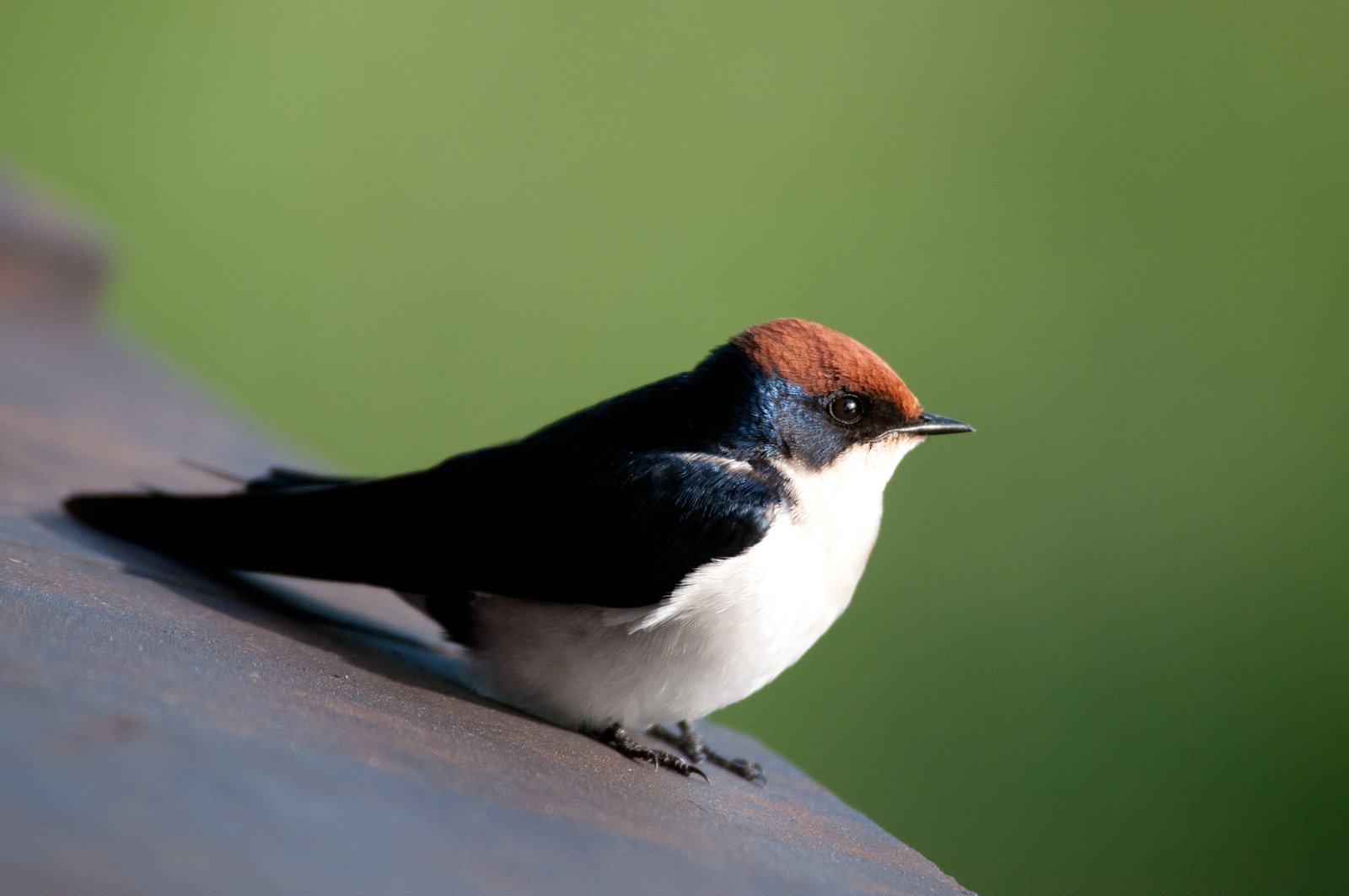
The Wire-Tailed Swallow is a small, crisp blue-and-white swallow with a rufous crown and two wire-thin tail streamers. It is a resident of rivers and dams in the warm north and east of the region and likes to breed under bridges.
Voice
A sharp, repeated chik-chik or chirrik, and a chattering, twittering song, often from a wire or a branch over water.
Recording: Bram Piot — CC BY-NC-SA 4.0 · shortened to the first 60 s, mono · xeno-canto
Identification
13–17 cm including the tail wires. The upperparts are glossy dark steel-blue, the crown and forehead bright rufous. The underside is gleaming white, with a narrow blue-black band across the undertail coverts that shows in flight as a dark undertail. The tail is almost square-cut, with a row of white spots, and the outer feathers end in very thin, long wires that are shorter in the female. The underwing coverts are white. Juveniles are duller, with a brown crown and no wires. The flight is very fast and agile, low over water.
Confusion species
Pearl-Breasted Swallow Hirundo dimidiata has a blue crown, no tail wires and no white tail spots. White-Throated Swallow Hirundo albigularis has only a rufous forehead, a blue crown and a clear black breast band. Barn Swallow Hirundo rustica has a rufous throat and a black breast band, and broader streamers. Grey-Rumped Swallow Pseudhirundo griseopyga has a grey-brown crown and a grey rump. Without visible wires, the rufous crown and the white underside with a dark undertail band are decisive.
Habitat
Rivers, streams, dams, lakes and irrigation canals in savanna and woodland, often also in villages and camps near water. It builds an open mud nest bowl against a vertical face under an overhang, such as under bridges, in culverts, on pillars, on rock faces and on buildings close to water. It hunts small flying insects low over the water and likes to perch on dead branches and wires.
Where the bird is most at home, classified by the vegetation units of southern Africa.


Range and movements
In the warmer north and east of the region: Angola, Zambia, Malawi, Mozambique, Zimbabwe, northern Botswana (Okavango, Chobe, Limpopo valley), northern Namibia (Kunene, Kavango and Zambezi regions) and in South Africa in Limpopo, Mpumalanga, eastern North West, KwaZulu-Natal and along the Orange River in the Northern Cape; it has spread south into the Eastern Cape. Beyond the region in much of sub-Saharan Africa and in southern and south-eastern Asia.
- Resident
- Summer visitor (c. Oct–Mar)
- Winter visitor (c. Apr–Sep)
- Passage (Mar–Apr, Oct–Nov)
- dark = core range, pale = thinly spread
How and when to look
Check low bridges over rivers in the Kruger National Park, along the Zambezi or in the Okavango; pairs often sit on the bridge railing or a nearby wire. The tail wires are barely visible in flight; look for the rufous cap and the gleaming white underside.
Conservation status
Not threatened and common. It has benefited from bridges, dams and buildings near water, which has allowed its range in South Africa to expand southwards.
Scientific name
Hirundo smithii | Leach, 1818
Leach described the species in 1818 and placed it straight away in the genus where it still stands. The genus Hirundo was introduced in 1758 by Linnaeus. Hirundo is the ordinary Latin word for 'swallow'. smithii honours the Norwegian botanist and physician Christen Smith (1785–1816), who died on the British Congo expedition led by James Tuckey. The specimen the first description was based on came from Chisalla Island in the Congo River.