All species › Even-toed ungulates › Bovids › Abruzzo Chamois
Abruzzo Chamois | Rupicapra pyrenaica
Pyrenese gems | Gamuza De Los Abruzzos
Rupicapra pyrenaica, known as the Abruzzo chamois or Pyrenean chamois, is the chamois of the Pyrenees, the Cantabrian Mountains and the Apennines. The species consists of three separate populations, recognised as subspecies: pyrenaica in the Pyrenees, parva in the Cantabrian Mountains and ornata, the Abruzzo chamois in the strict sense, in the central Apennines. It nowhere overlaps with the chamois (R. rupicapra) of the Alps and the Carpathians.

Tracks
The track is two-toed, 5 to 6 cm long, with the halves spread apart and a hard rim; the toes spread on steep ground. In snow the trails cross snowfields diagonally from ledge to ledge. The droppings are black pellets in loose heaps on ledges, not separable with certainty from those of ibex and goat. Resting places are scraped hollows under overhanging rocks with droppings and hair. The clearest sign is the alarm whistle, a sharp, high blast through the nose.
Identification
A small, slender goat-antelope with a head-body length of about 100 to 130 cm, a shoulder height of 70 to 80 cm and a weight of 22 to 30 kg, smaller and more lightly built than the chamois. The summer coat is cinnamon to fawn. The winter coat is dark brown to blackish on the flanks, with pale patches on throat, shoulder and flank that are largest in the Abruzzo form, where they also appear on the rump. The head is pale, with a dark brown band from the muzzle through the eye; chest and forelegs are dark. Both sexes carry thin black hooked horns up to about 20 cm; in the male they are thicker at the base and more sharply hooked.
Similar species
The chamois (R. rupicapra) is larger, has an almost black winter coat without pale patches on throat and shoulder, and lives in the Alps, the Jura, the Carpathians and the Balkans; where a chamois is seen, the mountain range decides the species. The Spanish ibex is much more robust, has no facial pattern and, in the male, heavy backward-curving horns. Free-ranging domestic goats and the mouflon, with curled horns and a pale saddle patch, are other possible confusions at a distance.
Habitat
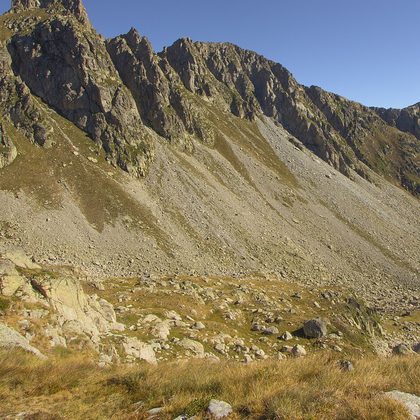
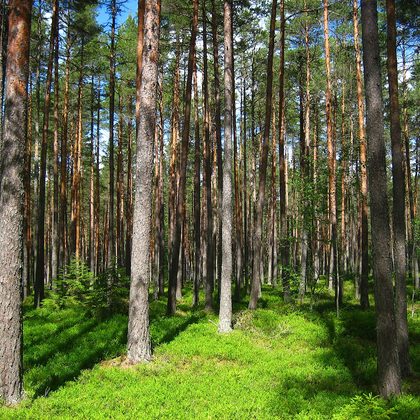
Alpine grassland, scree, cliffs and grassy strips between rock bands in summer; in winter beech, pine and silver fir forest and sunny, steep slopes where the snow is blown clear. In the Pyrenees the species lives between 1,000 and 2,800 m, in the Cantabrian Mountains between 400 and 2,400 m.
Where the animal is most at home, classified with EUNIS — the European standard for habitats.




Distribution
In the Pyrenees the subspecies pyrenaica occurs in Spain, France and Andorra. In the Cantabrian Mountains lives parva, from Galicia to the Sierra de Híjar. The Abruzzo chamois (ornata) survived in the early twentieth century only in the area of the Abruzzo National Park; through reintroductions it now lives in five populations totalling more than 3,000 animals, including the Majella, where 40 animals released between 1991 and 2006 had grown to more than 1,400 by 2021. In 2022 the total population of the species was estimated at about 50,000 mature animals.
- Native
- dark = core range, pale = thinly spread
Way of life
The chamois is active by day. Females, kids and young animals live in groups; old males live alone for much of the year. In summer the food consists of alpine grasses and herbs, in winter of twigs, buds, needles and dry grass. The animals move up and down with the seasons. The rut falls in November and December. After a gestation of about twenty weeks a single kid is born in May or June and follows its mother within a few days.
Where and when to look
Early in the morning scan the grassy strips between the rock bands with a telescope. Suitable areas are Ordesa y Monte Perdido and Aigüestortes National Parks in the Pyrenees, the Picos de Europa and Somiedo in the Cantabrian Mountains, and the Abruzzo National Park and the Majella in the Apennines. Do not walk above a group, and listen for the alarm whistle, which is often the first sign of chamois.
Conservation status
Least Concern (LC, 2021); the Abruzzo chamois is Vulnerable (VU) as a subspecies, after being assessed as Endangered in 1996. All three populations recovered in the twentieth century after being reduced to a few nuclei. Diseases cause heavy local mortality: outbreaks of a pestivirus in the Catalan Pyrenees since 2001, sarcoptic mange in the Cantabrian Mountains, and infectious keratoconjunctivitis in the Pyrenees. In Spain and France the species is hunted under quotas; in Italy the Abruzzo chamois is strictly protected.
Scientific name
Rupicapra pyrenaica | Bonaparte, 1845
Bonaparte described the species in 1845 and placed it straight away in the genus where it still stands. Rupicapra is Latin, from rupes, 'rock', and capra, 'goat': the rock goat. pyrenaica is Latin for 'of the Pyrenees'. The specimen the first description was based on came from Pyrenees.