All species › Carnivores › Dogs, wolves and foxes › African Golden Wolf
African Golden Wolf | Canis lupaster
Canis lupaster | Canis lupaster
Canis lupaster was described in 1832 by Hemprich and Ehrenberg from the Fayum in Egypt, but for a century and a half it was treated as a subspecies of the Golden Jackal. Genetic work since 2011 has shown that the African 'golden jackals' form a species of their own, closer to the Grey Wolf than to the Eurasian jackal. Within the guide area it lives in North Africa, from Morocco to Egypt. It is also called African Wolf or African Golden Wolf.
Tracks
No descriptions of track, trail or scat specific to this species were found in the sources consulted. The print is a canid print with four toes and claw marks, intermediate in size between Red Fox and Grey Wolf. In the related Golden Jackal the pads of the two middle toes are often fused at the base, but this shows only in a perfect print. A print or scat does not separate the species from a dog; DNA from scat or hair is the usual route, and much of the current knowledge of its North African distribution was gathered that way.
Identification
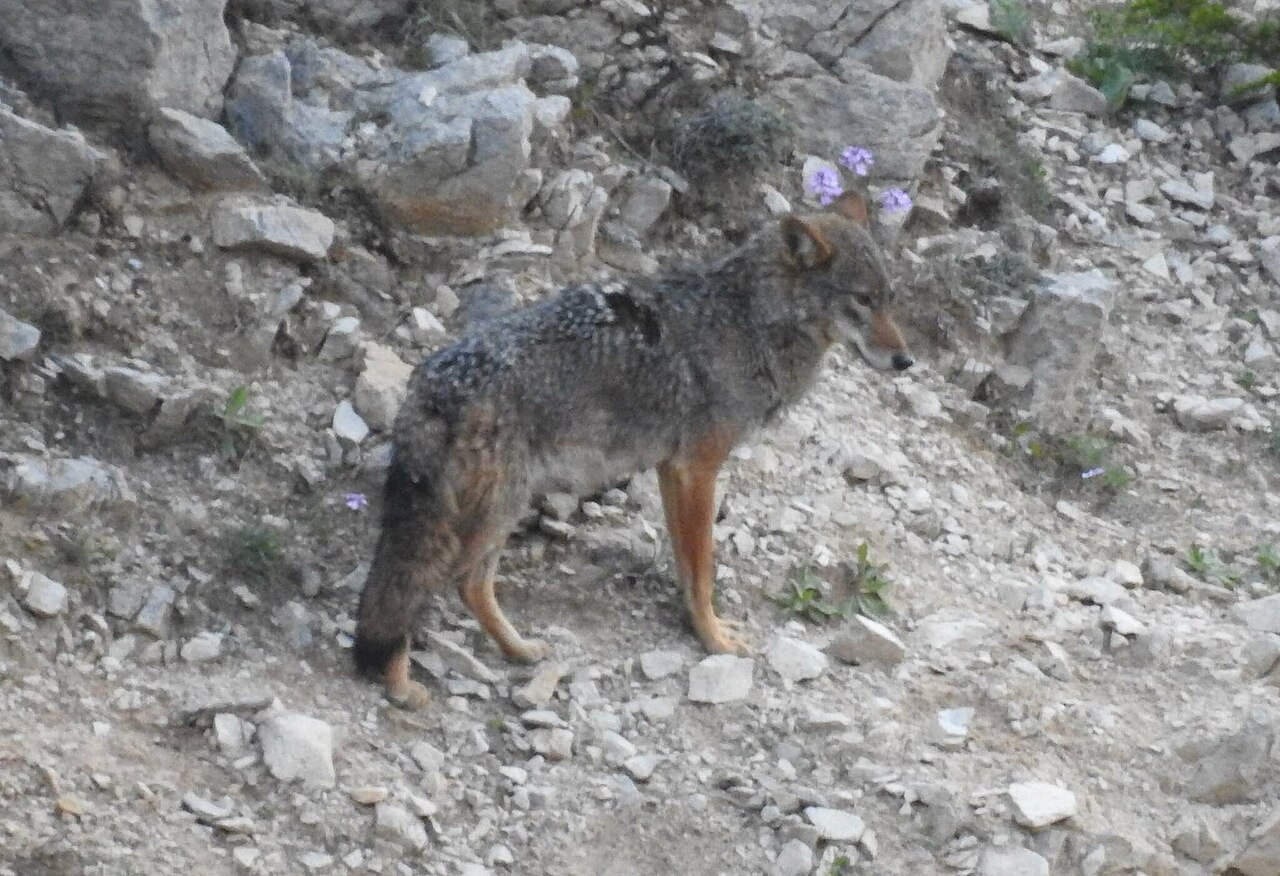
A medium-sized canid with a wolf-like build: larger than the African jackals of the genus Lupulella and smaller than the smallest Grey Wolves. Camera-trap images from Morocco show a large-framed animal with a heavy neck and a robust body. The holotype has a ginger head with a grizzled forehead and ears and a dark dorsal ruff of black-tipped hairs from the neck to the tail. No summary figures for external measurements were found in the sources consulted; the characters that separate it from the Golden Jackal lie in the skull: a longer, narrower palate, a smaller interorbital breadth and a mediolaterally flatter upper canine.
Similar species
The Golden Jackal (Canis aureus) is hardly separable by appearance; the two were kept under one name until 2015 because skull and teeth are very similar. Within the guide area they barely overlap: the Golden Jackal lives in Europe, Turkey and the Levant, Canis lupaster in North Africa. Where both might occur near Sinai and the Nile Delta, only DNA decides. The Red Fox is smaller and shorter-legged, with black backs to the ears and usually a white tail tip. Feral and free-ranging dogs occur in the same areas and are a real source of confusion at a distance and on camera-trap images.
Habitat
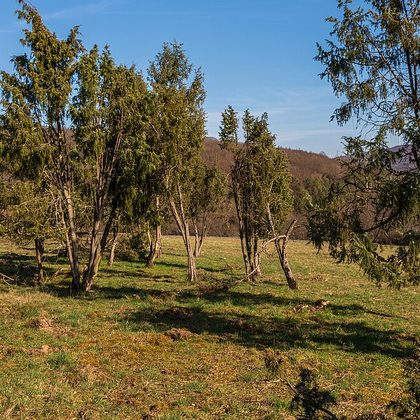
According to the 2017 redescription, accounts of the 'Golden Jackal' in Africa from before the split refer to this species. They mention semi-desert, grassland and savanna, up to 3800 m in Ethiopia. In the north of the range it occupies dry open country, scrub and mountains; in Morocco it has been recorded in the Middle Atlas. Settlements are visited at night for refuse.
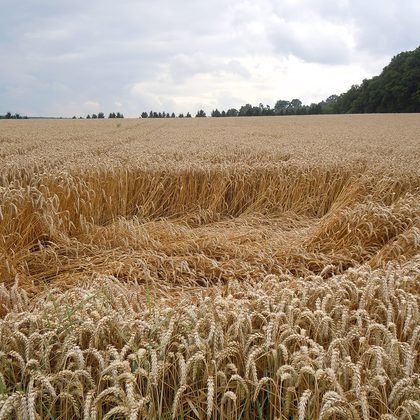
Where the animal is most at home, classified with EUNIS — the European standard for habitats.



Distribution
North, West and East Africa. A 2012 study found the species over more than 6000 km, from Senegal and Morocco to Egypt and Ethiopia. Within the guide area records come from Algeria, Morocco, Tunisia and Egypt; in GBIF most recent records are from Algeria. Whether and where it meets the range of the Golden Jackal around Sinai and the Nile Delta has not been resolved.
- Native
- dark = core range, pale = thinly spread
Way of life
What follows comes from African studies published under the name Golden Jackal which, according to the redescription, refer to this species. It is mainly nocturnal but with a flexible rhythm. The basic unit is a pair, sometimes with offspring from earlier years that act as helpers and provision the pups; pairs in Tanzania stayed together long-term and jointly defended a territory. The diet is varied: rodents, lizards, snakes, birds, hares, gazelle fawns and plant material. Gestation is about 63 days; in Tanzania litters averaged five to seven pups, with a range of one to eight. The species does not hibernate.
Where and when to look
In the guide area the best places to look are the mountains and steppes of North Africa, at dusk and at night. A camera trap along a track or at a water point yields more than searching by sight. Because the species cannot be separated with certainty from a dog or a Golden Jackal in the field, a record gains value with a photograph and, where possible, a scat sample for DNA analysis.
Conservation status
Least Concern (LC, 2019). The taxonomy is recent: in 2011 the Egyptian 'jackal' was recognised as a separate wolf-like lineage; in 2015 genome-wide data showed that African and Eurasian golden jackals are distinct species, separated for 1.0 to 1.7 million years, and the authors used the name Canis anthus. In 2017 anthus was assessed as a nomen dubium and lupaster took priority. Few data are available on numbers and trends in North Africa.
Scientific name
Canis lupaster | Hemprich & Ehrenberg in Ehrenberg, 1833
Hemprich & Ehrenberg in Ehrenberg described the species in 1833 and placed it straight away in the genus where it still stands. Canis is the Latin word for 'dog'. lupaster is Latin lupus, 'wolf', with the suffix -aster, which expresses an incomplete likeness: something like 'would-be wolf'. The specimen the first description was based on came from Egypt, Fayum.