All species › Carnivores › Mustelids › American mink
American mink | Neogale vison
Amerikaanse nerts | Neovison vison
The American mink is a mustelid of riverbanks and shores from North America. Within the area of this guide it is an introduced species: all populations derive from animals imported for fur farming since the early twentieth century that escaped or were released. It now lives across most of northern, western and central Europe and overlaps with the related European mink in Spain, France and Estonia.

Tracks
The track has five toes and is 2.5 to 4 cm long and 3 to 3.5 cm wide; the claws usually register. Tracks of American and European mink are in practice indistinguishable. The usual gait is bounding. The scat is 6 to 8 cm long and about 1 cm thick, long and twisted with tapered ends, greenish, black or brown, and often contains fish scales, bones, feathers, hair or crustacean shell. It has a sharp smell, likened to burnt rubber and rotting meat. The American mink deposits its scats openly on stones, roots and other raised points along the bank and forms latrines; the European mink hides them in dense bankside vegetation. Mink rafts are used for monitoring and trapping: floating platforms with a layer of clay or wet sand in which tracks are left. The den lies in the bank, under tree roots, among rocks or in a disused muskrat or beaver burrow.
Identification
An elongated, short-legged mustelid with a glossy dark brown to almost black coat and a tail about half the head-body length. Head-body 33 to 43 cm in males and 30 to 40 cm in females, tail 15 to 20 cm. Males are about 10% longer and twice as heavy as females: 850 to 1805 g against 450 to 840 g. White is usually confined to the lower lip and chin, often with scattered white spots on the throat and chest. Small round ears, short muzzle. It swims and dives.
Similar species
The European mink is the closest relative and overlaps in northern Spain, south-western France and on Hiiumaa. It is smaller, with a tail shorter than half the head-body length, and has white on the upper lip as well as the chin. Because American mink can also have a white upper lip, a certain identification is often possible only with an animal in the hand or with DNA. The European polecat has pale underfur showing through the dark guard hairs on the flanks and a white mask between eye and ear; the mink is uniformly dark. The otter is much larger (head-body 57 to 95 cm, 7 to 12 kg), with a broad, flat head, a thick tapering tail and webbed feet.
Habitat
Banks of streams, rivers, lakes and ponds, marshes, reedbeds and swamp woodland, and on the coast beaches, rocky shores and island archipelagos. Females prefer small streams, males larger waters. Cover in the form of bankside vegetation, rocks or tree roots determines whether a bank is used.
Where the animal is most at home, classified with EUNIS — the European standard for habitats.

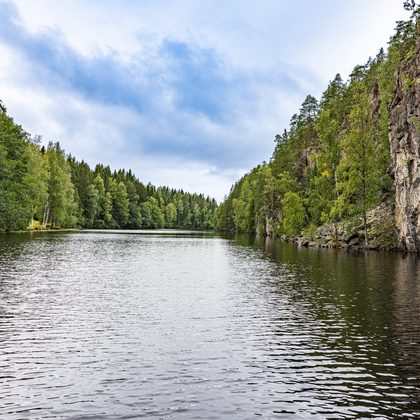

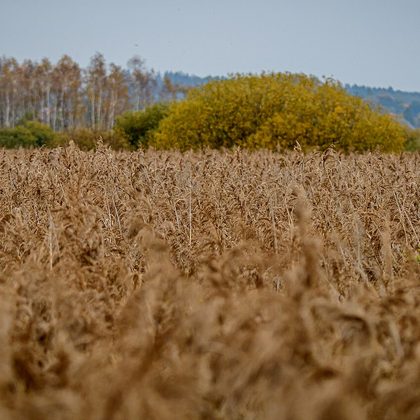


Distribution
Native to North America (Canada and the United States). Within the area of this guide all populations derive from fur farming. The Handbook of the Mammals of the World lists feral populations in Belarus, Belgium, the Czech Republic, Denmark, Estonia, Finland, France, Germany, Great Britain, Iceland, Ireland, Italy, Latvia, Lithuania, the Netherlands, Norway, Poland, Portugal, Russia, Spain and Sweden. A 2007 review (Bonesi & Palazón) covering 28 European countries found that farming is concentrated in the north but the species is widely distributed across Europe, and that in some countries it is declining for reasons that are mostly unknown. In the Outer Hebrides mink arrived with fur farms in the 1950s; feral animals were recorded on Lewis by 1969. In Spain the species is spreading rapidly, including into the range of the European mink.
- Established introduction
- dark = core range, pale = thinly spread
Way of life
Mainly nocturnal, with frequent periods of daytime activity, especially at dusk and dawn. Solitary outside the breeding season. Females have home ranges of about 8 to 20 ha, males larger ones of up to 800 ha; daily movements average under 5 km. The diet consists of small mammals, fish, birds, eggs, amphibians, reptiles and invertebrates such as crustaceans, molluscs, insects and earthworms. On European rivers the diet was about 30% mammals, 27% fish and 17% amphibians; on lakes 33% birds and 28% fish. Mating February to April; after a gestation averaging 51 days a single annual litter of two to ten young, five on average, is born. The eyes open at five weeks, the young are weaned at five to six weeks and leave the mother in autumn. Both sexes reach sexual maturity at about ten months.
Where and when to look
Search the bank for scats on stones and roots and for tracks in mud and sand under overhanging banks. A mink raft with a clay pad shows within a few days whether a mink is passing. A dark mustelid running along a stream or rocky shore by day and disappearing into the water is, across most of the area of this guide, an American mink; in northern Spain, south-western France and on Hiiumaa the head must be checked for a white upper lip.
Conservation status
Least Concern (LC, 2016) globally. Within the area of this guide it is an invasive introduced species. Documented effects concern ground-nesting birds, rodents, amphibians and other mustelids. In Britain predation by mink is considered a cause of the steep decline of the water vole. On islands and in coastal archipelagos it affects colonies of seabirds and other ground-nesting birds, at times killing more prey than it eats. The European mink is displaced from its territories by the larger species. In the Outer Hebrides an eradication project has run since 2001: from the Uists and Benbecula (2001–2006) it was extended to Lewis and Harris (2013); in 2016 seven animals were caught there, and terns and other ground-nesting birds have since occupied more breeding sites. On the Estonian island of Hiiumaa the American mink has been eradicated, after which European mink were released. Under Commission Implementing Regulation (EU) 2025/1422 of 17 July 2025 the species was added to the list of invasive alien species of Union concern (Regulation 1143/2014); the obligations take effect for this species on 7 August 2027, two years later than for most other species added by that regulation (only the North American Beaver received the same deferral), so that member states with mink farms can put measures in place.
Scientific name
Neogale vison | (von Schreber, 1777) (GBIF: Mustela vison)
Von Schreber described the species in 1777 as Mustela vison; because it was later moved to another genus, the author and year stand in brackets. Neogale is Greek, from neos, 'new', and galē, 'weasel'; the genus holds the weasels of the New World. vison is the French name of the mink, taken over undeclined by von Schreber; the word goes back to late Latin vissio, 'stench', after the sharp smell of the anal glands. The specimen the first description was based on came from Canada.