All species › Rodents › Mice and rats › Baluchistan Gerbil
Baluchistan Gerbil | Gerbillus nanus
Gerbillus nanus | Gerbillus nanus
The Baluchistan Gerbil (Gerbillus nanus) is a medium-sized gerbil of salt flats and sand deserts between Sinai and the Indus. What was formerly treated as a single species from Morocco to Pakistan has been split in two on the basis of DNA studies: the North African animals are now called Gerbillus amoenus. In the west of its range G. nanus occurs in Sinai, the Negev, the Arava and Jordan.

Tracks
The burrow lies under a shrub. The tunnels are fairly extensive for a gerbil, about 1.5 m long and up to 75 cm deep, and the entrance lies almost always in the shade of a low shrub, often among halophytes such as Nitraria. A small fan of excavated sand lies at the entrance. In fine sand the trail is visible: paired prints just over 1 cm long, four toes on the fore foot and five on the hind foot, in a series of bounds with untrodden sand between them and sometimes a thin tail line. On hard silt or clay pans no tracks remain and only the burrow can be found. Droppings are black, spindle-shaped and 2 to 3 mm long. Feeding signs consist of chaff and empty seed husks of grasses and Medicago, usually heaped under the shrub where the animal has fed; green buds are clipped off obliquely. While foraging the animal shelters in any small hole along the way, so a series of small unoccupied scrapes along a row of shrubs is also part of the signs. As with all gerbils, pellets of Barn Owl and Eagle Owl are the quickest way to establish the species composition of a desert area.
Identification
A gerbil of medium size, head-body 72 to 110 mm, with a tail about a fifth longer, and a long, soft coat in which scattered white hairs are mixed through the brownish grey of the back, giving the back a faintly frosted appearance. The belly is white. White spots are present above the eyes and behind the ears. The tail is long and densely haired and ends in a well-developed tuft of long grey hairs; this tuft is the best field character. The soles are naked, the hind foot is 19 to 30 mm long, and the ears are small to medium (7 to 14 mm). Weight 14 to 29 g.
Similar species
The gerbils of the Levant closely resemble each other and often cannot be identified with certainty in the field; certainty requires skull measurements and chromosomes. There are nonetheless useful pointers. Gerbillus henleyi is much smaller, half the weight, and has a thin tail pencil rather than a true tuft. Wagner's Gerbil (Gerbillus dasyurus) is the gerbil of stone (rocky slopes, scree and walls), whereas G. nanus inhabits sand, silt and salt flats; habitat often separates them better than appearance. Gerbillus andersoni of the coastal dunes has haired soles, a difference immediately visible on a trapped animal but seldom on a photograph. Sundevall's Jird (Meriones crassus), which inhabits the same deserts, is two to five times as heavy, more robustly built and has partly haired soles. A House Mouse lacks the tail tuft, the white face spots and the long hind foot.
Habitat
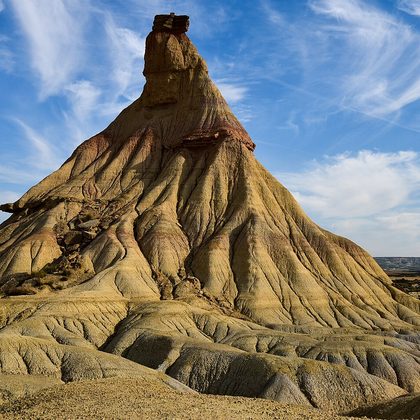
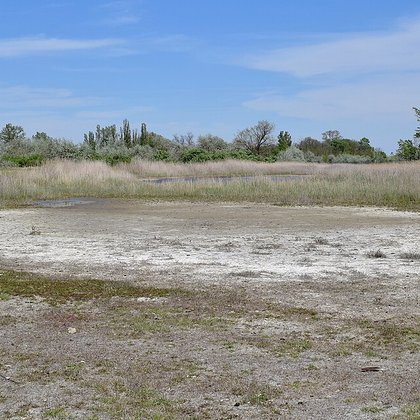
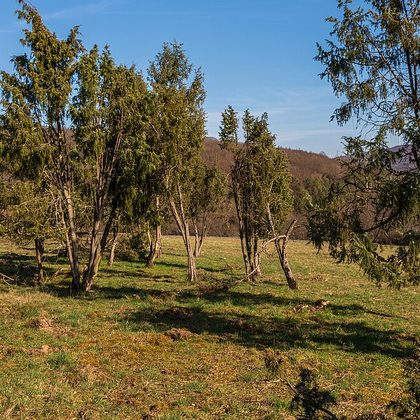
Salt flats, semi-desert and sand desert, with a preference for sandy or silty soil over rock. In Israel the species has been found among shrubs of Nitraria retusa and in the low vegetation of salt flats; also in wadis with some perennial vegetation, on uncultivated clay pans and in gravelly semi-desert. In the east of the range the picture differs: in Balochistan the species lives mainly on stony ground with hard soil. From sea level to about 1000 m.
Where the animal is most at home, classified with EUNIS — the European standard for habitats.

Distribution
The nominate form occurs from Sinai through Israel and Jordan, Iraq and Iran to Afghanistan, Pakistan and north-western India; in addition there are forms on the Arabian Peninsula, in Yemen and on the Batinah coast of Oman. The western part of the range comprises Sinai, the Negev, the Arava and adjacent Jordan. This picture has recently changed: molecular work revealed two widely separated clades, an eastern one from Israel to Pakistan and a western one in Mali, Mauritania and Libya. The western animals are now called Gerbillus amoenus, so that North African localities on older maps no longer belong to this species. Whether G. garamantis is an older name for that western group has not been established. The species does not occur in Europe.
- Native
- dark = core range, pale = thinly spread
Way of life
Crepuscular and nocturnal, with most activity at the beginning and end of the night and a quiet period in between. Entirely ground-living. It eats seeds and buds of grasses and seeds of Medicago, and does not drink: moisture from food and from its own metabolism is sufficient. At night it moves far from the burrow and shelters in any available hole along the way. The species is not colonial and lives solitarily or at most in loose groups. Little is known about breeding: two pregnant females in Oman carried two and five embryos, and in Rajasthan breeding falls between December and June, with litters of two to three young. Gestation is about 20 days; the young are born naked and blind, open their eyes at ten days and are weaned at twenty days. There is no hibernation or winter dormancy.
Where and when to look
After sunset go to a salt flat or a sandy wadi floor with low shrubs and search at first dark: the first activity peak falls early in the night, and around midnight activity is low. In the Arava and the Negev the Nitraria salt flats are known sites. Use a red lamp and sit still; gerbils come close to a seated observer. By day, search the base of shrubs for burrow entrances with a fresh fan of sand, and the sand between them for series of bound tracks. Without the animal in the hand a gerbil in the Levant can often be identified only to the genus Gerbillus, and even in the hand not always further.
Conservation status
Least Concern (LC, 2016), with a caveat stated by the Red List itself: the assessment still covers the old, much broader species concept, and a reassessment is needed now that the North African animals have been split off. On the Arabian Peninsula the species appears common. In the east of the range, on the Indus plain, the expansion of irrigated agriculture is a threat. In Sinai and the Negev it forms an edge population, where the main threat is not farming but the paving and building-over of the desert margin, and where no counts are made.
Scientific name
Gerbillus nanus | Blanford, 1875
Blanford described the species in 1875 and placed it straight away in the genus where it still stands. Gerbillus is a diminutive of gerbo, the old name of the jerboa, from Arabic yarbūʿ: the jerboa's little cousin. nanus is Latin for 'dwarf', borrowed from Greek nanos, after the animal's small size. The specimen the first description was based on came from Pakistan, Balochistan.