All species › Bats › Vesper bats › Barbastelle bat
Barbastelle bat | Barbastella barbastellus
Mopsvleermuis | Barbastela
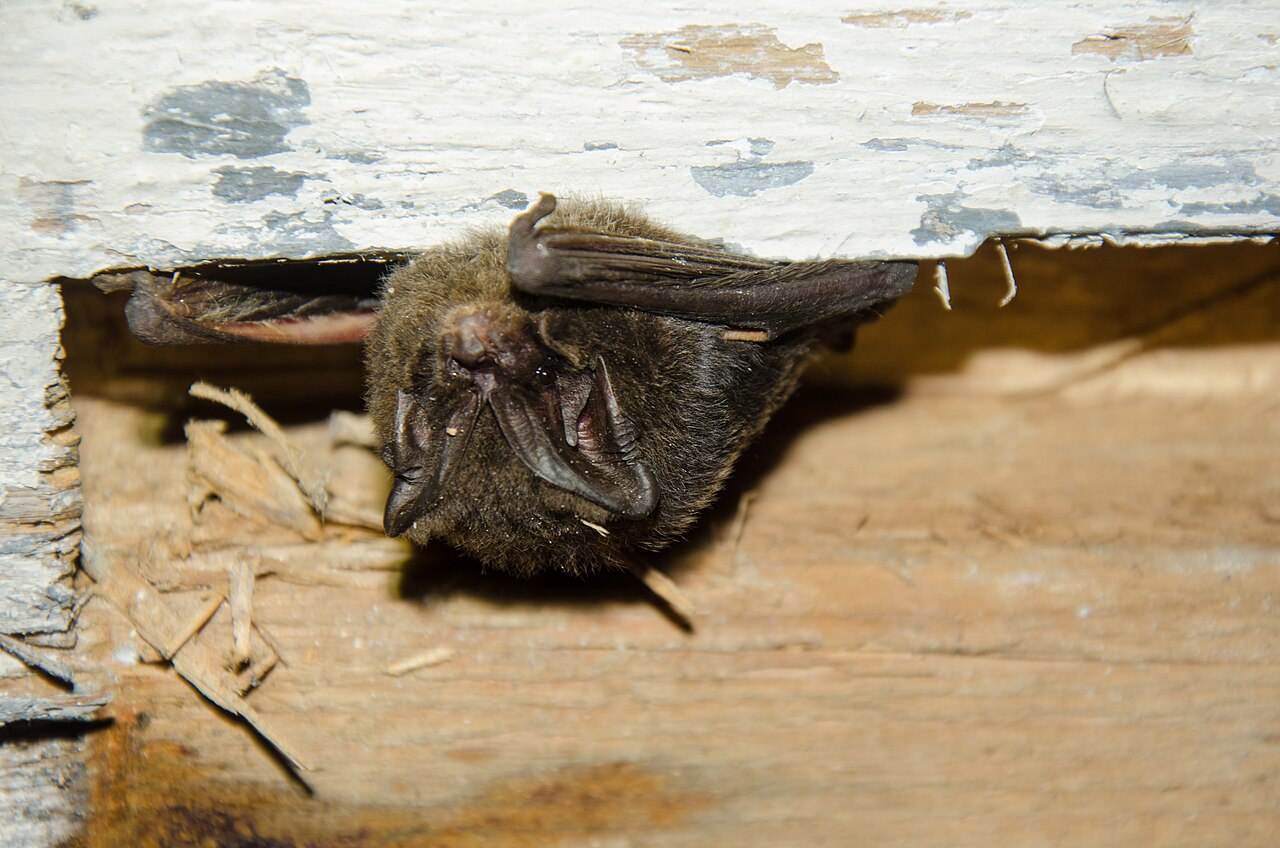
The Barbastelle is a medium-sized woodland bat with a flat, blunt snout and broad ears that meet on top of the head. Forearm 35 to 43 mm, weight 5 to 14 grams. The species is tied to old woodland with plenty of dead wood: summer roosts are mainly gaps behind loose bark, which last only a few years, and a colony changes tree almost daily. The genus Barbastella is represented in Europe by this species only. It is listed as Near Threatened on the global Red List.
Tracks
In summer the bats roost behind loose bark of dead or dying trees (oak, beech, spruce, old pine), in splits and cracks in trunks, in tree holes, and sometimes behind shutters and cladding of old buildings. A colony may use up to thirty trees in a small patch of woodland in one summer. Because roosts change so often, piles of droppings are seldom found. In winter Barbastelles hang or sit singly or in small groups in crevices near the entrances of caves, mines, bunkers and cellars, where it is cold (mostly 2 to 5 °C) and dry; groups of over 1000 have been counted in France and over 7000 in Slovakia and Poland. On a bat detector the call sequence sounds like an alternation of loud and soft ticks.
Identification
A dark bat with long, silky, blackish-brown fur with white or yellowish-golden tips, giving a frosted look; juveniles are darker still. The skin is dark brown to grey. The head is the key character: short, broad, trapezium-shaped ears that face forward and meet along their inner edges over the top of the head, with a distinctive flap of skin on the outer margin and five to six transverse folds; the tragus is triangular and tapers abruptly to a rounded tip. The snout is short and flat, the eyes small. The ears are not folded at rest. The wings are blackish, fairly long and narrow. Echolocation consists of two alternating call types, one louder and lower (about 30 to 37 kHz), the other fainter and higher (up to about 43 kHz), with calls of 1 to 5 ms. On this basis the handbook counts the species among the easiest European bats to identify by sound.
Similar species
The head with joined, forward-facing ears is unique to the genus in Europe. The long-eared bats (Plecotus) also have ears joined at the base, but they are much longer (29 to 35 mm in the Brown Long-eared Bat) and are folded under the wings at rest; their eyes are larger. Barbastella leucomelas occurs in North Africa and the Middle East and B. caspica in the Caucasus; the handbook separates the Barbastelle from these by its short, broad ears joined over the head and its short snout. The call sequence with two alternating types distinguishes the species on a bat detector from all other European bats; in weak recordings only the louder type around 32 kHz is audible, and confusion with other species is then possible.
Habitat
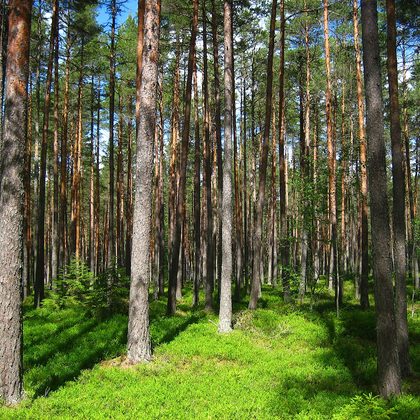
Old, structurally diverse woodland with standing dead trees, often coniferous, but also riparian and other broadleaved woodland. The bats forage along woodland edges, over water and in semi-open terrain above the canopy, usually no more than 5 m above the vegetation; bats foraging over the canopy sometimes dive quickly into the forest. In the north of the range the species lives mainly in lowlands, in the south mainly in mountains. In Switzerland it selects well-structured, mature woodland and avoids open woodland and rocky slopes; in Italy maternity colonies have been found in rocks. The handbook gives elevations from sea level to 2260 m.
Where the animal is most at home, classified with EUNIS — the European standard for habitats.



Distribution
Europe from Ireland and the Iberian Peninsula east to Latvia, Belarus, Ukraine and the Caucasus, including the large Mediterranean islands, Morocco and Anatolia. In Norway the species has not been recorded since 1949 and may be extinct; the handbook also considers this possible for Belgium and the Netherlands. The subspecies B. b. guanchae lives on Tenerife and La Gomera (Canary Islands). In Britain it occurs in the south and in Wales.
- Native
- dark = core range, pale = thinly spread
Way of life
The Barbastelle is a dietary specialist: moths, with a preference for large species and for species with ears, made up 73 to 94 per cent of the diet by weight in Germany and 99 per cent by volume in the Swiss Alps; flies, caddisflies, lacewings and spiders make up the rest. The handbook explains the alternating call types as a way of being less audible to moths that can hear bats. The bats emerge early, sometimes before sunset, and forage first in sheltered, dark terrain and later in the night in open space. Foraging areas lie up to 20 km, on average about 7 km, from the roost. Maternity colonies hold up to 30 animals in trees and up to 100 in buildings. Females breed from their second year and have one young or twins; births fall between May and August, and young are independent at six to nine weeks. Mating takes place in autumn at swarming sites and in caves. Hibernation is interrupted about every fifteen days. Winter and summer roosts lie up to 40 km apart; the longest known movement is about 290 km, between Austria and Hungary. The greatest recorded age is 23 years.
Where and when to look
The chance of a record is highest with a bat detector along a woodland edge or forest track in old woodland in the first two hours after sunset: the alternating pattern of two call types is recognisable by sound. The bats themselves are seldom seen. Winter counts in bunkers, mines and caves provide most records, but they are carried out by licensed counters; entering a hibernation site disturbs the sleeping bats. A tree with loose bark from which bats emerge in the evening may be a roost; in the EU, breeding sites and resting places of bats are protected under Article 12 of the Habitats Directive.
Conservation status
Near Threatened (NT, 2016). According to the handbook it is rare and declining over almost its whole range, with low numbers and high sensitivity because of its sedentary habits; strong declines have been reported recently from many regions. Only in Germany, where insecticide use was reduced, do populations appear to be recovering. The main threat is habitat loss through modern forestry: young and secondary woodland offers too few old trees with loose bark. Disturbance of roosts and caves by tourists and speleologists is also cited. The species is listed in Annexes II and IV of the Habitats Directive and is covered by the Bern Convention and the EUROBATS Agreement.
Scientific name
Barbastella barbastellus | (von Schreber, 1774)
Von Schreber described the species in 1774 as Vespertilio barbastellus; because it was later moved to another genus, the author and year stand in brackets. Barbastella is Latin, from barba, 'beard', and stella, 'star'; Italian barbastello, 'bat', probably lies behind it. barbastellus comes from Italian barbastello, an old word for the bat. Its further origin is disputed: some read in it barba, 'beard', and stella, 'star', after the stiff hairs around the muzzle, while others take it for a corruption of Latin vespertilio, 'bat'. The specimen the first description was based on came from France, Burgundy.