All species › Bats › Vesper bats › Rüppell's Bat
Rüppell's Bat | Vansonia rueppellii
Rüppels dwergvleermuis | Murciélago enano ventriblanco
Rüppell's Bat is a small bat of savanna, desert oases and riverbanks in Africa and the Middle East, with a grey back and pure white underparts. J. B. Fischer described it in 1829 as Vespertilio rüppelii from Dongola in Sudan. It was long placed in Pipistrellus; on genetic evidence it now stands in its own genus, Vansonia, either as a very old lineage within the Pipistrellini or as sister to Pipistrellus and Nyctalus. The guide area includes only the northern edge of the range: Israel, the Nile valley and the oases of Egypt and Libya, and Morocco.
No photograph of a living wild animal of this species with a suitable Creative Commons licence exists. Do you have one that meets the rules? Send it in.
Tracks
Few roosts are known. In Egypt single bats or pairs were found under rocks; in Zambia one was behind a board against a wall, and again in the same place a few days later. Droppings and other signs have not been described. The most visible sign is the species itself, hunting at dusk low over open water.
Identification
A small bat with soft, dense, sleek fur: back grey, pale greyish brown or sepia, sometimes with a silvery sheen, underparts pure white, throat white or pale rusty brown. Ears and face are blackish and contrast with the pale fur. The ears are relatively long for a pipistrelle-like bat; the tragus is half the ear length, of constant width, with a slightly concave anterior margin and rounded tip. The wings are usually translucent pale grey but vary from whitish to mid-brown; the tail membrane is pale grey and reaches the tip of the tail. Flight over water is fast and straight with sudden swerves, dives and upward swoops, usually about 1 m above the surface. Calls are loud, steep frequency-modulated with a near-constant end; the start frequency reaches up to 100 kHz, the end frequency lies at 49 to 53 kHz in Israel and 54 to 57 kHz in Morocco, and call duration in Israel averaged 4.2 ms.
Similar species
The combination of pure white underparts, grey back and blackish face separates the species from the other small bats in its part of the guide area. Kuhl's Pipistrelle (Pipistrellus kuhlii) is the same size but brown, with paler, not pure white underparts and a white wing border; it calls lower, around 34 to 41 kHz. Hypsugo ariel in Israel and Sinai is smaller and pale all over, with a pinkish rather than blackish face. Savi's Pipistrelle (Hypsugo savii) also has pale underparts, but a dark back with golden tips, and calls around 30 to 35 kHz. Pipistrellus deserti, a small pale species, also occurs in the Maghreb and Egypt; with a bat in the hand the colour of belly and face and the measurements decide.
Habitat
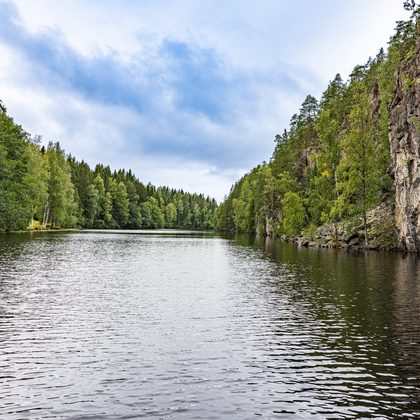
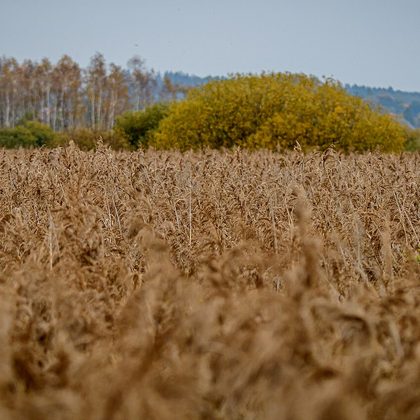
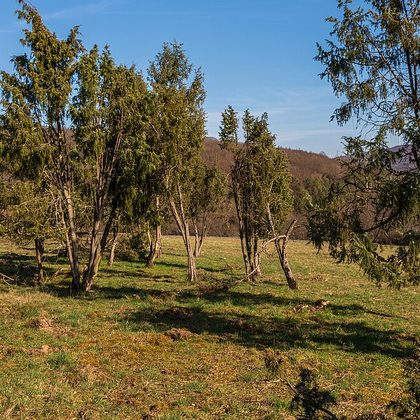
Mainly woodland and grassland savanna, also desert and montane forest, and along river systems; in forest only where there is water nearby to forage over. In Egypt, Zambia, Botswana and Zimbabwe associated with rivers and swamps; in Mauritania in temporary wetlands in acacia savanna; in Libya and Egypt around permanent oases in the middle of the desert. The handbook gives elevations from sea level to 1700 m. Foraging takes place over open water and the surrounding grassy or marshy banks.
Where the animal is most at home, classified with EUNIS — the European standard for habitats.



Distribution
Scattered across Africa and the Middle East: North Africa from Morocco to Egypt, West Africa (Senegal, Mauritania) east to Sudan and Ethiopia and south through almost all of sub-Saharan Africa to northern South Africa and Zanzibar, and in the Middle East in Israel, south-eastern Iraq, Kuwait, extreme south-western Iran, Bahrain and south-western Yemen. The handbook expects the distribution to be much more continuous than the known localities show. Within the guide area most records are from Israel and Egypt, with a few from Morocco and Tunisia. Six or seven subspecies have been described, but the two North African forms (rueppellii and senegalensis) cannot be separated morphologically; the handbook therefore treats the species as monotypic.
- Native
- dark = core range, pale = thinly spread
Way of life
Rüppell's Bat hunts almost always over open water and the surrounding bank vegetation, sometimes up to 10 m high, taking flying insects in agile flight: moths, flies, beetles, caddisflies and hymenopterans. A stomach from Libya contained 50 per cent flies (Brachycera), 30 per cent moths and 20 per cent midges (Nematocera). The large share of day-flying flies suggests that the bats emerge early at dusk. The species lives largely alone, but sometimes forages over water in groups of up to several dozen. Little is known about breeding in the north of the range; in Zambia young were seen in September and November, in Malawi in December. In Malawi bats became torpid during the day at temperatures of 21 to 24 °C. The sources consulted record nothing about hibernation in the north of the range. The Bat Hawk (Macheiramphus alcinus) has been reported as a predator.
Where and when to look
In the guide area the best place is an oasis, river or pond in Israel or the Egyptian Nile valley at dusk: the bats hunt low over the water, and the white belly can sometimes be seen in low light as a bat turns. On a detector a series of loud calls ending around 50 kHz is an indication, not proof. Capture for identification in the hand requires a licence.
Conservation status
Least Concern (LC, 2017). The species is widespread and common over much of Africa. A possible threat is the use of pesticides against locusts, which can poison the bats themselves. In North Africa and the Middle East the known localities are scattered and often tied to oases and rivers.
Scientific name
Vansonia rueppellii | (J. B. Fischer, 1829)
J. B. Fischer described the species in 1829 as Vespertilio Rüppelii; because it was later moved to another genus, the author and year stand in brackets. Vansonia honours Georges van Son (1898-1967), entomologist at the Transvaal Museum, where Roberts coined the name in 1946. rueppellii honours the Frankfurt naturalist Eduard Rüppell (1794–1884), who travelled in north-eastern Africa; Fischer still wrote Rüppelii, and the umlaut has been transliterated as ue under the rules. The specimen the first description was based on came from Sudan.