All species › Bats › Vesper bats › Crete Pipistrelle
Crete Pipistrelle | Pipistrellus creticus
Pipistrellus creticus | Pipistrellus creticus
Pipistrellus creticus, the Crete Pipistrelle, is a very small pipistrelle found only on Crete: forearm 29 to 30.3 mm, weight 3.3 to 3.9 grams. Benda and colleagues described it in 2008 as a subspecies, Pipistrellus hanaki creticus, from animals from the Rouva oak forest in the prefecture of Heraklion, at 940 m. Genetic work later placed it as sister species of the Soprano Pipistrelle, and it has since been treated as a separate species. Little is known about its way of life.
No photograph of a living wild animal of this species with a suitable Creative Commons licence exists. Do you have one that meets the rules? Send it in.
Tracks
Nothing has been published on roosts, colonies or field signs of this species in the source consulted for this guide. Social calls have been recorded, of two types: type A with a peak around 27.7 kHz and a duration of 19.9 ms, and type B with a peak around 20.9 kHz and a duration of 24.8 ms. Type B was most frequent from July to October; use of type A declined from July to November. Droppings of eight animals (55 pellets) have been examined for prey remains.
Identification
A very small pipistrelle. The upperparts are rusty brown, darkest along the back and on the crown and paler on the flanks; the underparts are paler brown. Face, membranes, ears and tragus are dark brown, slightly paler around the eyes and at the base of the ears. In the breeding season the colours are brighter, especially around the face and behind the ears, which are then more reddish. The ears have rounded tips; the tragus has a rounded tip and bends forward near the top. The tail membrane runs from the calcar at the ankle to the tail tip, which projects 0.5 to 1 mm beyond it, and is the same colour as the wing. The glans penis is simple and carries a more or less obvious pale median stripe on the upper side; the foreskin is covered in greyish-brown hairs. Search calls are frequency-modulated with a quasi-constant end (FM-QCF): the start frequency averages 59.5 kHz (46.2 to 101.1 kHz), the end frequency 48.8 kHz (43.6 to 55.2 kHz), the duration 4.3 ms (1.5 to 8.6 ms).
Similar species
Externally the species resembles Pipistrellus hanaki of Cyrenaica in north-eastern Libya, but it is clearly smaller in body and skull (P. hanaki: forearm 30.8 to 33.4 mm); because the two do not share an island or mainland, the difference plays no part in the field. According to the handbook Crete also holds Nathusius's Pipistrelle (P. nathusii, forearm 32 to 37 mm, call around 38 to 43 kHz) and Savi's Pipistrelle (Hypsugo savii, forearm 31 to 38 mm, call around 30 to 35 kHz, dark back with golden hair tips); Kuhl's Pipistrelle (P. kuhlii, forearm 30 to 37 mm, call around 34 to 41 kHz, usually with a white wing border) lives on the large Mediterranean islands. P. creticus is smaller than all three and calls higher, with an end frequency around 49 kHz. In the hand a forearm under about 30 mm and a weight under 4 grams decide. Separation from the Soprano Pipistrelle (P. pygmaeus), its closest relative, does not arise on Crete, since the handbook does not include Crete in that species' range.
Habitat
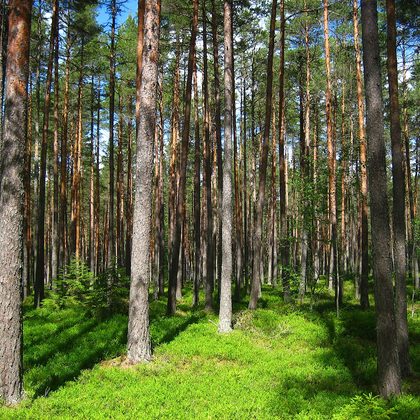
Mediterranean woodland of oak (Quercus) and cypress (Cupressus), from sea level to about 940 m; the species has also been found in Sweet Chestnut (Castanea sativa) plantations. The type locality is a pasture with a stream by the chapel of Agiou Ioanni in the Rouva oak forest, at 940 m.
Where the animal is most at home, classified with EUNIS — the European standard for habitats.


Distribution
Crete only. The species is endemic to the island and, according to the handbook, is regarded as common there. Its closest relatives are the Soprano Pipistrelle (P. pygmaeus) and P. hanaki of north-eastern Libya, which together with it form a group that is sister to the Common Pipistrelle.
- Native
- dark = core range, pale = thinly spread
Way of life
Nocturnal. The food consists of insects, probably caught in flight over open ground. In the droppings of eight animals flies (Brachycera), cicadas and leafhoppers (Auchenorrhyncha) and moths predominated; ants and ichneumon wasps, mosquitoes, non-biting midges and beetles occurred in smaller amounts. According to the handbook there are no data on movements, social organisation or breeding, and nothing has been published on overwintering either; the value 'hibernation' on the fact card is an assumption based on related species and does not rest on observations of this species.
Where and when to look
A bat detector at about 50 kHz picks up the search calls; they lie above those of the other pipistrelles of Crete. Oak woodland and chestnut plantations in the interior of Crete, up to about 940 m, are the places where the species has been recorded. A certain identification needs a recording with frequency analysis, or an animal in the hand.
Conservation status
Not Evaluated (NE). The handbook (2019) lists the species as not assessed on the global Red List; it was only recently confirmed as a separate species. It is common on Crete but occurs only there, which according to the handbook may indicate a need for protection; further research into its status is needed. On Crete, like all bats in the European Union, it is covered by Annex IV of the Habitats Directive.
Scientific name
Pipistrellus creticus | Benda in Benda, Georgiakakis, Dietz, Hanák, Galanaki, Markantonatou, Chudárková, Hulva, & Horáček, 2008
Benda in Benda, Georgiakakis, Dietz, Hanák, Galanaki, Markantonatou, Chudárková, Hulva, & Horáček described the species in 2008 and placed it straight away in the genus where it still stands. Pipistrellus is formed from Italian pipistrello, 'bat', which goes back to Latin vespertilio, from vesper, 'evening'. creticus means 'Cretan', after Crete, from which Benda described the animal. The specimen the first description was based on came from Greece, Crete.