All species › Rodents › Blind mole-rats › Hellenic Blind Mole-rat
Hellenic Blind Mole-rat | Nannospalax hellenicus
Nannospalax hellenicus | Nannospalax hellenicus
Nannospalax hellenicus, the Hellenic Blind Mole-rat, is the southernmost blind mole-rat in Europe and the only one that reaches the Peloponnese. Méhely described the taxon in 1909 as a subspecies of Spalax monticola, from animals on Mount Parnassus. The Mammal Diversity Database has treated it as a species since 2024 and includes the Greek forms thessalicus, peloponnesiacus and epiroticus, plus the subspecies nopcsai described in that year. The species has the highest chromosome number in the European complex: 58, against 46 in N. bulgaricus at the other extreme.
No photograph of a living wild animal of this species with a suitable Creative Commons licence exists. Do you have one that meets the rules? Send it in.
Tracks
In the Greek mountains the earth mounds are the most useful sign. They are broad, low mounds of coarse clods with no visible opening, in a meandering line twenty to thirty metres apart across a mountain pasture or an abandoned plot. The line follows the main tunnel, which with side branches can be tens of metres to nearly two hundred metres long. The tunnels are five to seven centimetres wide; the feeding tunnels are shallow, the grass-lined nest chamber and store chambers deeper. On the limestone soils of central Greece confusion is most likely with the mole: it throws up smaller, higher heaps of fine crumbs from a vertical shaft, whereas the mole-rat's mound spreads broadly. The Hungarian field protocol only counts a mound as a blind mole-rat's at a base diameter of more than sixty centimetres. There are also gnawed bulbs and rhizomes in opened tunnels (in the Greek mountains wild bulbs are the main food) and skull remains in pellets of Eagle Owl and Barn Owl, which are frequent on the limestone cliffs of Parnassus and the Peloponnese.
Identification
Like the related species: a neckless, cylindrical burrower with a broad, flat, wedge-shaped head, a large bare triangular nose pad and a stiff fringe of pale bristles running back from it. The fur is velvety and lies in any direction, brownish grey with a yellow or rufous tinge. The yellow to orange incisors protrude in front of the lips. There are no ear pinnae, no visible eyes and no external tail. No body measurements have been published for this species; those of the Lesser Blind Mole-rat are not adopted. The identifying character is karyological: 2n = 58 chromosomes with a fundamental number NF = 88 in the Parnassus animals, against 56/84 in the Epirote form that the Mammal Diversity Database assigns to the same species. This difference indicates that the classification of this group is still provisional.
Similar species
This species cannot be identified in the field. Blind mole-rats of the leucodon complex are externally alike in shape, size, coat colour, head profile and tooth colour, and the differences cited in the literature fall within the variation of each population. The species are separated by chromosome number, fundamental number and DNA, and their species status rests on crosses between forms that produced no embryos. In Greece locality helps only partly: Thrace and the north-eastern islands hold N. serbicus, Limnos holds N. insularis, and on Lesbos the range of N. xanthodon begins, itself regarded as a superspecies. What can be excluded are the mole, which is smaller, with spade-shaped forefeet and a short tail, and the Water Vole, with normal ears, eyes and a long tail. A field record is best entered as 'blind mole-rat', with mountain and altitude; the species name requires a karyotype.
Habitat
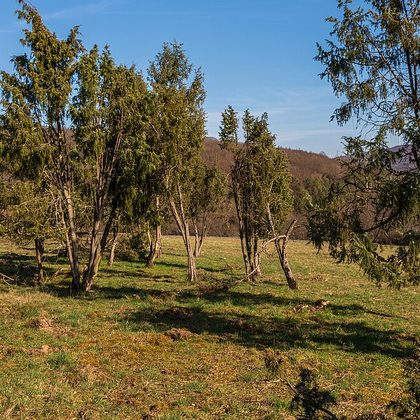
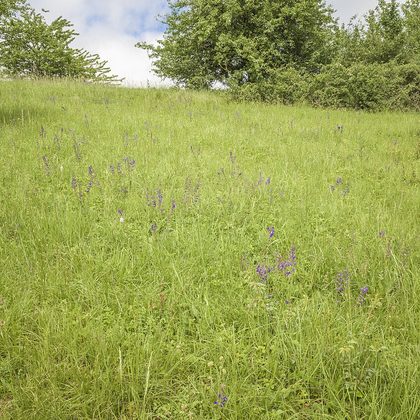
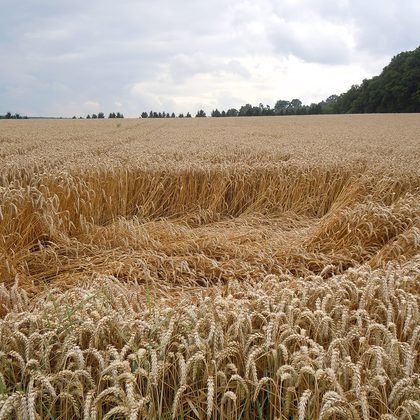
Mountain pasture, hay meadow and dry grassland on deep, loose soil, from the lower hills to well above the treeline; the complex has been recorded up to 2,400 m. The species lives on the high meadows of Parnassus, the Pindus and the mountains of the Peloponnese, on old terraces and abandoned plots, unmown margins and karst plains where the weathered soil is deep enough. Dense woodland, rock and waterlogged ground are unsuitable, and where limestone lies at the surface no digging is possible. Populations are therefore confined to sharply bounded patches of suitable soil.
Where the animal is most at home, classified with EUNIS — the European standard for habitats.


Distribution
The Greek mainland, with Parnassus as the type locality: central Greece, Thessaly, Epirus and the Peloponnese, and also Albania, where a subspecies of its own was described in 2024. The boundary with N. serbicus in Macedonia and Thrace has not been established, because this requires trapping and karyotyping. Within this species too the Greek populations differ in chromosome number, which indicates that the classification is not final. Maps from before 2024 show the whole of Greece under the name Nannospalax leucodon. Blind mole-rats are absent from western and northern Europe and from the Iberian Peninsula.
Way of life
Hardly anything has been recorded for this species separately; the following applies to the complex, within which the way of life varies little. The animals live solitarily and almost entirely underground, are active around the clock with most digging at the beginning and end of the day, and do not hibernate: in the Greek mountain winter, with snow lying well into spring, they live on their store chambers. The diet consists of bulbs, tubers, rhizomes and thick roots, in southern Europe mainly wild bulbs, supplemented in late spring with green plant material. One burrow system is the territory of one animal, which tolerates no conspecifics outside the mating season. After a gestation of about thirty days two to four young are born, usually in March or April; females first breed in their second year. Predators are Red Fox, Beech Marten, Polecat, shepherd dogs and Eagle Owl; in the southern mountains the Eastern Imperial Eagle also hunts blind mole-rats.
Where and when to look
In April, May or June, as soon as the snow has gone and the grass is still short, search open meadows on the plateaus of Parnassus, the Pindus or the Peloponnese for a line of low, broad mounds tens of metres apart. Fresh soil is dark, damp and coarsely clodded; overgrown mounds indicate an abandoned system. Comparing a mole-rat mound with a molehill on site is the only identification that gives a result in the field. The animal itself is rarely seen, at most when it crosses a mountain road. Record mountain and altitude for every find; in this group locality determines the assignment.
Conservation status
Not evaluated by the IUCN. The Red List recognises only the collective species Nannospalax leucodon, assessed as Least Concern; that assessment says nothing about the Greek animals. There are no national counts, no trend data and no estimate of the number of sites. For a species with a limited and strongly fragmented mountain range this is a problem: each population is isolated on its own patch of suitable soil, and lost populations are not replenished from the surroundings. The main threats in Greece are the loss of extensive grazing, which lets the high meadows become overgrown with scrub, the conversion of grassland to arable and orchards, road construction and ski development on Parnassus, and fire. As long as the Greek blind mole-rats are officially regarded as a form of a species not threatened, they fall outside the scope of conservation instruments.
Scientific name
Nannospalax hellenicus | (Méhelÿ, 1909)
Méhelÿ described the species in 1909 as Spalax monticola hellenicus; because it was later moved to another genus, the author and year stand in brackets. Nannospalax joins Greek nannos, 'dwarf', to Spalax: the small blind mole-rat. hellenicus means 'Greek', from Greek Hellas, the Greeks' own name for their country; Méhelÿ described the animal from Mount Parnassus. The specimen the first description was based on came from Greece, Mount Parnassus.