All species › Carnivores › Mongooses › Herpestes javanicus
Herpestes javanicus | Urva auropunctata
Indische mangoeste | Herpestes javanicus
The small Indian mongoose is native from Iraq and Iran to India, Bangladesh, Myanmar and southern China. In Europe it was released in 1910 on the Croatian island of Mljet to control the nose-horned viper. From Mljet it was taken to other Dalmatian islands and the Pelješac peninsula, and it has since spread along the coast into Montenegro, Bosnia and Herzegovina and Albania. It has been on the EU list of invasive alien species of Union concern since 2016. It was long lumped with the Javan mongoose as Herpestes javanicus, the name under which it appears on the Union list.
Tracks
The mongoose marks with secretions of the anal glands, which open into an anal pouch; it wipes the pouch against objects. Rest sites are in fallen trees and cavities among roots, and in the native range in self-dug burrows. Because the species is active by day, searching and camera trapping yield more than tracking. An indication of its presence on an island is the absence of the nose-horned viper and Balkan green lizard from suitable ground.
Identification
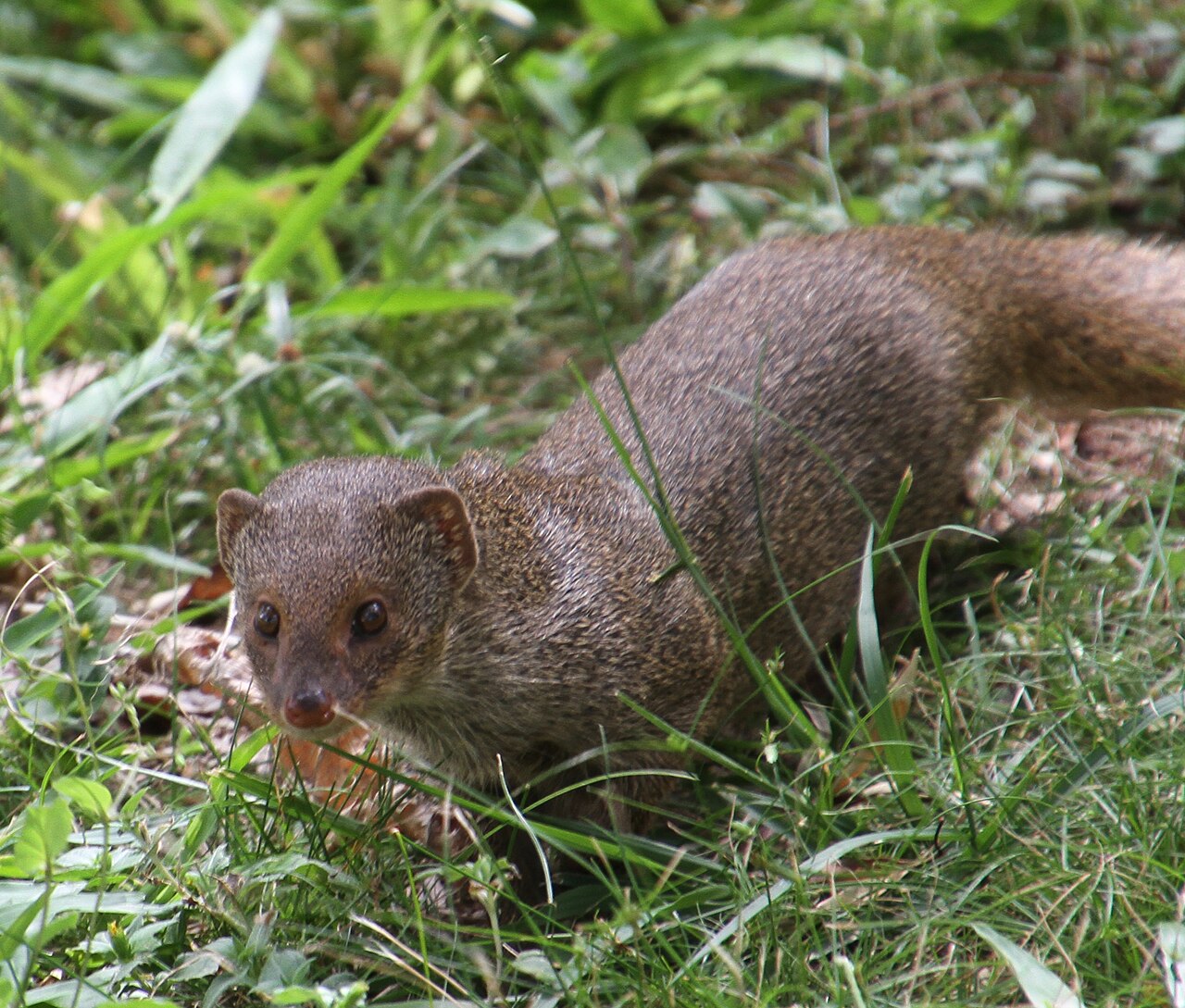
A small, slender mongoose with short legs, a pointed muzzle with a blackish rhinarium, small eyes with brown iris and short ears. The coat is buff, rufous or dark yellowish grey; the hairs are ringed white and dark, giving a finely grizzled appearance. The tail is muscular at the base and tapers gradually. Each foot has five toes with long, sharp, non-retractile claws, and the soles are naked. Males are larger than females, especially in introduced populations.
Similar species
No other mongoose lives on the Adriatic coast. The stone marten is larger, with a bushy tail and a white throat patch; the weasel is much smaller, with a short tail and white underparts; the polecat is dark with a white facial mask. The Egyptian mongoose of Iberia, North Africa and the Levant is much larger (48–60 cm head-body, 1.7–4 kg) and has a tail ending in a black tuft; the two species do not meet in the guide area.
Habitat
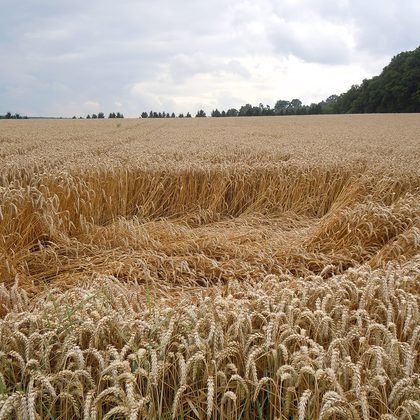
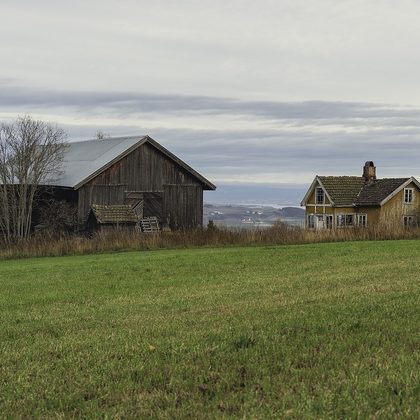
In the native range forest, scrub and open ground, also close to human habitation. In Montenegro its distribution coincides with Mediterranean maquis and garrigue in a narrow coastal strip up to 300 m altitude.
Where the animal is most at home, classified with EUNIS — the European standard for habitats.


Distribution
Native to south-west and south Asia: from Iraq and Iran through Afghanistan, Pakistan, India, Nepal and Bhutan to Bangladesh, Myanmar and southern China. Introduced to dozens of islands in the Caribbean, Pacific and Indian Ocean, to Japan, Suriname, Guyana and French Guiana, and to Croatia. In the Adriatic it was released on Mljet in 1910, then on Korčula, Hvar, Čiovo and Škrda and on the Pelješac peninsula. From there it is spreading along the Dalmatian coast, north to the Neretva. It reached Montenegro unaided from the second half of the 1980s and now occupies the whole coast from the Croatian to the Albanian border, over 447 km². It is also moving inland in eastern Herzegovina (Bosnia and Herzegovina).
- Established introduction
- dark = core range, pale = thinly spread
Way of life
Diurnal; on Caribbean islands mainly active between 10:00 and 16:00 and little on rainy days. It is largely solitary, but in introduced populations animals are often seen close together; on Oahu (Hawaii) males formed coalitions in the breeding season and sometimes shared a sleeping den. Home ranges on islands measure from a few to over a hundred hectares. The mongoose is omnivorous: insects, reptiles, centipedes, arachnids, rodents, crabs, birds, amphibians and plant matter. Gestation is about 49 days; litters average 2 (1 to 5), and there can be 2 to 3 litters a year.
Where and when to look
On Mljet, Korčula, Hvar and Pelješac and along the coast of southern Dalmatia and Montenegro the species can be seen by day, mainly in maquis. A record outside the known area, or inland, matters for tracking the spread: report it with a photograph and location to the national authority for invasive species.
Conservation status
Least Concern (LC, 2016) globally. In Europe it is an invasive alien: since 2016 it has been on the European Union's Union list under the name Herpestes javanicus. On Korčula and Mljet the nose-horned viper and Balkan green lizard were entirely absent in surveys, and on Hvar they were rare. The mongoose has so far been eradicated only from six very small islands. For Montenegro, researchers warned of the consequences for the reptiles and amphibians of the southern Adriatic coast, one of the richest areas in Europe for these groups. Elsewhere, as an introduced species, it has contributed to extinctions of birds, mammals and reptiles on islands, and it can transmit rabies and leptospirosis.
Scientific name
Urva auropunctata | (B. H. Hodgson, 1836) (GBIF: Herpestes javanicus)
B. H. Hodgson described the species in 1836 as Mangusta Auropunctata; because it was later moved to another genus, the author and year stand in brackets. Urva is a local name Hodgson noted down in Nepal: he used it as a specific name in 1836 and as a genus name the year after. He explains the word no further. auropunctata is Latin for 'gold-speckled', from aurum, 'gold', and punctatus, 'spotted', after the golden flecking the banded hairs give the coat. The specimen the first description was based on came from Nepal.