All species › Hedgehogs, shrews and moles › Shrews › Iberian Shrew
Iberian Shrew | Sorex granarius
Iberische bosspitsmuis | Musaraña Ibérica
The Iberian Shrew is a Sorex found only in the west and centre of the Iberian Peninsula. It closely resembles the Common and Crowned Shrews, and was long treated as a subspecies of the former; since 1975 it has been recognised as a separate species on the basis of its chromosomes. It lives along mountain streams and rivers and in damp woodland, and in the west reaches the Atlantic coast. Little has been published on its way of life.
No photograph of a living wild animal of this species with a suitable Creative Commons licence exists. Do you have one that meets the rules? Send it in.
Tracks
No signs are known that belong to this species alone; droppings, runs and tunnels do not differ from those of other shrews. The species is recorded by live-trapping and in owl pellets, especially those of the Barn Owl. In pellets, Sorex skulls and jaws are recognisable by their red-brown tooth tips; within the range of the Crowned Shrew identification to species remains uncertain even then.
Identification
A medium-sized Sorex with a three-toned coat: the back is sepia to dark brown, the flanks paler and the belly yellowish grey. Young animals are paler and lack the clear contrast between back and flank. The tail is bicoloured, sepia above and dark ochre below, and slightly longer than half the head-body length. The tooth tips are red-brown. There are no external features that reliably separate the species from its close relatives. On the skull, a shorter rostrum, a broader palate, paler upper incisors and an unpigmented hypocone on the first molars stand out. The karyotype, 2n = 36 or 37 with only acrocentric autosomes, is unique within the Common Shrew group. Head-body 5.0 to 7.2 cm, tail 3.6 to 4.6 cm, hind foot 11 to 12.5 mm, weight 4.5 to 8 g.
Similar species
The Crowned Shrew (Sorex coronatus) of northern Iberia cannot be told from this species externally, and nor can the Common Shrew (Sorex araneus) of the Pyrenees and the rest of Europe. Reliable identification rests on chromosomes or DNA; skull features such as the shorter rostrum and broader palate give an indication in series. In practice the locality therefore decides: in central Spain and in Portugal a three-toned Sorex of this size is almost certainly this species, whereas in the north-west, where the ranges meet, genetic work is needed. The Eurasian Pygmy Shrew (Sorex minutus), which also occurs in the Sierra de Guadarrama and Sierra de Gredos, is smaller and lighter, with a relatively smaller head, a longer tail and a less contrasting coat. The Greater White-toothed Shrew (Crocidura russula) has white teeth, prominent ears and long scattered hairs on the tail; Cabrera's Water Shrew (Neomys anomalus) along the same streams is larger, blackish with a pale belly, and swims.
Habitat
Mainly the banks of mountain streams and rivers, and also damp beech, oak, pine and holm oak woodland with a well-developed litter and herb layer. In the Central System it lives between about 500 and 2,000 m; westwards it descends to the coast, where it also occurs in grassy lowlands by the Atlantic. The species is tied to a cool, damp climate with more than 600 mm of rain a year. Because such places are scattered in the interior, its occurrence there is sporadic too.
Where the animal is most at home, classified with EUNIS — the European standard for habitats.


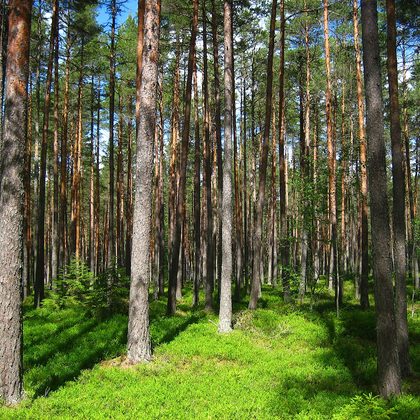

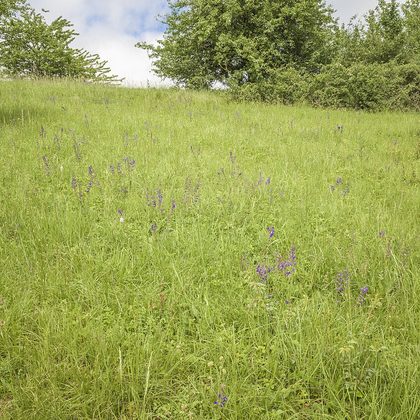
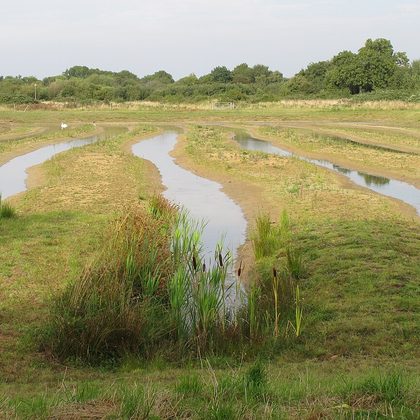
Distribution
An endemic of the Iberian Peninsula. The range covers northern Portugal north of the Tagus, including the Serra da Estrela, and in Spain Galicia, western León, north-western Zamora and the Central System as far as the Sierra de Ayllón in Segovia. The type locality is La Granja in Segovia, at the foot of the Sierra de Guadarrama. In the north the range meets that of the Crowned Shrew. In older literature the species appears as Sorex araneus granarius.
- Native
- dark = core range, pale = thinly spread
Way of life
No data have been published on its daily rhythm, social life or range size. Its food consists of invertebrates: annelid worms, insects, arachnids and molluscs. Like all shrews it does not hibernate. Breeding takes place in spring and summer; in Portugal a gestation of 18 to 21 days and five to seven embryos per pregnant female have been recorded, elsewhere four and six. Animals mature only in their second calendar year and seldom survive their second autumn.
Where and when to look
A record can only be properly supported by trapping or pellets. The best places are vegetated banks of mountain streams and damp woodland edges in the Sierra de Guadarrama, Sierra de Gredos, Serra da Estrela and Galicia. Analysing Barn Owl pellets from villages at the foot of these ranges yields most records. Anyone trapping or finding an animal in Galicia or León can keep a tissue sample for DNA analysis, since the Crowned Shrew also occurs there. Trapping shrews requires a permit in Spain and Portugal.
Conservation status
Least Concern globally (2016). The range is small and the distribution within it fragmented, because the species depends on damp, cool places. There are too few data to assess the state of its populations. Degradation of vegetated banks and the loss of damp woodland reduce the habitat available to it. It is listed on Appendix III of the Bern Convention.
Scientific name
Sorex granarius | G. S. Miller, 1910
G. S. Miller described the species in 1910 and placed it straight away in the genus where it still stands. Sorex is the Latin word for a shrew. granarius is Latin for 'of grain', from granum, 'grain', and granarium, 'granary'; Miller gives no explanation. The specimen the first description was based on came from Spain, Segovia.