All species › Hedgehogs, shrews and moles › Shrews › Equal-toothed shrew
Equal-toothed shrew | Sorex isodon
Grauwe spitsmuis | Musaraña Siberiana
The Equal-toothed or Taiga Shrew is a large, dark Sorex of the taiga, ranging from Scandinavia to Kamchatka and Sakhalin. In the mountain forests of southern Siberia it is the most numerous shrew, but in Europe, at the western edge of its range, it is scarce and local. The scientific name isodon, 'equal-toothed', refers to a dental feature: the small unicuspid teeth of the upper jaw decrease gradually in size from front to back, without the step seen in other species. In 2023 it was found in Lithuania for the first time, outside its previously known range.
No photograph of a living wild animal of this species with a suitable Creative Commons licence exists. Do you have one that meets the rules? Send it in.
Tracks
No signs are known that belong to this species alone; droppings and runs under the litter and through moss cannot be told from those of other shrews. Records come from pitfall-trapping studies and from owl pellets. Sorex skulls and lower jaws are recognisable by their red-brown tooth tips; to pick out this species a hand lens is needed to check the size and colour of the fifth upper unicuspid and the position of the mental foramen in the lower jaw.
Identification
A large Sorex with an almost uniformly coloured, dark coat: in young animals brown to dark brown on the back and slightly paler below, in adults darker, up to blackish brown, with no clear boundary between back, flank and belly. The three-toned pattern of the Common Shrew is therefore absent. The tail is usually longer than half the head-body length, somewhat square in cross-section, bicoloured or bicoloured only at the base with a dark tip, and ends in a small tuft. The decisive characters are in the teeth: the unicuspid teeth of the upper jaw decrease gradually in size, and the fifth is well developed and has a dark pigmented tip. The karyotype is 2n = 42. Head-body 5.4 to 8.6 cm, tail 3.7 to 5.5 cm, hind foot 13 to 15 mm, weight 6.1 to 16.3 g.
Similar species
The Common Shrew (Sorex araneus) lives alongside this species throughout and closely resembles it in shape and size. In the field the Taiga Shrew cannot be separated from it with certainty; pointers are the dark, even coat without a paler flank band, the somewhat longer, angular tail and a slightly larger build, but young and moulting animals of both species overlap. In the hand or on a skull the teeth decide: in the Common Shrew the fifth upper unicuspid is small and unpigmented, in the Taiga Shrew well developed and dark-tipped; the position of the mental foramen in the lower jaw and the shape of the jaw's ramus also differ. Laxmann's Shrew (Sorex caecutiens), a close relative, is clearly smaller and paler-bellied; the Eurasian Pygmy Shrew (Sorex minutus) and Eurasian Least Shrew (Sorex minutissimus) are much smaller. The Water Shrew (Neomys fodiens), also dark and often along the same streams, has a sharply demarcated pale belly and swimming fringes on the feet.
Habitat
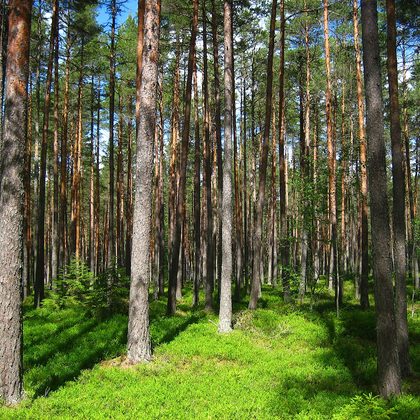
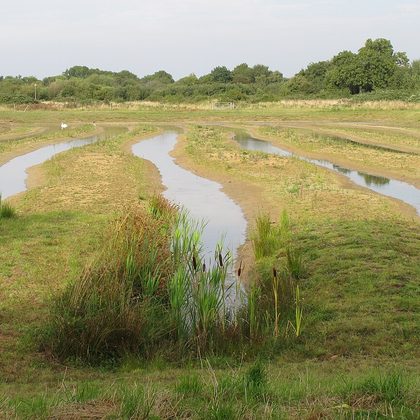
In Europe mainly cool, damp, old coniferous forest, especially spruce forest with a thick litter layer, a tall, lush herb layer and high humidity, and mosaics of rich spruce forest with wet meadows, mires and riparian zones. At the western edge of the range, in Belarus and Ukraine, it is found mostly in swampy stream valleys, floodplain meadows and alder carr along rivers. Outside the forest belt, in forest-steppe and forest-tundra, it is rare, and it avoids tundra.
Where the animal is most at home, classified with EUNIS — the European standard for habitats.




Distribution
From Fennoscandia and central European Russia through the whole Siberian taiga to the Pacific, including Kamchatka, Sakhalin, north-east China, northern Mongolia and the Korean Peninsula. The European subspecies is S. i. ruthenus. Within the area covered by this guide the species is best known from Finland, where it has been found at more than seventy sites. In Sweden and Norway its range is fragmented, with isolated populations. To the south the range reaches northern and north-eastern Belarus and the Sumy region of north-eastern Ukraine. In 2023 it was trapped in Lithuania for the first time, 200 to 225 km from the nearest known sites in Belarus.
- Native
- dark = core range, pale = thinly spread
Way of life
The Taiga Shrew is active around the clock in several bouts; day and night activity are of about equal length. It finds its food mainly by digging in the litter layer: earthworms and fly larvae are the most important items in almost the whole range, followed by spiders, caterpillars, beetle larvae and centipedes and millipedes; adult beetles play a minor role. It does not hibernate. Breeding begins two to three weeks later than in the other shrews of the same area and continues into September; a female has up to three litters per season, with one to eleven young and about seven on average. Animals live solitarily in their own ranges, which in Karelia measure 1,200 to 2,600 m² for overwintered males and 700 to 1,400 m² for young males; in favourable spots the ranges lie close together. As in other Sorex species, an animal usually survives only one winter.
Where and when to look
A record of this species almost always requires trapping or pellet analysis; a dark shrew darting across the moss in a Finnish or Swedish spruce forest may just as well be a Common Shrew. Anyone trapping under licence does best in damp old spruce forest with a tall herb layer, along streams and spring-fed patches, and checks the traps often. Even in suitable places the Taiga Shrew usually makes up less than a tenth of the shrews caught. With a dark, evenly coloured animal in the hand, a hand lens on the fifth upper unicuspid helps; a photograph of it makes the record verifiable. Records at the western edge of the range, such as in Lithuania, Belarus and Norway, add to knowledge of the distribution.
Conservation status
Least Concern globally (2016). In the mountain forests of southern Siberia it is common and often the most numerous shrew, but in the European part of its range it is scarce: in mixed shrew communities it usually makes up less than ten per cent. In European Russia it is therefore on several regional Red Lists, including those of Karelia and the Novgorod and Ryazan regions, and in Norway it is listed as Data Deficient. Because the species depends on old, damp conifer forest with a thick litter layer, clear-felling and forest drainage work against it. It is listed on Appendix III of the Bern Convention.
Scientific name
Sorex isodon | Turov, 1936
Turov described the species in 1936 and placed it straight away in the genus where it still stands. Sorex is the Latin word for a shrew. isodon is Greek for 'equal-toothed', from isos, 'equal', and odōn, 'tooth', after the unicuspid teeth, which differ little in size. The specimen the first description was based on came from Russia, Siberia.