All species › Bats › Vesper bats › Natterer's bat
Natterer's bat | Myotis nattereri
Franjestaart | Murciélago Ratonero Gris
Natterer's bat is a medium-sized Myotis of woodland, parkland and small-scale farmland, named after the row of stiff hairs along the edge of the tail membrane. It hunts slowly and with great manoeuvrability among vegetation and takes prey from leaves and from the ground. What was long treated as a single species has since the start of this century been split into several species on the basis of genetic and morphometric studies; as currently defined, Natterer's bat in the strict sense is a species of northern, central and eastern Europe.
Tracks
Summer roosts are in tree holes, hollow trees, rotten branches and abandoned woodpecker holes, in bat boxes and in crevices in rocks and walls, and in buildings, among other places in hollow bricks and in abandoned buildings. Beneath such a roost there is sometimes a small amount of droppings. From August to late October the bats swarm at night in front of caves and mines, often together with Daubenton's and Bechstein's bats. In winter they hang in caves, mines, tunnels and other underground spaces, singly or in small groups in crevices, and locally in large hibernating colonies. The species is found dead relatively often on sticky flypaper.
Identification
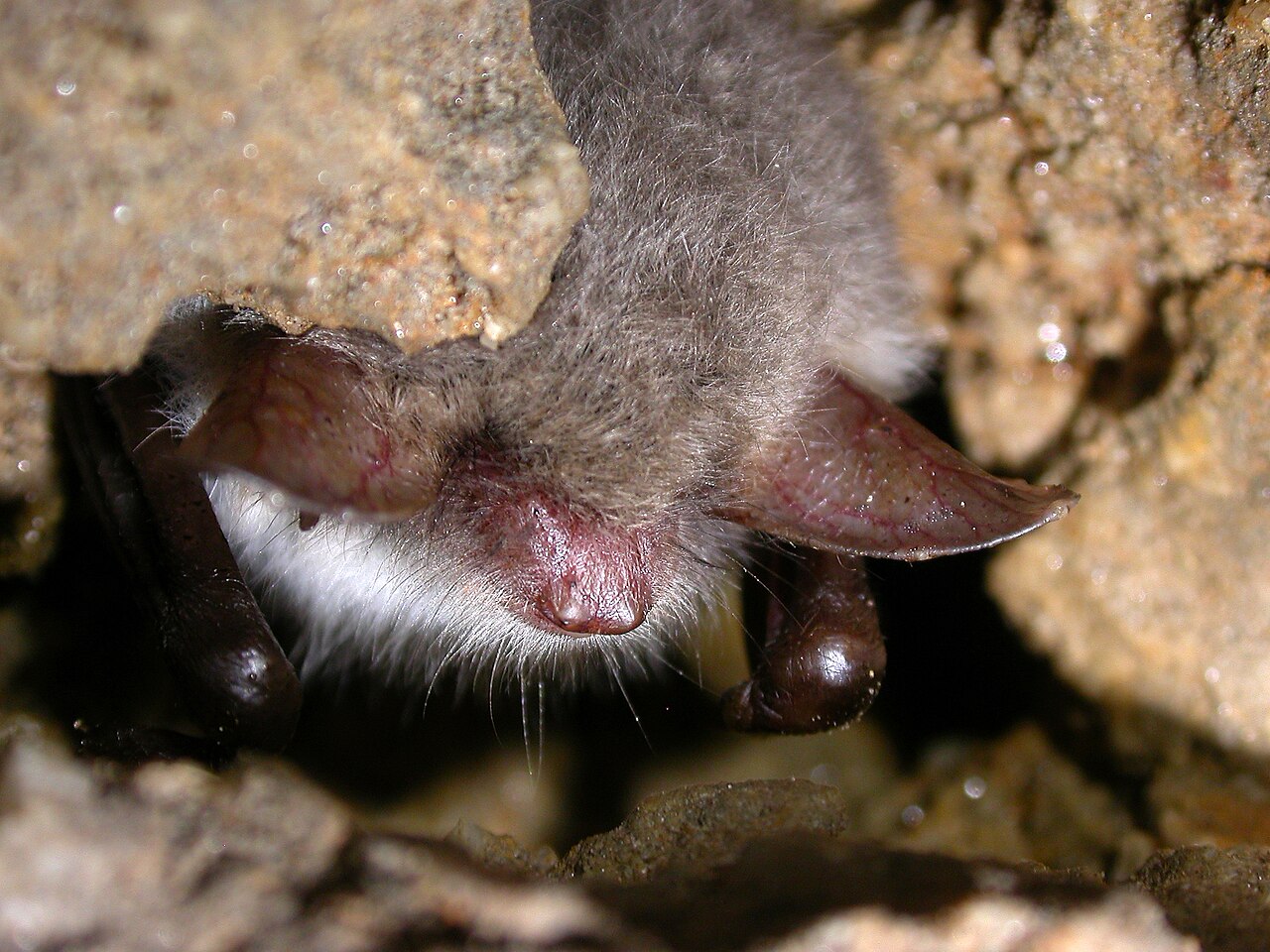
A medium-sized bat: forearm 38.5 to 41 mm, weight 7 to 10 g, wingspan 24.5 to 30 cm. The back is brown to greyish, the underside pale grey to whitish and sharply demarcated; the fur is long and shaggy. The face is bare and distinctly pink, especially around the eyes, with a narrow, long muzzle. The ears are fairly long, with several folds on the outer margin, and when laid forward extend beyond the muzzle; the tragus is long and pointed, reaching beyond half the ear length. The group character lies at the tail: the edge of the tail membrane carries two rows of stiff hairs and is supported by an S-shaped calcar. The tibia is naked. Juveniles are darker, with blackish skin and wings. The wings are broad; the flight is slow and agile. Echolocation consists of short, strongly modulated calls of 3 to 5 ms starting at 100 to 150 kHz and ending at 20 kHz or lower, one of the broadest frequency ranges in the genus.
Similar species
Natterer's bat gives its name to the nattereri complex, which has been split. Myotis crypticus (Italy, the Alps and the north of the Iberian Peninsula), M. escalerai (Iberian Peninsula and adjacent France), M. nustrale (Corsica), M. hoveli (southern Turkey and the Levant) and M. tschuliensis (Crimea and the Caucasus) share the fringe on the tail membrane and the S-shaped calcar. External differences between these species are small and rest mainly on measurements; DNA is usually needed for certain identification, and where the range boundaries lie is not yet known everywhere. An observation without genetic material outside the core range of Natterer's bat is therefore recorded as Myotis nattereri complex. The fringe and calcar separate the group from other Myotis species. Bechstein's bat (M. bechsteinii) has clearly longer ears with more folds and lacks the fringe; Geoffroy's bat (M. emarginatus) has rusty brown, woolly fur and a deep notch in the outer margin of the ear. On a bat detector the calls of Natterer's bat can be separated from those of other small Myotis by the broad frequency range, but not from those of the split-off species.
Habitat
Woodland of varied composition, broadleaf and coniferous, as well as orchards, gardens, parks, tree plantations and pastures, from sea level to about 2000 m. The species forages along rivers, in riparian woodland and over meadows. It is sensitive to habitat loss and fragmentation. Hibernation sites are in caves, mines and tunnels.
Where the animal is most at home, classified with EUNIS — the European standard for habitats.







Distribution
As currently defined, northern, central and eastern Europe up to about 60°N, including Great Britain and Ireland, and western Turkey. Isolated populations in western Russia, on Crete and Cyprus, and in Iraq, Iran and Turkmenistan have not yet been assigned to a subspecies or species. The split-off related species live in the Iberian Peninsula, Italy, the Alps, Corsica, the Levant and the Caucasus; the status of populations on other large Mediterranean islands is also uncertain following the recent taxonomic changes. Older distribution data under the name M. nattereri may refer to any of these species.
- Native
- dark = core range, pale = thinly spread
Way of life
Natterer's bat hunts in slow flight 1 to 4 m above the ground and takes prey from leaves and from the ground; it can hover before plucking prey from a surface, and sometimes uses the tail membrane to scoop prey off vegetation. The diet consists mainly of spiders (including harvestmen), caterpillars and flies, and in smaller numbers beetles, moths and centipedes. The bats usually emerge more than half an hour after sunset, but may also hunt late at night or in daytime; they fly up to 4 km to foraging areas covering up to 500 ha in total. Maternity colonies usually hold 20 to 50 females with young, in buildings sometimes more than 120. The young, one per year, are born between early June and early July, fly after about 20 days and are independent after a month. Males form groups of up to 25. Mating takes place at swarming sites and in hibernacula. The species is sedentary: distances between summer, swarming and winter roosts usually do not exceed 40 km; movements of 266 to 327 km have been reported as exceptions. Large hibernating colonies can hold more than 8000 bats.
Where and when to look
Hunting Natterer's bats can be seen in the evening along woodland edges, avenue trees and over meadows, low down near the vegetation. On a bat detector the species is characterised by very short calls with a broad frequency range; even so, outside the core range of the species a recording is not conclusive with respect to the split-off species. During licensed trapping studies the fringe on the tail membrane can be examined. Hibernation and swarming sites are not disturbed.
Conservation status
Least Concern (LC, 2023). The current assessment covers the species in the strict sense, after the split of the related species. Natterer's bat is not common, but populations in central Europe appear stable. Reported causes of local decline are habitat loss and fragmentation, disturbance and the loss of old buildings and renovation of houses used as roosts, and mortality on sticky flypaper. The species is listed in Annex IV of the Habitats Directive and is covered by the Bern Convention and the EUROBATS Agreement.
Scientific name
Myotis nattereri | (Kuhl, 1817)
Kuhl described the species in 1817 as Vespertilio Nattereri; because it was later moved to another genus, the author and year stand in brackets. Myotis is Greek, from mys, genitive myos, 'mouse', and ous, genitive ōtos, 'ear': 'mouse-ear'. nattereri honours the Austrian naturalist Johann Natterer (1787–1843), later famous for eighteen years of collecting in Brazil, who pointed the bat out to Kuhl. The specimen the first description was based on came from Germany, Hesse.