All species › Rodents › Voles and hamsters › Northern red-backed vole
Northern red-backed vole | Clethrionomys rutilus
Kleine rosse woelmuis | Myodes rutilus
The Northern Red-backed Vole (Clethrionomys rutilus) belongs to the red-backed voles, the same genus as the Bank Vole, and not to the Microtus voles, beside which the literature long placed it. It is the commonest woodland rodent of taiga and tundra, from Finnish Lapland to Kamchatka and across the Bering Strait into Alaska and Canada. The range covers about eighteen and a half million square kilometres, one of the largest of any vole. In Europe the species is confined to the far north.
Tracks
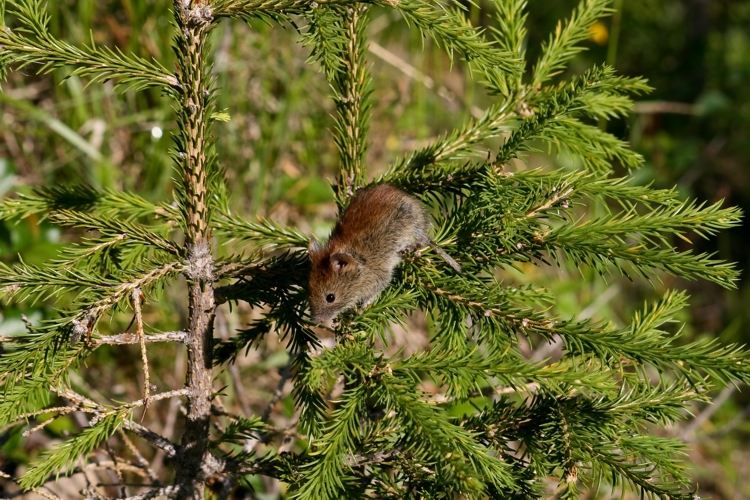
The species lives at the surface, and its signs lie on the turf, not under it. In coniferous woodland they consist of narrow runways three to four centimetres wide under root plates, fallen trunks and dwarf shrubs, and round holes three to four centimetres across at the foot of a tree, between stones or at the edge of a moss hummock. The most characteristic sign forms under the snow: in winter the animal makes long runs within the snowpack, against the ground, and after the melt in May these lie as strands of woven grass and moss on the forest floor, with the globular winter nests of grass, moss and lichen, about fist-sized, that lay in the snowpack during winter. There are also bitten-off bilberry and crowberry stems, peeled twigs of dwarf birch and willow and, in autumn, gnawed fungi on stumps and in the moss. Bark gnawing in this species is often above the snow line, because the animal climbs up to two metres into trees and shrubs. Droppings are four to six millimetres long, blunt-ended cylinders, dark green to black, left in small piles along the runway and at the nest. Under roosts of Tengmalm's, Hawk and Great Grey Owls it is often the most numerous prey species in pellets in the taiga.
Head close-up
Identification
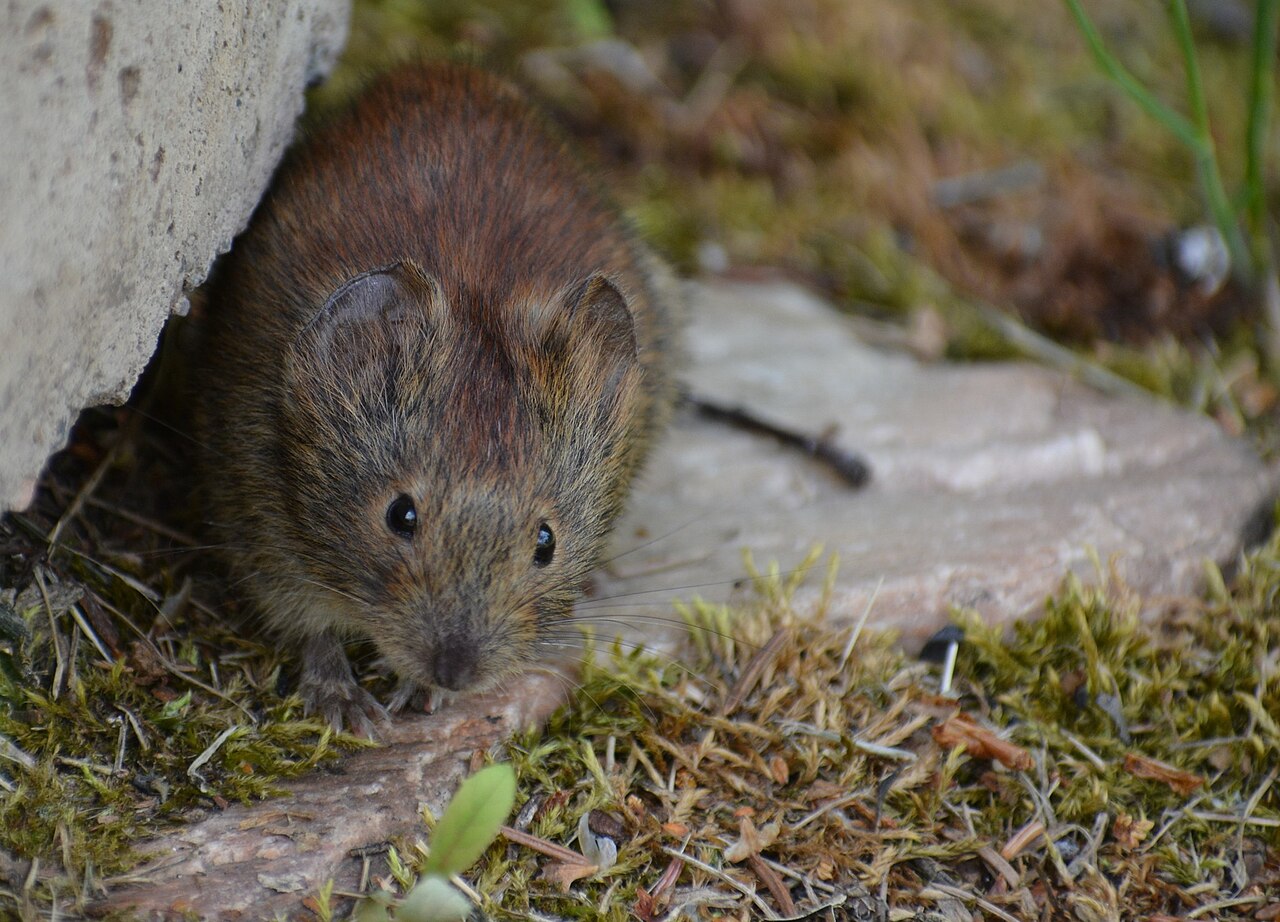
A small, thickset vole with a bright rusty-red dorsal band sharply set off against grey flanks and a grey-white belly. The mantle is brighter and purer red than in the Bank Vole, and the boundary with the flank is sharper. Head-body length is 8.5 to 12.3 cm, the tail 2.1 to 5 cm, about a third of head-body length and thus shorter than in the Bank Vole; the tail is sharply bicoloured, dark above and white below, with a short terminal tuft. The ears project clearly from the fur and the eyes are large, features of a vole that lives above ground and climbs. The winter coat is denser and longer than the summer coat, making the animal look heavier. Females have eight nipples in four pairs.
Similar species
The Bank Vole (Clethrionomys glareolus) occurs alongside the Northern Red-backed Vole throughout Fennoscandia and is the species most often confused with it: it is generally a little larger, chestnut rather than bright red, with a less sharp boundary between back and flank, and has a longer tail, about half the head-body length. In the north tail length is the most usable difference. The Grey Red-backed Vole (Craseomys rufocanus) is distinctly larger and more coarsely built, greyer on the flanks, with a narrow red mantle on an otherwise grey body; it lives in the same Scandinavian birch woods. Lapland also holds the Wood Lemming (Myopus schisticolor), slate-grey with a rusty saddle and a very short tail, and the Norway Lemming, blotched yellow and black. Nomenclature: the Mammal Diversity Database places the red-backed voles in Clethrionomys again; many datasets, including GBIF, still use Myodes. The species are the same.
Habitat
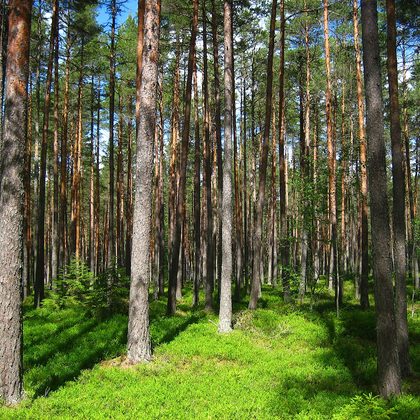
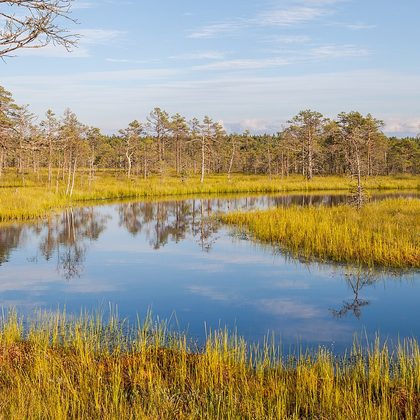
Taiga and the adjoining continental tundra, and within them virtually every stage of woodland: spruce, pine and larch forest, birch and mixed woodland, clear-fells and young plantations, swamp forest and bog margins. In the tundra the species is tied to shrub zones and open larch and birch woodland. A requirement is a thick layer of moss, lichen and litter with dead wood, which provides cover, food and winter quarters. In the Altai it occurs up to 2,300 m. Bare, closely grazed grassland is avoided.
Where the animal is most at home, classified with EUNIS — the European standard for habitats.


Distribution
From northern and eastern Fennoscandia east through northern Russia and Siberia to Kamchatka, Sakhalin and Hokkaido, and across the Bering Strait into Alaska and northern Canada; south to northern Kazakhstan, Mongolia and northern China. In Europe the range comprises Finnish Lapland, northern Sweden, Finnmark and northern Russia, with the southern limit roughly where closed taiga begins. The species is absent from the British Isles and from western, central and southern Europe; no vagrants outside the range are known.
- Native
- dark = core range, pale = thinly spread
Way of life
Mainly nocturnal, in spring also crepuscular; in winter polyphasic, with activity periods spread over day and night. The diet is broad: leaves, buds, twigs and berries of dwarf shrubs, forbs, fungi, mosses, lichens and occasionally insects. Berries and fungi dominate in summer; in the Altai, Siberian pine nuts are the most important food in autumn and winter, and northern animals lay in stores in autumn. Breeding runs from April to mid-September, with a gestation of seventeen to nineteen days and usually two or three, at most four litters per season; a litter holds two to fourteen embryos, northern litters being the largest. The young leave the nest at fifteen to eighteen days. Adults move up to 370 to 390 metres from the nest, males up to a kilometre; females are more sedentary than males, and the animals live singly or in small groups. No hibernation or winter torpor; active all year.
Where and when to look
The best chance is in July or August in the north of Finland, Sweden or Norway, in old spruce or birch forest with a thick layer of moss and lichen and plenty of fallen dead wood. Wait quietly by a fallen trunk or a brash pile, early in the morning or towards dusk: the species shows itself above ground more often than most voles, and in good light the red back can be recognised at ten metres. Watch for animals in young spruces as well, as the species climbs. A second good time is just after the snow melt, in late May, when the winter runs and the globular winter nests lie exposed on the forest floor.
Conservation status
Least Concern (LC, 2020), with a Holarctic range of about 18.5 million square kilometres; the species is one of the few voles that occur in both Europe and North America. Numbers follow the three- to four-year cycle usual in northern voles; in a trough a district can appear almost empty for years. No significant threats are known. Changes in the taiga can nevertheless have effects: clear-felling that leaves no dead wood, and above all the loss of a stable snow layer, since the species spends the winter under the snow. Where snow becomes thinner or thaws and refreezes during the winter, that shelter disappears; this applies to all small mammals of the north.
Scientific name
Clethrionomys rutilus | (Pallas, 1779) (GBIF: Myodes rutilus)
Pallas described the species in 1779 as Mus rutilus; because it was later moved to another genus, the author and year stand in brackets. Clethrionomys is Greek: the second element is mys, 'mouse', and the first is usually read as klēthrion, a diminutive of klēthra, 'alder'. Other dictionaries derive it from kleithron, 'bar, bolt'; the origin is not certain. rutilus is Latin for 'reddish, glowing red', after the bright red-brown back. The specimen the first description was based on came from Russia, Siberia.