All species › Carnivores › Bears › Polar bear
Polar bear | Ursus maritimus
IJsbeer | Oso polar
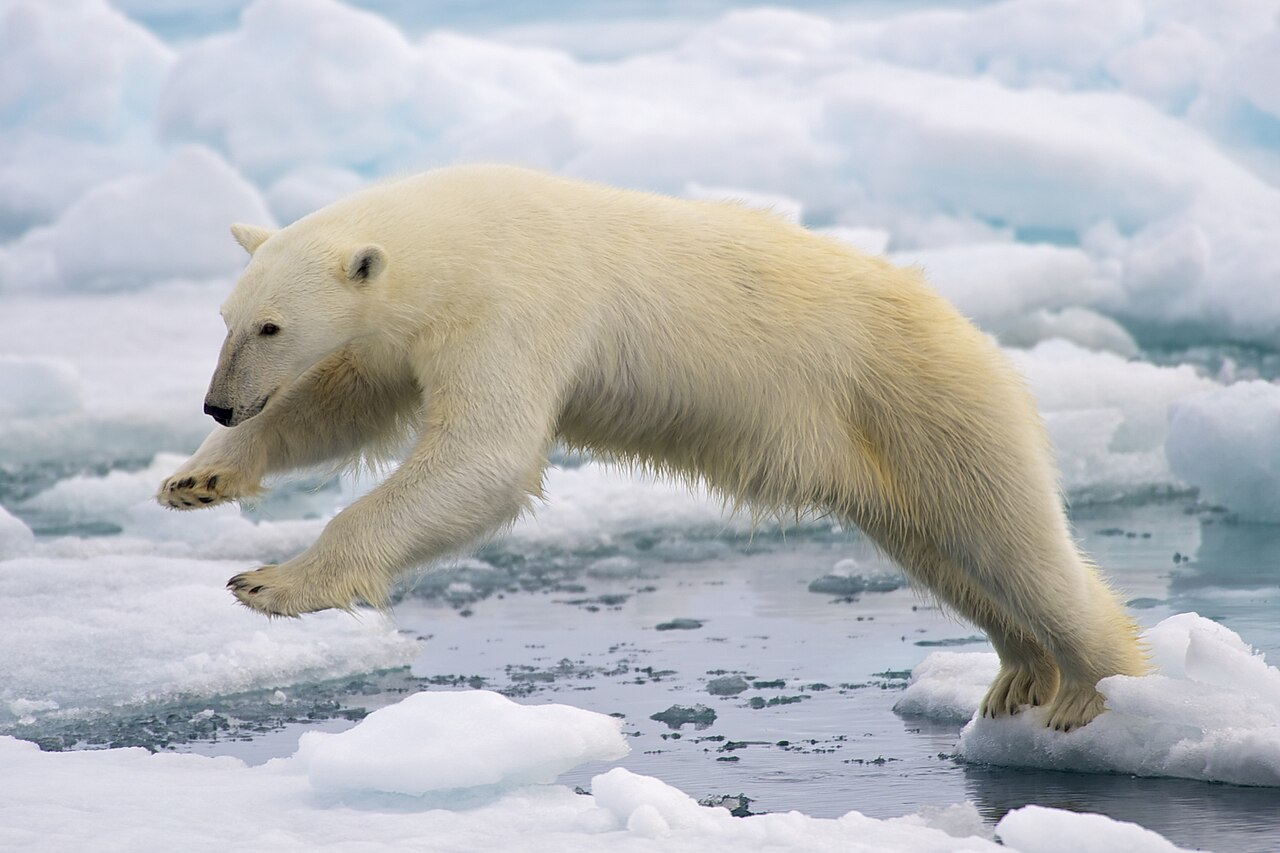
The Polar Bear is one of the largest land carnivores and hunts almost exclusively on sea ice, for seals. In Europe it lives only on Svalbard and on the sea ice of the Barents Sea as far as Franz Josef Land, at around 78 degrees north and further north.
Tracks
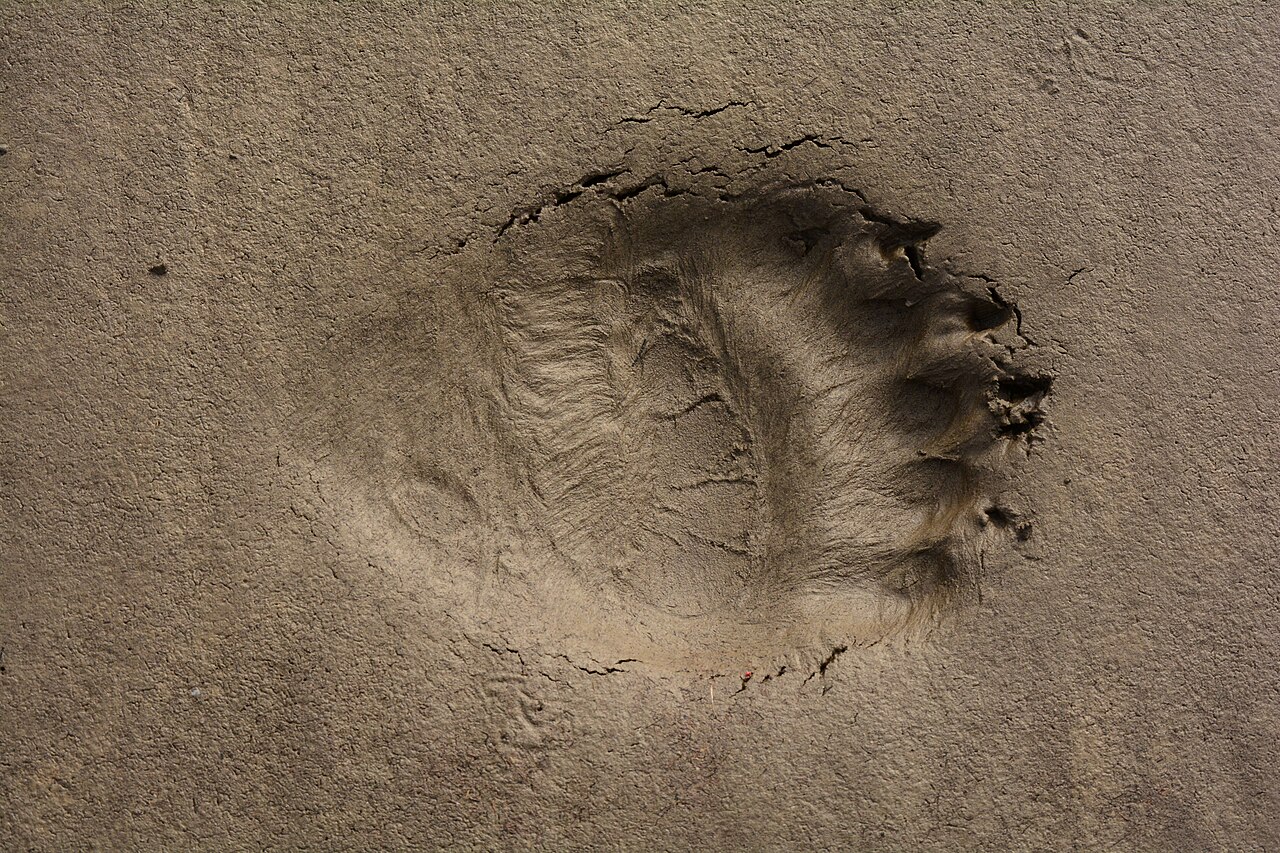
Unlike a seal, a Polar Bear does leave prints, and they are the largest in Europe. The hind foot measures thirty centimetres or more in length and leaves a long, narrow sole print with five toes; the forefoot is shorter but broader and leaves a round print about 25 cm across. In fresh wet snow or mud the hair between the pads is visible as a fine brushed texture that gives the print a blurred edge; the claw marks are short, thick dashes just in front of the toes. The stride of a walking animal is a good metre, and the trail consists of two slightly separated lines; the hind foot is placed just behind or half over the forefoot print. There are also slide marks where the animal has pushed itself along on its belly over the snow to clean its fur, and places where a seal was killed: a ring of blood and yellow fat around a broken-open snow lair or a breathing hole, with the skin and blubber eaten and the meat often largely left. The female's maternity den lies in a steep snow slope and becomes visible when she emerges with the cubs in March: an opening in the snow with a trampled, yellow-stained forecourt and many small prints around it. Droppings are black, tarry and glossy with seal fat, and contain hair.
In its habitat

The young

Identification
A long-bodied, long-legged bear with a long neck, a narrow head and a straight profile, without the forehead step of the Brown Bear, and small, rounded ears set well back. The coat is white to cream and yellows in summer to straw or dirty grey; the skin beneath is black, as are the nose, lips and soles. There is no shoulder hump and the back is level. The paws are very large: the forepaw is up to thirty centimetres wide and is used for swimming, while its broad surface spreads the weight on snow; there is webbing between the toes, dense fur between the pads, and small rough papillae on the soles give grip on ice. Males are two to three times as heavy as females and have a heavier head and thick hair cuffs on the forelegs.
Similar species
No other bear occurs within the European range. A lying animal ashore can resemble a snow heap or a pale stone at a distance; look for the black nose and black eyes, visible as three dark points, and for movement. Confusion with the Brown Bear is possible only where both species occur, and that is nowhere the case in Europe. The Brown Bear is brown and has a distinct shoulder hump, a shorter neck, a broader, domed forehead and larger ears. A dirty-yellow, wet Polar Bear can look brown in late summer, but the profile and the absence of a hump decide. Stranded or emaciated animals can be recognised by the long, slim body and the very large paws.
Habitat
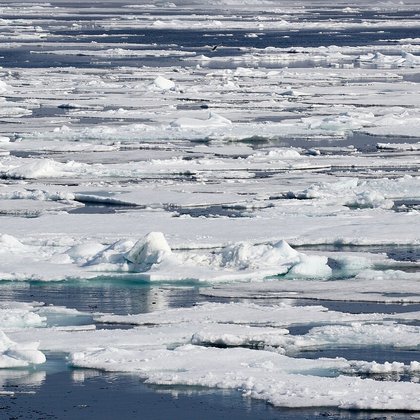
Sea ice over the edges of the continental shelf and of fjords, where the seals live, and the coast and tundra where the ice fails. The best hunting is not the thick closed pack but the zones of leads, pressure ridges and young ice, where ringed seals must keep breathing holes open. In summer, as the ice retreats, the bears of Svalbard move to the glacier fronts and the bird cliffs or stay ashore on the bare tundra, living on eggs, seabird chicks, carrion and seaweed and losing weight. The maternity den is dug in thick firm snowdrifts on the slopes of coastal hills and on the islands, above all on Kong Karls Land east of Spitsbergen.
Where the animal is most at home, classified with EUNIS — the European standard for habitats.



Distribution
Around the Arctic Ocean, divided into nineteen subpopulations. The European subpopulation is that of the Barents Sea, which includes Svalbard with Bjørnøya, Franz Josef Land and the sea ice between them, and is estimated at about two to three thousand animals. The species does not occur on the mainland of Norway, Finland or Russia south of the Arctic Ocean. A small number of animals are known from Iceland that arrived on drift ice from Greenland; they are almost always shot there.
- Native
Way of life
Mainly active by day and most active in the first half of it. Hunts almost exclusively seals, in Svalbard above all the Ringed Seal and besides that Bearded and Harp Seals: it waits motionless at a breathing hole until a seal surfaces and hauls it out with a blow of the forepaw, or stalks a hauled-out animal sliding on its belly, or breaks into a snow lair through the roof with a jump to take the pup. An adult bear eats mainly the blubber and often leaves the meat. Solitary, with an enormous range: a collared animal may cover thousands of kilometres in a year. Only pregnant females lie up in winter; they dig into a snow slope in November and stay there some four months without food or water. Around new year one or two cubs are born, blind and barely half a kilo; in March or April the family emerges and the cubs stay with their mother for two and a half years. All other polar bears are active right through the winter. Lives twenty-five to thirty years in the wild.
Where and when to look
In Europe the species can be seen only in Svalbard, from a ship or on an organised trip. Expedition cruises along the east coast, through Hinlopen Strait and to the Sjuøyane in July and August offer the best chance; the animals are then usually seen on the ice edge or on a beach among driftwood. The protected area of Kong Karls Land, where many maternity dens are located, may not be entered by anyone. Outside Longyearbyen carrying a firearm is a legal requirement and strict distance rules apply: never approach a bear, not even by boat, and keep hundreds of metres away. A bear approaching a ship must be kept at a distance; such situations mostly end badly for the bear.
Conservation status
Vulnerable (VU, 2015). The world population is estimated at about twenty-six thousand animals. Since the 1973 agreement hunting has been subject to quotas in all five Arctic states; in Svalbard the species has been fully protected since 1973 and the population has recovered since. The main threat is now the loss of sea ice: for every week the ice disappears earlier and returns later, a bear cannot hunt and must live on its fat reserves. In several subpopulations the animals have become lighter and there are fewer cubs as a result. The Barents Sea is one of the fastest-warming seas in the world, but its subpopulation is so far assessed as stable; the bears there have shifted from the disappearing fjord ice to drift ice further north. In addition there is pollution with PCBs and mercury, which accumulate in the fat layer, increasing shipping and tourism, and conflicts with people when hungry bears approach settlements.
Scientific name
Ursus maritimus | Phipps, 1774
Phipps described the species in 1774 and placed it straight away in the genus where it still stands. Ursus is the Latin word for 'bear'. maritimus is Latin for 'of the sea', from mare, 'sea'; Phipps met with the bear on the pack ice off Spitsbergen. The specimen the first description was based on came from Norway, Spitsbergen.