All species › Carnivores › Raccoons and coatis › Raccoon
Raccoon | Procyon lotor
Gewone wasbeer | Mapache común
The raccoon is a North American carnivore that was released near Kassel in 1934, also escaped from fur farms, and has since spread across a large part of Europe. It is the only mammal in Europe with a hand-shaped print with five long toes, and it is often first detected in or around buildings, such as lofts and sheds.
Tracks
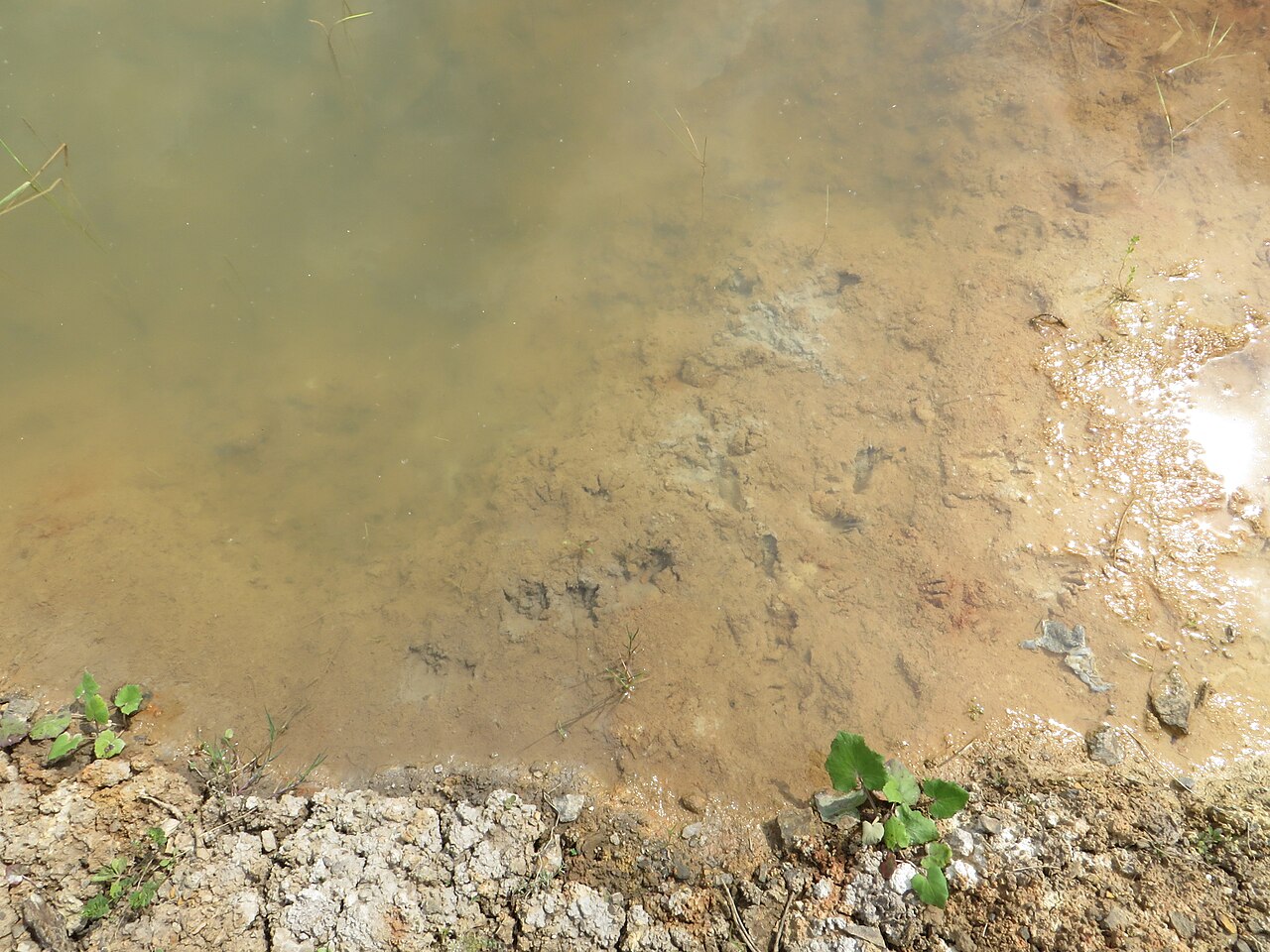
The print is the most distinctive character of the species: five long, thin, spread toes with small claw points in front of a small pad, hand-shaped and roughly 6 to 9 cm long. No other European mammal makes such a print; the badger also has five toes, but they are short and set in an arc before a broad pad with heavy claws, and the otter has webbed feet. The hind foot is longer and registers the whole sole, producing an elongated print with heel and five toes. The trail is characteristic too: the raccoon walks with a pacing gait in which the left forefoot and the right hind foot land side by side, so that the trail is a series of unequal pairs, a fore print beside a hind print. They are found mainly in the mud of stream, pond, lake and reservoir margins. The dropping is 5 to 15 cm long and about two centimetres thick, blunt-ended and often clearly segmented, and contains many identifiable remains: maize kernels, cherry and elder stones, crayfish shell and beetles. It is left at fixed latrines, which are not on the ground but raised: on a stout branch, a stump, a roof edge, a loft beam or a decking board, with old and new droppings together. Fresh raccoon droppings can contain eggs of the roundworm Baylisascaris procyonis and require care. There are also climbing marks on trunks and drainpipes, five narrow parallel scratches; torn refuse sacks and tipped bins; robbed nest boxes and nests of hole-nesters; stripped maize cobs and feeding damage to cherries and grapes; and noise above a ceiling: thumping, scratching and a wide range of chittering, churring and growling that differs from the sounds of a cat.

In its habitat
The young
Identification
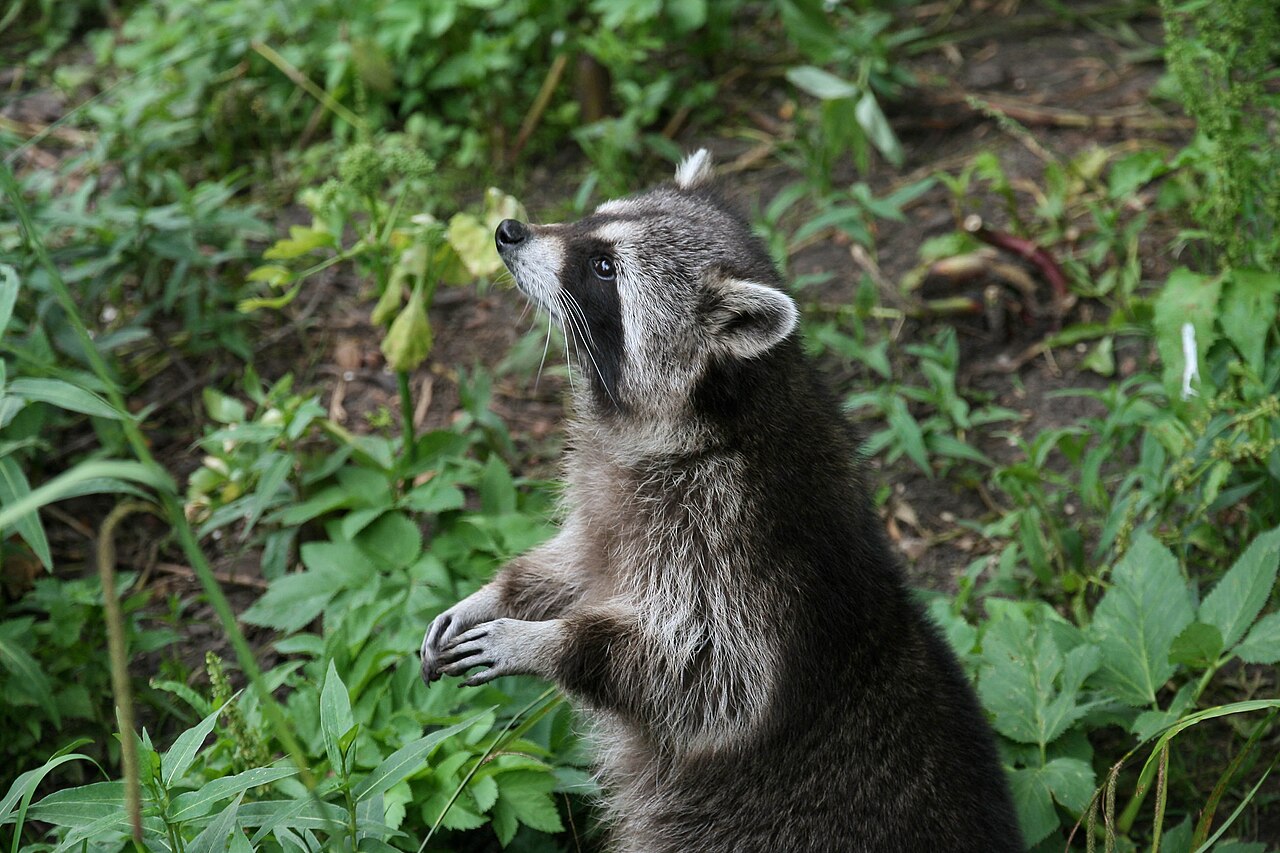
A stocky, high-backed carnivore the size of a small badger, with a pointed muzzle, small round white-edged ears and a dense grizzled grey coat. Two features are decisive: the black eye mask, sharply outlined between white brow stripes and a white muzzle, and the tail with four to seven black rings on a yellowish-grey ground. The legs are short and grey-black, and the forefeet have five long, mobile toes with which the animal feels, grasps and turns over its food; this handling in shallow water was interpreted as 'washing' and gave the species its name in several languages. The raccoon walks with an arched back and low head, climbs well and can climb a smooth drainpipe or tree trunk; in autumn it becomes visibly fatter. Young animals have the mask and tail rings from the start.
Similar species
The combination of mask and ringed tail is found in no other animal in Europe, but in a torch beam or on a camera-trap image three species are possible confusions. The Raccoon Dog is the commonest and also has a dark face mask, but it runs broad and vague into the cheeks; its coat is brown and shaggy with a dark dorsal line, it is far lower on the leg, its tail is short and unringed, and it does not climb. The Badger has stripes over the head rather than a mask around the eye, is greyer, broader and much heavier, and has a short pale tail. A domestic cat on a shed roof is sometimes taken for a raccoon until the tail becomes visible. The Dutch name 'wasbeerhond' in older literature refers to the raccoon dog; confusing the two names leads to misunderstanding. Whether an animal belongs to an established population or is an escaped or released pet differs between countries. Established populations occur in Germany, the Netherlands and Belgium. In Britain and Ireland there is no established population and every animal is an escaped captive; keepers must be licensed and escapes are reportable. In Spain feral raccoons derive from released pets, and established populations, of which that along the Jarama and Henares near Madrid is the best known, coexist with recently released animals.
Habitat
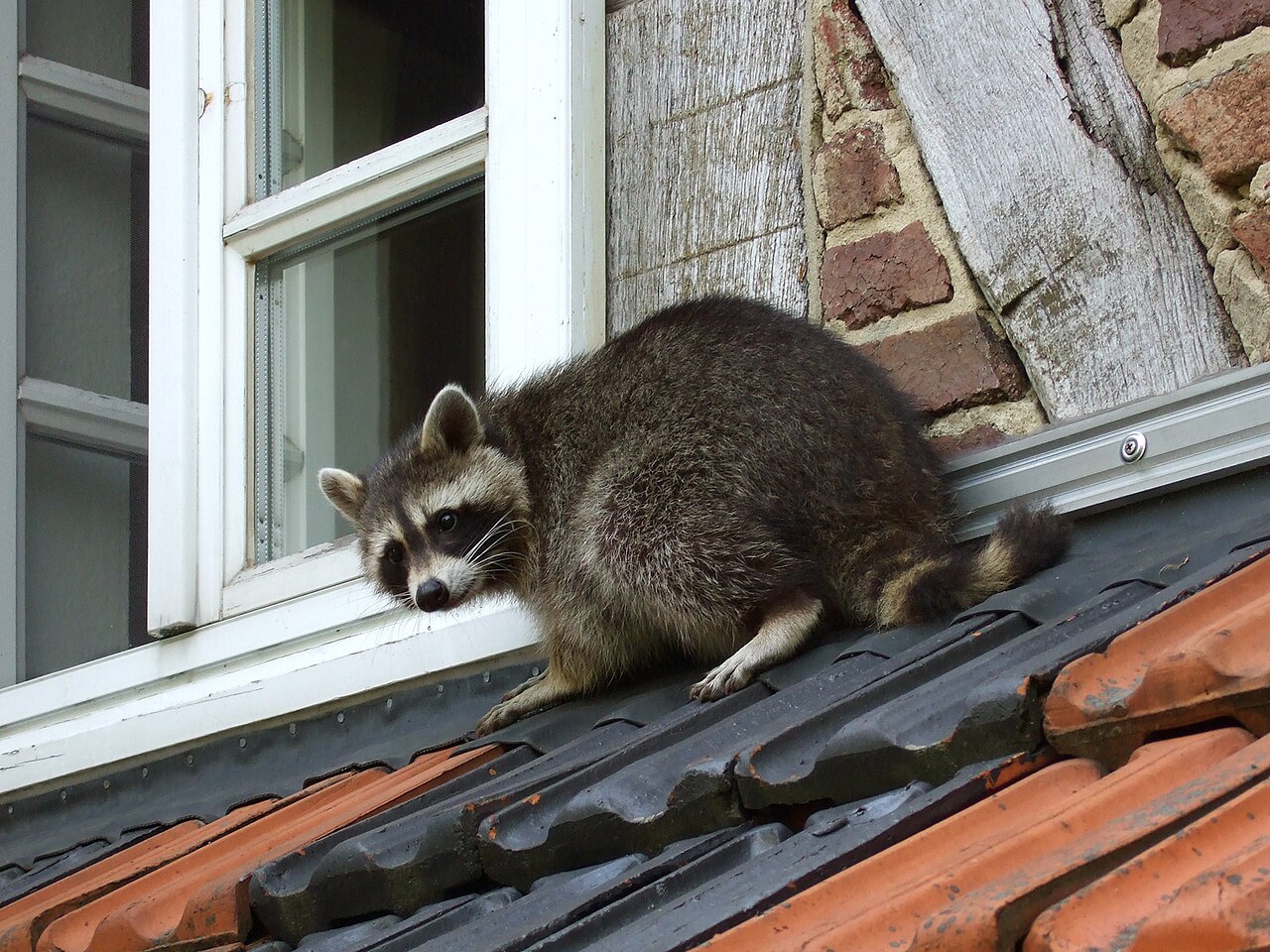
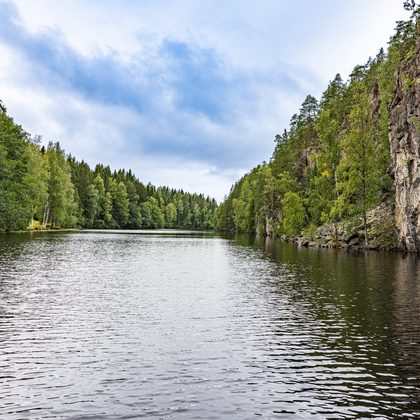
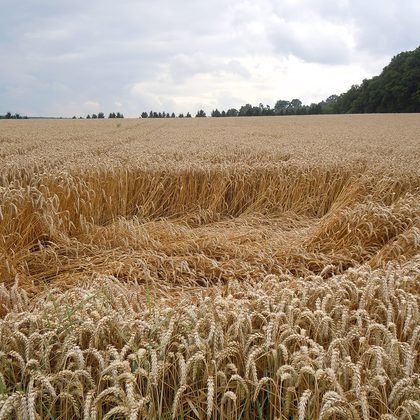
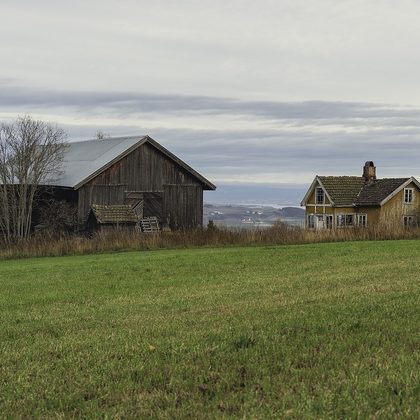
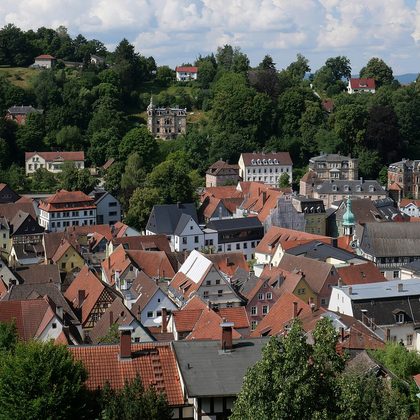
In North America the raccoon mainly inhabits old broadleaved woodland with hollow trees near water, and this is also the optimal habitat in Europe: broadleaved and mixed woodland with large hollow trees along streams, rivers, ponds and marshes. The species is, however, very flexible and also lives in parks, allotments, campsites, farmyards, gardens, railway banks and built-up areas, with a roof void, a shed, a chimney or a hollow tree as a daytime den. It needs water nearby, something to climb and above all a varied food supply; wide open arable plains and high mountains are avoided.
Where the animal is most at home, classified with EUNIS — the European standard for habitats.



Distribution
The native range is North America, from southern Canada to Panama. In central Europe the populations go back to two events in Germany: the release of a few animals at the Edersee near Kassel in 1934 and an escape from a fur farm near Berlin in 1945, with later escapes from farms and zoos in addition. From that core the species has spread through Germany, Poland, Czechia, Austria, France, Italy, Belarus and the Caucasus; Germany alone holds hundreds of thousands. From the German border the raccoon has reached the Netherlands and Belgium: in the Netherlands the number of reports rose from a handful to more than a hundred a year after 2017, with breeding confirmed in Limburg, the Biesbosch and eastern Overijssel; in Belgium it occurs mainly in Wallonia, where it is spreading west from the Ardennes, and in Limburg. In Spain the origin is different: not releases for the fur trade but abandoned pets, mainly from the 2000s. There are established breeding populations in the Madrid region, along the Jarama, Henares and Manzanares rivers, where systematic trapping has taken place since 2013, and nuclei or repeated records in Guadalajara, Catalonia, the Valencia region, Andalusia and the Balearic Islands. In Britain and Ireland there is no established population; raccoons are kept under licence, escapes occur and the animals are recaptured. All European occurrences date from after 1934.
- Established introduction
- dark = core range, pale = thinly spread
Way of life
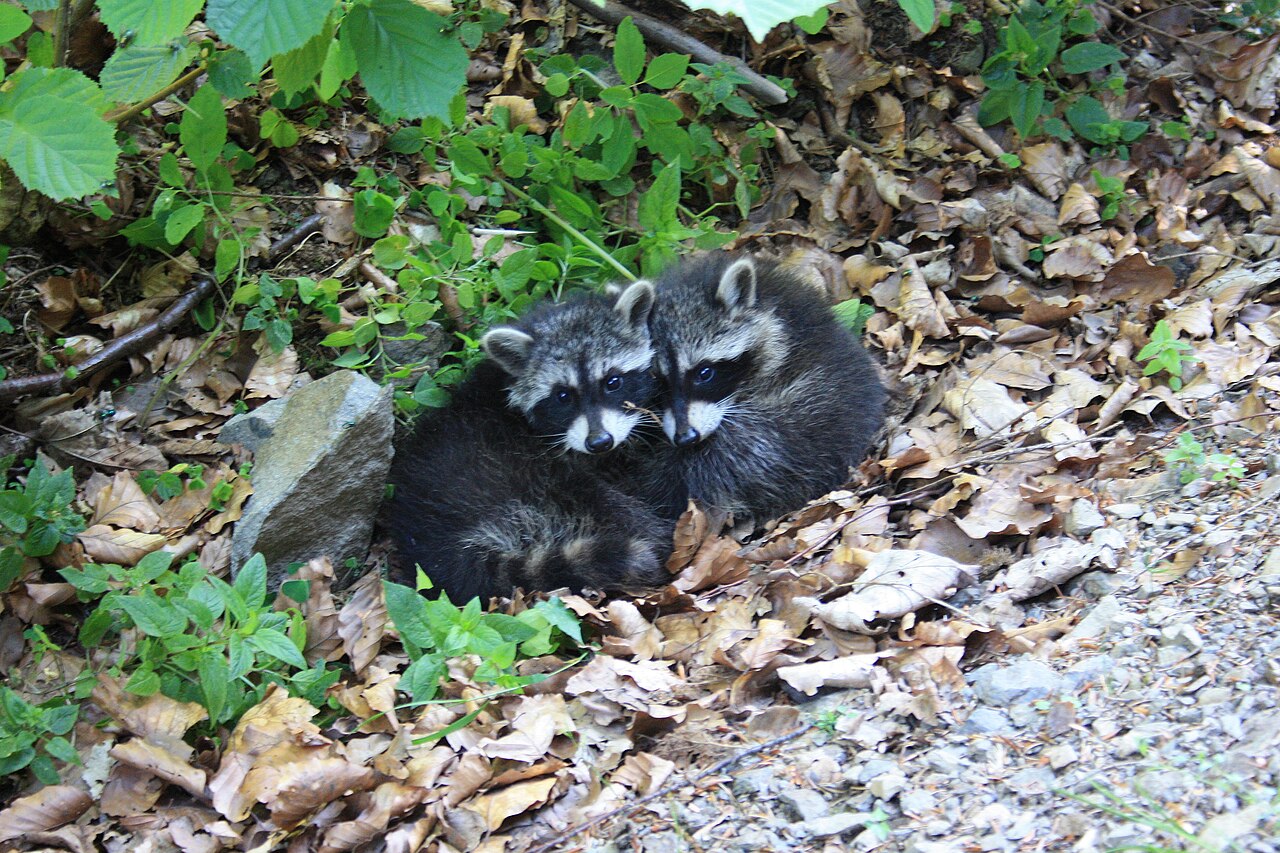
The raccoon is nocturnal and in towns often active from dusk. It is a thorough omnivore: earthworms, beetles, grasshoppers, crayfish, mussels, frogs, fish, eggs and nestlings, mice, maize, cereals, nuts, fruit and, where it lives near people, a large share of their refuse. It is solitary, with a home range of a few tens to a few hundred hectares, much smaller in towns; females with young may form small groups and several animals sometimes share a den tree. Mating falls in February and March; after just over two months three to five young are born in April or May in a hollow tree, a shed or a loft, and they stay with the mother all summer. The species does not hibernate: in frost and snow it sleeps in its den for days or weeks on end, living off the fat laid down in autumn, but its body temperature does not drop, and in mild winter weather it is active outside.
Where and when to look
Searching for tracks in mud produces the most records: after a dry spell, fore and hind prints side by side can be found along an exposed stream or pond margin. Camera traps at a latrine, a maize-field edge or a pond are also productive. In Germany the raccoon is regularly seen in the evening in the parks of Kassel and Berlin; along the Jarama and Henares near Madrid it is recorded regularly. A raccoon outside the known core areas is information relevant to management and should be reported to the competent authority. Feeding and leaving out food waste or refuse sacks are to be avoided: a raccoon that has learned where the bins are keeps returning.
Conservation status
Least Concern globally (LC, 2016); in Europe the relevant question is a different one. Since 2016 the raccoon has been on the Union list of invasive alien species: keeping, breeding, transporting and trading it are banned, and member states must eradicate new incursions and manage established populations; Britain has retained this listing in its own law, and in Spain the species is also on the national list of invasive alien species (Catálogo Español de Especies Exóticas Invasoras). The reason is the damage the species causes: it robs the nests of hole-nesters and of ground-nesting water and marsh birds, eats amphibians and European pond turtle eggs, is a local problem at heron and tern colonies, carries the roundworm Baylisascaris procyonis, which can also be dangerous to people, and carries other pathogens; rabies, of which the raccoon is a main host in North America, plays no significant part in European raccoons, since western and central Europe are free of rabies in wild terrestrial mammals. There is also damage to buildings: roof insulation, chimneys and lofts. In Germany control at this scale has proved unfeasible and policy concentrates on vulnerable sites and species; in the Netherlands and Flanders the aim is still to prevent establishment, and in Spain, where the nuclei are still limited, the aim is eradication.
Scientific name
Procyon lotor | (Linnaeus, 1758)
Linnaeus described the species in 1758 as Ursus Lotor; because it was later moved to another genus, the author and year stand in brackets. Procyon is Greek, from pro, 'before', and kyōn, 'dog'; it is also the name of the star that rises before the Dog Star. lotor is Latin for 'washer', from lavare, 'to wash', after the habit of dousing food in water. The specimen the first description was based on came from USA, Pennsylvania.