All species › Carnivores › Raccoons and coatis › South American coati
South American coati | Nasua nasua
Rode neusbeer | Coatí de cola anillada
The South American coati is a procyonid from South America, related to the raccoon. Within the area of this guide it is an introduced species: through the pet trade it reached Mallorca, where a breeding population became established in the south-west of the Serra de Tramuntana. That population was controlled between 2002 and 2013; isolated reports have continued since. Elsewhere in Europe only single escaped animals are involved.
Tracks
Coatis rest at night and give birth in nests in trees. By day they forage mainly on the ground, in groups. For trapping on Mallorca melon proved the most effective bait, alongside meat and cat food. Descriptions of track and scat were not found in the sources of this guide.
Identification
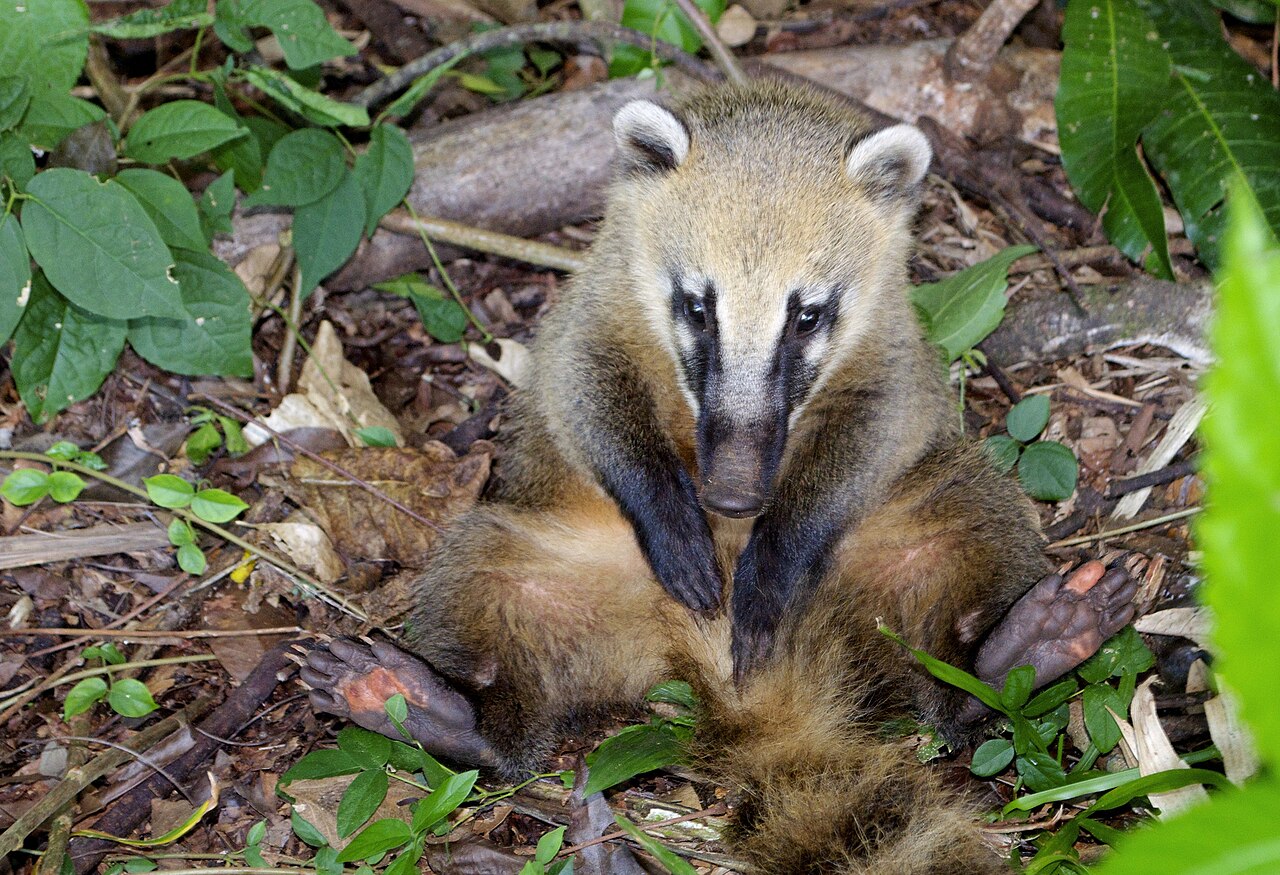
A slender, short-legged carnivore with a long, pointed, mobile snout and a long tail with dark rings that is often carried upright. Head-body 41 to 67 cm, tail 32 to 69 cm, shoulder height about 30 cm, weight 3 to 6 kg; males are larger than females. Colour ranges from orange or reddish to very dark brown, often with yellow tones, and varies even between young of one litter. The muzzle is brown or grey. The forefeet are used to hold and handle food.
Similar species
Within the area of this guide the combination of long snout and upright ringed tail is unique to this species. The raccoon has a black eye mask, a pointed muzzle and a shorter, thick ringed tail, and is nocturnal. The pine marten, which also occurs on Mallorca, has a yellow to orange-yellow throat and chest patch and a bushy unringed tail about half the head-body length. The common genet is slimmer, spotted and has a thin tail with eight to ten rings. The white-nosed coati (Nasua narica) of Central America has a white muzzle.
Habitat
In South America rainforest, gallery forest along rivers, cloud forest and dry areas such as chaco, cerrado and dry scrub forest, up to 2500 m. On Mallorca the woodland of the south-western Serra de Tramuntana.
Where the animal is most at home, classified with EUNIS — the European standard for habitats.


Distribution
Native to tropical and subtropical South America, from Colombia and Venezuela to Uruguay and Argentina. In Europe the only documented breeding population is that of Mallorca, derived from animals kept as pets. The establishment is dated differently in the literature: according to the European management sheet an eradication programme ran from 2002 to 2013, according to a 2019 study the species became established in 2004. In Britain escaped animals have been reported and recaptured, with no evidence of breeding. Before the restrictions of the Union list, 769 coatis were kept in 165 European zoos.
Way of life
Diurnal; the night is spent in a tree nest. Females and their young live in bands of usually 10 to 30 animals, exceptionally up to 65, with a dominance hierarchy. Adult males live alone outside the breeding season. Omnivorous: invertebrates such as beetle larvae, scorpions, centipedes, spiders, ants and termites, and also fruit, eggs, lizards, small mammals and carrion. Fruit is important mainly when arthropods are scarce. The breeding season varies between regions. The female leaves the band to give birth; after a gestation of 74 to 77 days one to seven, usually three or four, young are born in a tree nest, and she returns with them to the band after five to six weeks. The young are weaned at about four months; females reach sexual maturity at two years, males at about three. In the wild a coati lives about 7 to 8 years.
Where and when to look
A coati within the area of this guide is almost always an escaped or released animal. A sighting — with photograph, date and place — can be passed to the authority that manages invasive alien species in the country concerned. The species is active by day and lives in groups, and is therefore readily seen.
Conservation status
Least Concern (LC, 2016) in its native range, where it is hunted for food. In Europe the South American coati has been on the list of invasive alien species of Union concern (Regulation 1143/2014) since 3 August 2016: keeping, breeding, transport, trade and release are prohibited. In Spain it has been in the national catalogue of invasive alien species since 2013 (Real Decreto 630/2013). On Mallorca 44 animals were removed between 2002 and 2013, mainly with live traps and by shooting; this required more than 100 person-days of fieldwork and about 2000 km of travel per year, at an average cost of 1500 euros per animal caught. For the area of this guide the sources consulted describe no measured effects on native fauna or flora. The Spanish species sheet lists as possible effects predation, competition for food with other animals, an effect on plant regeneration and damage to agriculture and irrigation infrastructure; in parts of its native range the species is a host of Toxoplasma gondii and Trypanosoma cruzi.
Scientific name
Nasua nasua | (Linnaeus, 1766)
Linnaeus described the species in 1766 as Viverra Nasua; because it was later moved to another genus, the author and year stand in brackets. Nasua is formed on Latin nasus, 'nose', after the long mobile snout. The specific name repeats the genus name. The specimen the first description was based on came from Brazil, Pernambuco.